
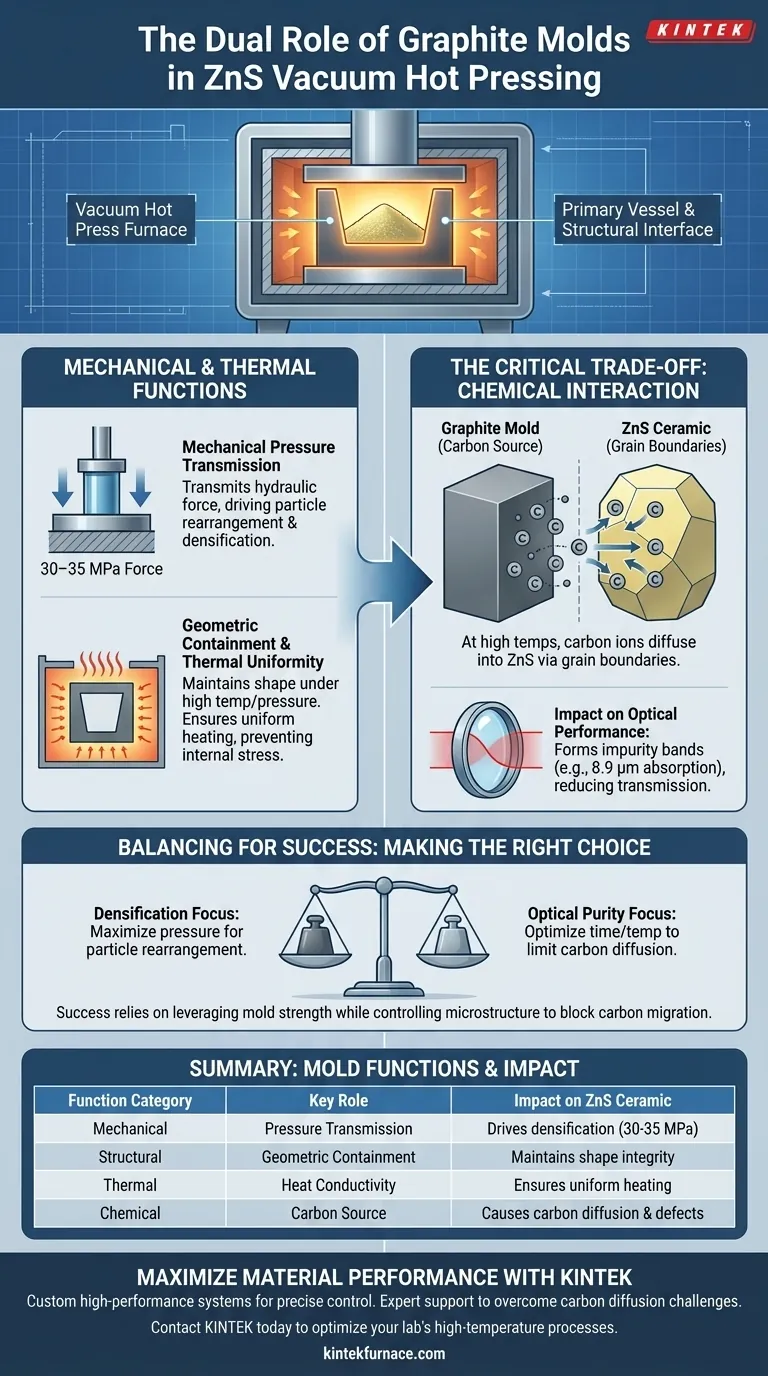
The graphite mold functions as the structural and mechanical interface during the vacuum hot pressing of Zinc Sulfide (ZnS). It serves as the primary vessel for shaping the ceramic powder while simultaneously acting as the essential medium for transmitting the extreme hydraulic pressure and heat required for densification.
The graphite mold is indispensable for converting hydraulic force into the mechanical pressure needed for sintering, yet it introduces a critical trade-off: at high temperatures, it acts as a carbon source that can diffuse into the ceramic, potentially compromising the material's optical purity.
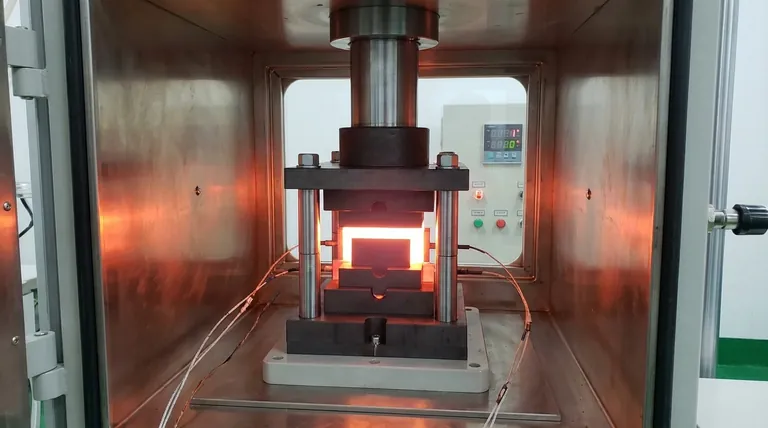
Mechanical and Thermal Functions
The graphite mold is not merely a container; it is an active component in the sintering physics. Its role is defined by its ability to withstand extreme environments while facilitating the physical changes in the ZnS powder.
Mechanical Pressure Transmission
The primary function of the mold is to act as a transmission medium. It transfers the mechanical force generated by the hydraulic system directly to the ZnS powder.
This pressure (often reaching 30–35 MPa) is critical for pressure-assisted sintering. It forces particle rearrangement and plastic deformation, driving the material toward maximum density.
Geometric Containment and Shaping
The mold defines the physical dimensions of the final ceramic. It acts as a high-strength container that holds the loose powder in a specific geometry (the "green body").
It must maintain this structural integrity without deformation, even when subjected to uniaxial pressures and temperatures potentially exceeding 1800°C.
Thermal Conductivity and Uniformity
Graphite possesses excellent thermal conductivity. This property allows the mold to transfer heat efficiently from the furnace elements to the ZnS sample.
This ensures uniform heating throughout the ceramic body. Thermal uniformity is vital for preventing internal stress and ensuring consistent optical properties across the lens or window.
Understanding the Trade-offs: Chemical Interactions
While the mold is mechanically essential, its chemical interaction with ZnS at high temperatures presents a significant challenge. This section addresses the "Deep Need" regarding process control and quality assurance.
The Carbon Source Effect
At elevated sintering temperatures, the graphite mold effectively becomes a carbon source. Carbon ions can detach from the mold surface and migrate toward the ceramic material.
Grain Boundary Diffusion
These carbon ions diffuse into the ZnS ceramic primarily through grain boundaries. The boundaries act as pathways for impurities to penetrate the microstructure of the material.
Impact on Optical Performance
When carbon diffuses into the ZnS, it forms impurity bands or carbonate defects. Specifically, this interaction creates a distinct infrared absorption band at 8.9 μm.
This defect reduces the overall optical transmission and performance of the ceramic. Consequently, process control must focus on managing grain growth to reduce the volume of grain boundaries, thereby suppressing this diffusion effect.
Making the Right Choice for Your Goal
Balancing the mechanical necessity of the mold with its chemical risks is the key to successful ZnS sintering.
- If your primary focus is Densification: Ensure the mold design and grade can withstand maximum uniaxial pressure (30+ MPa) to drive particle rearrangement without structural failure.
- If your primary focus is Optical Purity: Optimize the sintering schedule to achieve density quickly while minimizing the time spent at peak temperatures to limit carbon ion diffusion.
Success in vacuum hot pressing relies on leveraging the mold's strength while strictly controlling the microstructure to block the inevitable carbon migration.
Summary Table:
| Function Category | Key Role | Impact on ZnS Ceramic |
|---|---|---|
| Mechanical | Pressure Transmission | Drives particle rearrangement and 30-35 MPa densification |
| Structural | Geometric Containment | Maintains shape integrity under high-temperature uniaxial pressure |
| Thermal | Heat Conductivity | Ensures uniform heating to prevent internal stresses |
| Chemical | Carbon Source | Can cause carbon diffusion and 8.9 μm infrared absorption defects |
Maximize Your Material Performance with KINTEK
Precise control over vacuum hot pressing requires high-performance equipment that balances mechanical strength with thermal uniformity. KINTEK provides industry-leading solutions including Muffle, Tube, Rotary, Vacuum, and CVD systems, all fully customizable to meet the rigorous demands of ZnS ceramic production and advanced material research.
Our expert R&D and manufacturing teams are ready to help you overcome carbon diffusion challenges and achieve superior optical purity. Contact KINTEK today to optimize your lab's high-temperature processes.
Visual Guide
Related Products
- 2200 ℃ Graphite Vacuum Heat Treat Furnace
- Dental Porcelain Zirconia Sintering Ceramic Vacuum Press Furnace
- Vacuum Hot Press Furnace Machine Heated Vacuum Press Tube Furnace
- Vacuum Hot Press Furnace Machine Heated Vacuum Press
- Molybdenum Vacuum Heat Treat Furnace
People Also Ask
- Why are vacuum heat treating furnaces essential for aerospace? Ensure Superior Material Integrity for High-Stakes Applications
- What is the primary application of vacuum heat treating furnaces in aerospace? Enhance Component Performance with Precision
- How does a vacuum heat treating furnace improve the condition of metal alloys? Achieve Superior Metal Performance
- What is the process of vacuum heat treating? Achieve Superior Metallurgical Properties
- How does vacuum heat treating work in terms of temperature and time control? Master Precise Material Transformations














