
The combination of carbon dioxide and a precise flow meter is the defining factor in transforming standard biochar into a high-performance material. The flow meter regulates the delivery of CO2 into a high-temperature zone, where the gas acts as an "etching agent" that physically carves out the biochar's internal structure to dramatically increase its surface area.
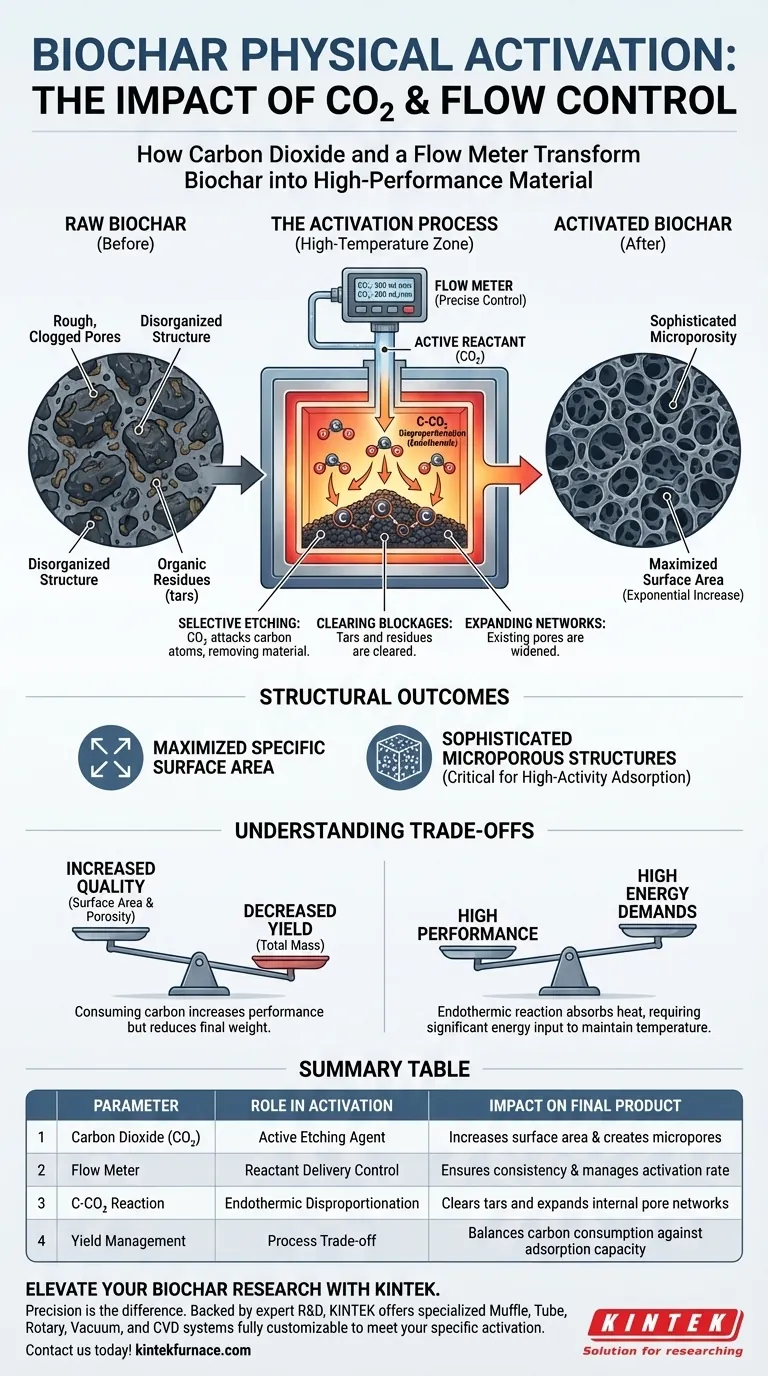
The core of this process is the C-CO2 disproportionation reaction, where carbon dioxide selectively removes carbon atoms from the biochar. This clears blocked pores and expands the material's internal network, creating the sophisticated microporosity required for high-activity adsorption applications.
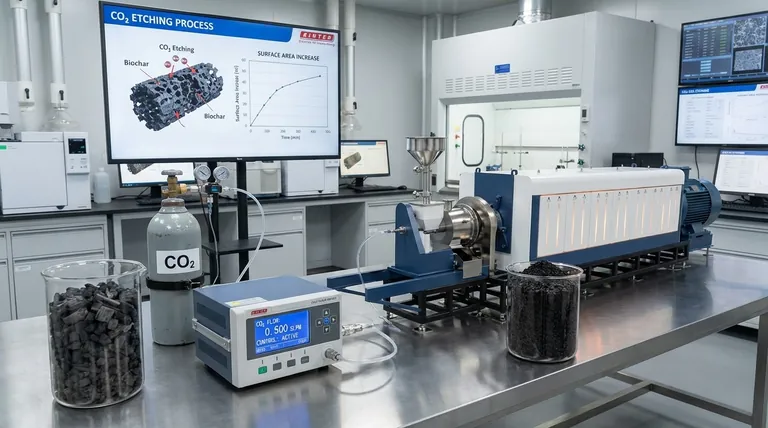
The Mechanism of Physical Activation
The "Etching" Effect of Carbon Dioxide
In physical activation, carbon dioxide is not merely a carrier gas; it is an active reactant.
When introduced to the reaction zone, CO2 triggers an endothermic C-CO2 disproportionation reaction.
This reaction selectively attacks and "etches" away carbon atoms from the biochar's skeleton, effectively consuming parts of the material to create value.
Clearing and Expanding Pores
Biochar created through simple pyrolysis often contains "rough pores" that are clogged with tars or disorganized carbon structures.
The CO2 reaction targets these blockages, clearing the debris and widening the existing pores.
This process transforms a closed, low-value structure into an open, highly accessible network.
The Critical Role of the Flow Meter
Ensuring Precise Reactant Delivery
The flow meter is the control interface for the entire activation process.
It allows operators to introduce the activation agent (CO2) at a specific, controlled rate into the high-temperature zone.
Without this regulation, the reaction could become erratic, leading to inconsistent product quality.
Controlling the Rate of Activation
The flow meter dictates the "aggression" of the etching process.
By adjusting the flow, you control how much CO2 interacts with the carbon bed over time.
This precision is vital for balancing the development of pores against the total consumption of the biochar.
Structural Outcomes
Maximizing Specific Surface Area
The primary goal of using CO2 activation is a significant increase in specific surface area.
By carving out new pathways, the available surface for chemical interaction grows exponentially compared to non-activated char.
Creating Microporous Structures
The etching process develops a sophisticated microporous structure.
These microscopic pores are the critical feature that defines "high-activity" adsorbent biochar.
Without this microporosity, the biochar would lack the capacity to effectively trap contaminants or molecules.
Understanding the Trade-offs
Quality vs. Yield
The C-CO2 disproportionation reaction works by consuming carbon atoms.
Consequently, as you increase surface area and porosity, you simultaneously decrease the total mass yield of the final product.
You are effectively trading physical weight for higher performance capabilities.
Energy Demands
The reference notes that the reaction is endothermic, meaning it absorbs heat.
Maintaining the high temperatures required for this reaction while introducing a continuous flow of cooler gas requires significant energy input.
Operators must balance the cost of this energy against the value of the resulting high-activity carbon.
Making the Right Choice for Your Goal
To optimize your biochar production, you must balance the flow of CO2 against your target specifications.
- If your primary focus is maximum adsorption capacity: Increase the CO2 exposure to maximize etching and micropore development, accepting a lower total yield.
- If your primary focus is material volume: Limit the CO2 flow or activation time to clear basic blockages without aggressively consuming the carbon skeleton.
Success in physical activation relies on using the flow meter to precisely manage the trade-off between consuming carbon and creating porosity.
Summary Table:
| Parameter | Role in Activation | Impact on Final Product |
|---|---|---|
| Carbon Dioxide (CO2) | Active Etching Agent | Increases specific surface area & creates micropores |
| Flow Meter | Reactant Delivery Control | Ensures consistency and manages activation rate |
| C-CO2 Reaction | Endothermic Disproportionation | Clears tars and expands internal pore networks |
| Yield Management | Process Trade-off | Balances carbon consumption against adsorption capacity |
Elevate Your Biochar Research with KINTEK
Precision is the difference between simple char and high-performance activated carbon. Backed by expert R&D and manufacturing, KINTEK offers specialized Muffle, Tube, Rotary, Vacuum, and CVD systems—all fully customizable to meet your specific activation requirements.
Whether you need precise gas flow integration or high-temperature stability for endothermic reactions, our lab high-temp furnaces provide the control you need for consistent results.
Ready to optimize your activation process? Contact us today to discuss your unique project needs!
Visual Guide
References
- Aik Chong Lua. Conversion of Oil Palm Kernel Shell Wastes into Active Biocarbons by N2 Pyrolysis and CO2 Activation. DOI: 10.3390/cleantechnol7030066
This article is also based on technical information from Kintek Furnace Knowledge Base .
Related Products
- Electric Rotary Kiln Small Rotary Furnace for Activated Carbon Regeneration
- 1700℃ Controlled Inert Nitrogen Atmosphere Furnace
- Controlled Inert Nitrogen Hydrogen Atmosphere Furnace
- 1200℃ Controlled Inert Nitrogen Atmosphere Furnace
People Also Ask
- What are the main applications of a rotary kiln electric furnace? Achieve Uniform Heat Treatment for Powders
- What are the key components of a rotary kiln electric furnace? Unlock Efficient Thermal Processing
- What is the significance of the refractory lining in a rotary kiln electric furnace? Unlock Efficiency and Longevity
- What advantages do electric rotary kilns offer over fuel-based kilns? Boost Efficiency and Purity in Your Process
- What materials can be processed in an electric rotary kiln? Versatile Solutions for Advanced Materials



