
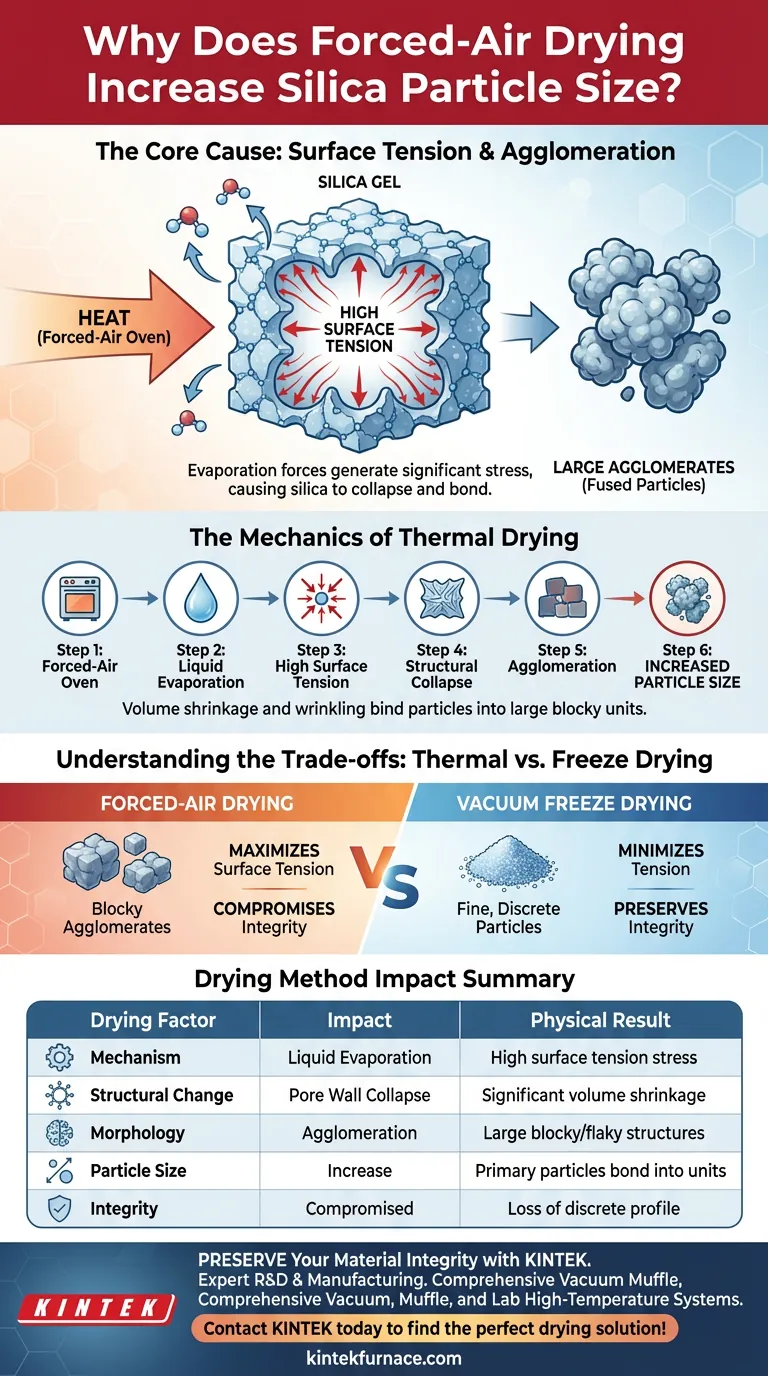
Forced-air drying increases particle size primarily through the formation of agglomerates caused by surface tension. When a silica sample is dried in a conventional thermal oven, the evaporation of liquid water generates significant physical stress on the material. This stress forces the silica structure to collapse and bond together, creating large, irregular clumps rather than preserving fine, discrete particles.
The removal of liquid water via heat creates high surface tension that shrinks and wrinkles the silica gel. This structural collapse results in strong interactions between particles, forming large "blocky" agglomerates that significantly inflate the measured average particle size.
The Mechanics of Thermal Drying
The Role of Surface Tension
In a forced-air oven, the drying process relies on the evaporation of liquid water. As water leaves the pores of the silica gel, it exerts significant surface tension on the pore walls.
Structural Collapse
This tension creates a powerful inward pulling force. Consequently, the silica gel undergoes severe volume shrinkage and wrinkling as the internal structure is pulled together.
The Formation of Agglomerates
Creating "Blocky" Structures
The strong interactions caused by shrinkage do not just reduce the volume of individual particles; they bind them together. The material consolidates into large blocky or flaky agglomerates.
Impact on Measurement
Because these particles are fused together, they act as single, much larger units during analysis. This results in an average particle size that is substantially larger than the inherent size of the primary silica particles.
Understanding the Trade-offs
Thermal vs. Freeze Drying
It is critical to recognize that this particle growth is specific to the method of water removal. Forced-air ovens rely on liquid evaporation, which maximizes surface tension.
The Cost of Convenience
While thermal drying is often faster or more accessible, it compromises the morphological integrity of the sample. In contrast, methods like vacuum freeze drying bypass the liquid phase, minimizing tension and preserving smaller particle sizes.
Making the Right Choice for Your Goal
To determine the best drying method for your silica application, consider the following:
- If your primary focus is minimizing particle size: Avoid forced-air drying, as the surface tension will inevitably cause agglomeration and shrinkage.
- If your primary focus is structural preservation: Utilize vacuum freeze drying to prevent the formation of large blocky agglomerates.
The method of drying is not just a finishing step; it is a determinant of the final material's physical dimensions.
Summary Table:
| Drying Factor | Impact on Silica Samples | Physical Result |
|---|---|---|
| Mechanism | Liquid Evaporation | High surface tension stress |
| Structural Change | Pore Wall Collapse | Significant volume shrinkage |
| Morphology | Agglomeration | Large blocky/flaky structures |
| Particle Size | Increase | Primary particles bond into units |
| Integrity | Compromised | Loss of discrete particle profile |
Preserve Your Material Integrity with KINTEK
Don't let surface tension compromise your research results. Backed by expert R&D and manufacturing, KINTEK offers a comprehensive range of Vacuum, Muffle, and customizable lab high-temperature systems designed to give you precise control over your material morphology. Whether you need to prevent silica agglomeration or require specialized thermal processing, our team can tailor a solution for your unique laboratory needs.
Contact KINTEK today to find the perfect drying solution for your application!
Visual Guide
References
- Shengwang Yuan, Yunhai Ma. A Comparative Study on Rice Husk, as Agricultural Waste, in the Production of Silica Nanoparticles via Different Methods. DOI: 10.3390/ma17061271
This article is also based on technical information from Kintek Furnace Knowledge Base .
Related Products
- High Temperature Muffle Oven Furnace for Laboratory Debinding and Pre Sintering
- 1400℃ Muffle Oven Furnace for Laboratory
- Custom Made Versatile CVD Tube Furnace Chemical Vapor Deposition CVD Equipment Machine
- 1200℃ Muffle Oven Furnace for Laboratory
- 1700℃ High Temperature Muffle Oven Furnace for Laboratory
People Also Ask
- What thermal phenomena occur during polymer binder burnout in ceramic green bodies? Lab Furnace Guide
- What role does a high-temperature muffle furnace play in STFO synthesis? Achieve Pure Perovskite Results
- Why is controlled heat treatment in a muffle furnace necessary for calcined clay? Achieve Optimal Pozzolanic Activity
- How does a high-temperature muffle furnace facilitate the formation of LaNbxAl1−xO3+δ perovskite structures? Key Roles
- What role does a high-temperature muffle furnace play in the multi-stage synthesis of Li0.5MnFe1.5O4? Key to Pure Spinel




