
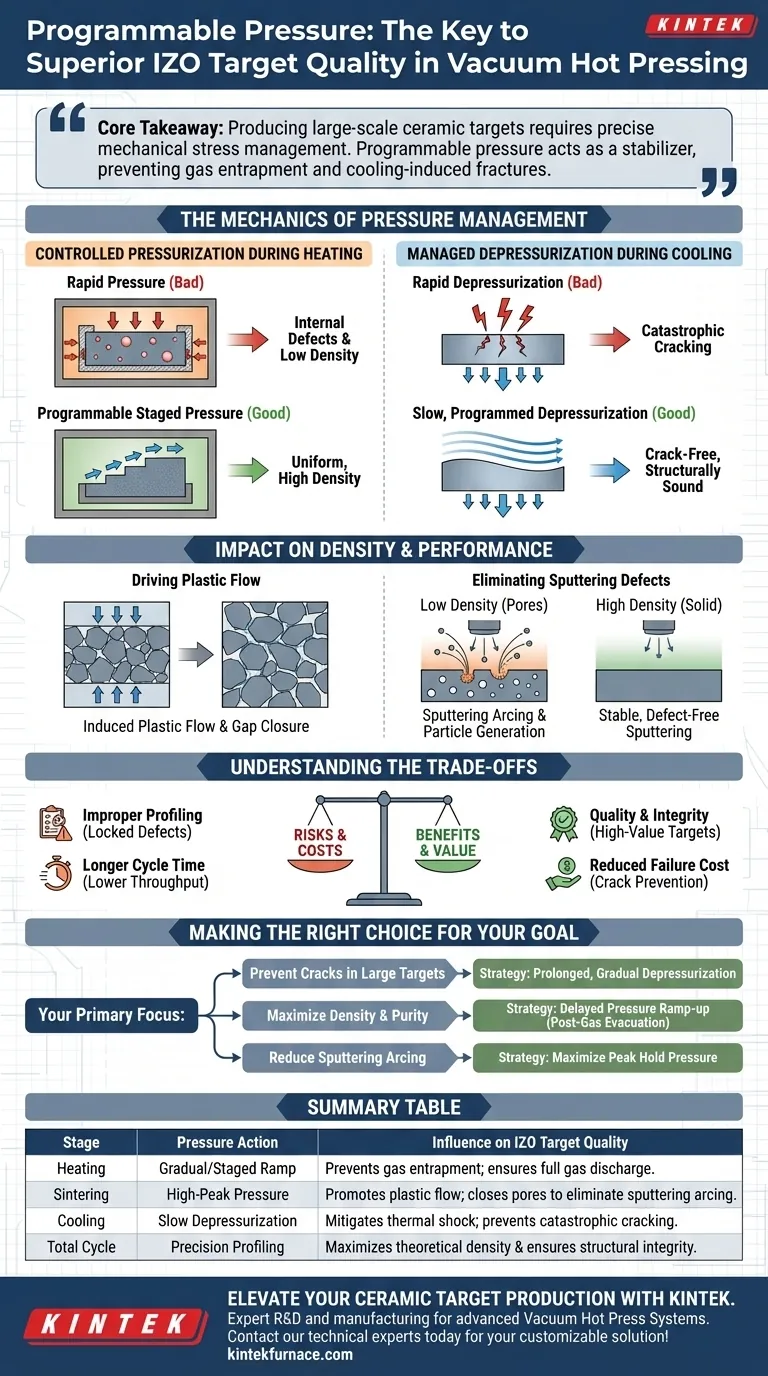
The programmable pressure function is the decisive factor in managing the structural integrity of Indium Zinc Oxide (IZO) targets during the sintering process. It influences quality by precisely controlling the rate of force application and release, which directly prevents gas entrapment during heating and eliminates cracking caused by thermal stress during cooling.
Core Takeaway Producing large-scale ceramic targets requires more than just high temperature; it requires the precise management of mechanical stress. Programmable pressure acts as a stabilizer, ensuring gases escape before the material seals and preventing fractures by controlling how the target relaxes during the cooling phase.
The Mechanics of Pressure Management
Controlled Pressurization During Heating
The primary risk during the initial heating phase is the entrapment of gases within the powder.
If mechanical pressure is applied too rapidly, the outer surfaces of the target may compact and seal prematurely. This traps volatiles and residual gases inside the material, leading to internal defects and low density.
Programmable pressure allows for a slow, staged application of force. This gradual ramp-up ensures that the powder remains permeable long enough for gases to discharge fully before the material densifies.
Managed Depressurization During Cooling
The cooling phase is critical for maintaining the structural integrity of ceramic targets, particularly large-sized IZO targets.
Rapidly releasing pressure while the material cools causes a sudden release of thermal stress. In brittle ceramic materials, this shock frequently results in catastrophic cracking or micro-fractures.
By programming a slow depressurization curve, the furnace maintains mechanical support while the target temperature drops. This allows the internal stresses to dissipate gradually, resulting in a crack-free, structurally sound component.
The Impact on Density and Performance
Driving Plastic Flow
While the pressure schedule prevents defects, the mechanical pressure itself is responsible for performance.
The application of force promotes contact and rearrangement among powder particles. This induces plastic flow, which physically forces particles together to close interstitial gaps.
Eliminating Sputtering Defects
The ultimate goal of this densification is to eliminate internal pores.
Targets produced with programmable vacuum hot pressing achieve extremely high densities at lower temperatures. High density is essential because it removes the internal voids that typically lead to sputtering arcing and particle generation during the target's end-use application.
Understanding the Trade-offs
The Risk of Improper Profiling
While programmable pressure is a powerful tool, it introduces complexity to the manufacturing recipe.
Applying pressure too early in the cycle, even slowly, can counter the benefits of the vacuum environment. If the powder is compressed before the vacuum has effectively removed oxygen or volatiles, defects become locked into the material.
Balancing Time and Throughput
Implementing slow pressurization and depressurization stages extends the total cycle time of the furnace.
Manufacturers must balance the need for quality with production throughput. However, for high-value IZO targets, the cost of a cracked target far outweighs the cost of a longer cycle time.
Making the Right Choice for Your Goal
To maximize the quality of your IZO targets, you must align the pressure strategy with your specific manufacturing challenges:
- If your primary focus is preventing cracks in large targets: Prioritize a prolonged, gradual depressurization stage during the cooling cycle to mitigate thermal shock.
- If your primary focus is maximizing density and purity: Ensure the pressure ramp-up is delayed until the vacuum has fully evacuated volatiles to prevent gas entrapment.
- If your primary focus is reducing sputtering arcing: Maximize the peak hold pressure to force pore closure, ensuring the highest possible theoretical density.
Ultimately, programmable pressure transforms the hot press from a simple heating device into a precision tool for stress management.
Summary Table:
| Stage | Pressure Action | Influence on IZO Target Quality |
|---|---|---|
| Heating | Gradual/Staged Ramp | Prevents gas entrapment; ensures full gas discharge before densification. |
| Sintering | High-Peak Pressure | Promotes plastic flow; closes pores to eliminate sputtering arcing. |
| Cooling | Slow Depressurization | Mitigates thermal shock; prevents catastrophic cracking and micro-fractures. |
| Total Cycle | Precision Profiling | Maximizes theoretical density and ensures structural integrity of large targets. |
Elevate Your Ceramic Target Production with KINTEK
Precise stress management is the difference between a high-density IZO target and a failed component. At KINTEK, we understand the complex thermodynamics of ceramic sintering. Backed by expert R&D and manufacturing, we offer advanced Vacuum Hot Press Systems, Muffle, Tube, Rotary, and CVD furnaces—all fully customizable to meet your unique materials science needs.
Ready to eliminate cracking and maximize density?
Contact our technical experts today to find the perfect customizable solution for your lab!
Visual Guide
Related Products
- Vacuum Hot Press Furnace Machine for Lamination and Heating
- Vacuum Hot Press Furnace Machine Heated Vacuum Press Tube Furnace
- Vacuum Hot Press Furnace Machine Heated Vacuum Press
- 600T Vacuum Induction Hot Press Vacuum Heat Treat and Sintering Furnace
- Vacuum Heat Treat Sintering Furnace with Pressure for Vacuum Sintering
People Also Ask
- What are the primary components of a vacuum hot press furnace? Master the Core Systems for Precise Material Processing
- What safety features are incorporated in vacuum hot press furnaces? Ensure Operator and Equipment Protection
- What are the benefits of the vacuum environment system in a vacuum hot press furnace? Unlock High-Density Sintering
- What industries benefit from the use of vacuum hot press furnaces? Unlock High-Performance Materials for Your Industry
- How does the uniaxial pressure applied by a vacuum hot press furnace affect the microstructure of ZrC-SiC materials?


















