
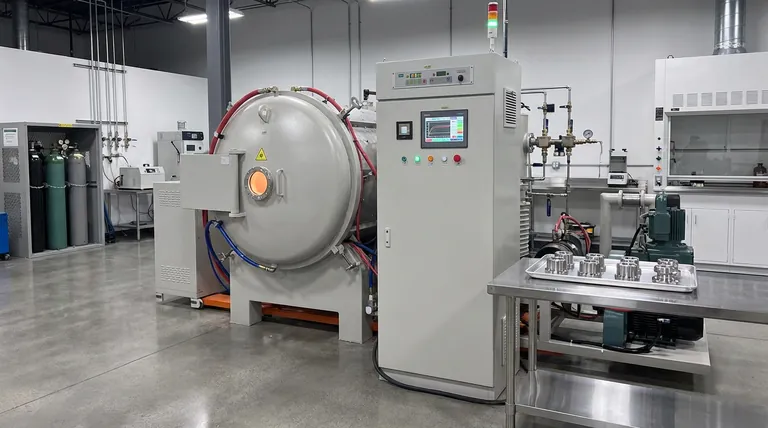
The specific atmosphere selected within a high vacuum sintering furnace is a decisive factor in the structural integrity and mechanical limits of 17-4PH stainless steel.
While an inert gas like argon provides protection, utilizing a reducing hydrogen (H2) environment actively alters the sintering kinetics. Hydrogen effectively strips oxide films from powder surfaces to promote surface diffusion, resulting in parts with porosity as low as 2.5% and a hardness increase of 15% compared to inert processing.
Core Takeaway A standard vacuum or inert atmosphere merely prevents new oxidation, but a reducing hydrogen atmosphere actively reverses existing oxidation to accelerate densification. This choice is the primary driver for achieving superior mechanical hardness (up to 420 HV) and minimizing porosity in sintered 17-4PH components.
The Mechanism of Reducing Atmospheres
Active Oxide Removal
Unlike inert gases, a reducing hydrogen atmosphere plays an active chemical role during the sintering process.
It targets and removes oxide films that naturally form on the surface of stainless steel powder particles. These films act as barriers to bonding; removing them is essential for high-performance sintering.
Promoting Surface Diffusion
Once the oxide barriers are eliminated, the metal surfaces are clean and reactive.
This cleanliness facilitates surface diffusion—the movement of atoms across the particle boundaries. Enhanced diffusion is the physical mechanism that drives the material toward a solid, dense state.
Impact on Mechanical Properties
Minimizing Porosity
The efficiency of the sintering atmosphere directly correlates to the density of the final part.
By facilitating better particle bonding through oxide removal, hydrogen atmospheres can reduce porosity to approximately 2.5%. This level of densification is critical for structural components that must withstand high stress without failure.
Increasing Hardness
The microstructural improvements gained from better densification translate directly to mechanical hardness.
17-4PH stainless steel sintered in hydrogen can reach hardness levels of up to 420 HV. This represents a significant 15% increase over identical parts processed in an argon atmosphere.
The Broader Role of Vacuum Quality
Prevention of Surface Degradation
Beyond the specific choice of gas, the baseline vacuum environment ensures the integrity of the alloy's composition.
High-vacuum processing prevents surface oxidation, decarburization, and gas absorption at high temperatures (around 1040 °C). This protection is vital for maintaining the precise chemical balance required for 17-4PH steel.
Foundation for Precipitation Hardening
The quality of the sintering atmosphere sets the stage for subsequent heat treatments.
By ensuring a clean, oxide-free microstructure, the material is better prepared for aging treatments (typically 480-620 °C). A pure foundation allows for the uniform precipitation of copper-rich (Cu-rich) strengthening phases, which are responsible for the alloy's final high-strength properties.
Understanding the Trade-offs
Cost and Complexity of Safety
While hydrogen offers superior mechanical properties, it introduces operational complexity.
Hydrogen is a flammable gas, requiring rigorous safety measures and specialized furnace designs. These requirements can increase the capital and operational costs compared to using inert gases like argon or nitrogen.
Process Necessity vs. Cost
If the superior densification of hydrogen is not strictly required for the application, inert atmospheres may be more economical.
However, when safety systems for flammable gases are already in place, the cost gap narrows. In these cases, the benefits of combining debinding and sintering in a single, atmosphere-controlled unit often outweigh the equipment costs.
Making the Right Choice for Your Goal
To select the correct atmosphere, you must weigh the performance requirements of your 17-4PH parts against your operational budget.
- If your primary focus is maximum mechanical strength: Prioritize a reducing hydrogen atmosphere to strip oxides, maximize density (low porosity), and achieve peak hardness (420 HV).
- If your primary focus is process economy and safety: Utilize an argon or nitrogen atmosphere, which prevents new oxidation but may yield slightly lower hardness and density figures.
- If your primary focus is compositional purity for aging: Ensure your furnace maintains a high-vacuum baseline to prevent decarburization, regardless of the partial pressure gas used.
Ultimately, the choice of atmosphere is not just about protection; it is a tool to actively engineer the density and hardness of your final component.
Summary Table:
| Atmosphere Type | Primary Function | Porosity Level | Hardness (HV) | Key Benefit |
|---|---|---|---|---|
| Hydrogen (H2) | Active Reduction | ~2.5% | Up to 420 HV | Strips oxide films; promotes diffusion |
| Argon (Inert) | Passive Protection | Higher | ~365 HV | Prevents new oxidation; safer/cheaper |
| High Vacuum | Surface Integrity | Variable | N/A | Prevents decarburization and degradation |
Elevate Your Metallurgy with KINTEK Precision
Is your sintering process achieving maximum material density? Backed by expert R&D and manufacturing, KINTEK offers high-performance Muffle, Tube, Rotary, Vacuum, and CVD systems designed to handle both inert and reducing atmospheres with precision. Whether you need to minimize porosity in 17-4PH stainless steel or customize a high-temp furnace for unique industrial needs, our team is ready to help.
Contact KINTEK today to optimize your heat treatment workflow
References
- Suhair Ghazi Mahdi. Comparative Study of Additive Manufacturing Techniques and Post-Processing on Microstructure and Properties of 17-4PH Stainless Steel and GRCop-42 Copper Alloy: Sintering Optimization vs Recrystallization Annealing. DOI: 10.22399/ijcesen.2657
This article is also based on technical information from Kintek Furnace Knowledge Base .
Related Products
- 9MPa Air Pressure Vacuum Heat Treat and Sintering Furnace
- 2200 ℃ Tungsten Vacuum Heat Treat and Sintering Furnace
- 2200 ℃ Graphite Vacuum Heat Treat Furnace
- Vacuum Heat Treat Sintering Furnace Molybdenum Wire Vacuum Sintering Furnace
- 600T Vacuum Induction Hot Press Vacuum Heat Treat and Sintering Furnace
People Also Ask
- What are the key features of vacuum pressure sintering furnaces? Unlock High-Purity, Dense Materials
- What are the key components of a vacuum pressure sintering furnace? Essential Systems for High-Performance Materials
- What safety features are integrated into vacuum pressure sintering furnaces? Ensure Operator and Equipment Protection
- What materials can be processed using vacuum pressure sintering furnaces? Unlock High-Performance Material Densification
- What are the main technical parameters of vacuum pressure sintering furnaces? Key Specs for Advanced Materials



















