
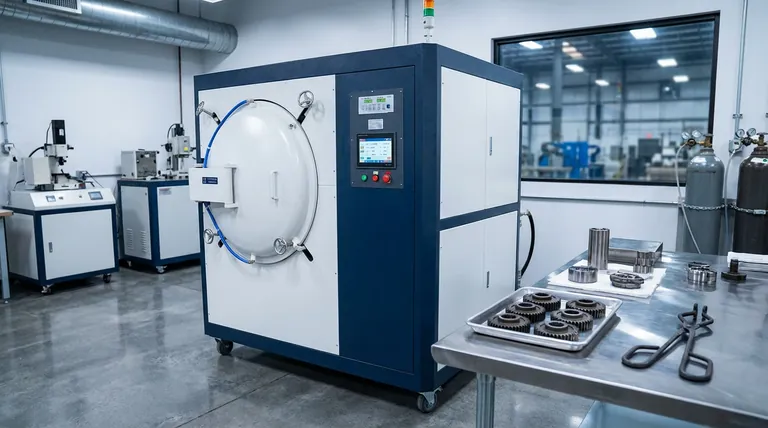
Vacuum furnaces are essential for re-quenching borided samples because they create a controlled environment that allows for core structural recovery without damaging the surface. Since the initial boriding process requires prolonged high temperatures that can coarsen the steel's internal structure, a secondary vacuum re-heat is necessary to restore toughness while protecting the hard boride layer from oxidation or decarburization.
The central value of this process is achieving a metallurgical compromise: it restores the core matrix to a tough sorbite structure after the damaging heat of boriding, without compromising the integrity of the extremely hard surface layer.
The Metallurgical Challenge of Boriding
The Side Effect of High Heat
Boriding typically takes place at temperatures above the transformation temperature of steel. Because this process requires extended exposure to this heat, the internal matrix structure of the steel often suffers.
Grain Coarsening
The most significant side effect of this prolonged high-temperature exposure is the coarsening of the matrix structure. While the surface becomes hard, the core grains grow larger, potentially reducing the material's overall toughness and impact resistance.
The Risk of Re-heating
To fix the core, the steel must be re-heated to austenitization temperatures. However, doing this in a standard atmosphere would cause the borided surface to react with oxygen, leading to oxidation and decarburization, effectively ruining the surface treatment.
How Vacuum Processing Solves the Problem
Protection During Austenitization
A vacuum furnace allows the sample to be re-heated to the necessary austenitization temperature in an oxygen-free environment. This ensures the hard borided surface remains chemically stable and does not degrade during the heating phase.
Controlled Quenching
Once the material is heated, the vacuum furnace facilitates oil quenching under inert gas protection. This rapid cooling is critical for transforming the heated austenite into the desired microstructure.
Recovering the Sorbite Structure
The specific goal of this quench is to recover the sorbite structure of the matrix. Sorbite offers an excellent balance of strength and ductility, repairing the brittleness associated with the coarse grains formed during the initial boriding.
Understanding the Trade-offs
Process Complexity vs. Material Performance
The primary trade-off here is the necessity of a multi-step process. While boriding provides surface hardness, it inherently degrades the core properties due to heat exposure; skipping the re-quenching step leaves you with a brittle core.
Equipment Specificity
Not all furnaces can achieve these results. The process requires advanced vacuum furnaces capable of integrated oil quenching and inert gas handling. Standard heat treatment equipment cannot replicate the atmosphere control required to protect the boride layer during the aggressive re-heating phase.
Making the Right Choice for Your Goal
When designing a heat treatment process for borided parts, consider the specific mechanical demands of the component.
- If your primary focus is Surface Integrity: The vacuum environment is non-negotiable to prevent decarburization and oxidation of the boride layer during re-heating.
- If your primary focus is Impact Resistance: The re-quenching step is critical to transform the coarse matrix back into a tough sorbite structure, ensuring the part does not shatter under load.
By utilizing vacuum re-quenching, you successfully bridge the gap between extreme surface hardness and reliable core toughness.
Summary Table:
| Process Challenge | Vacuum Furnace Solution | Metallurgical Outcome |
|---|---|---|
| Grain Coarsening | Controlled re-heating to austenitization | Restores tough sorbite structure |
| Surface Oxidation | Oxygen-free vacuum environment | Preserves hard borided layer |
| Decarburization | Inert gas protection | Maintains chemical stability |
| Core Brittleness | Integrated oil quenching | Optimal strength and ductility balance |
Elevate Your Material Performance with KINTEK
Don't let high-temperature coarsening compromise your components. KINTEK provides industry-leading vacuum furnace technology designed to bridge the gap between extreme surface hardness and core toughness. Backed by expert R&D and manufacturing, KINTEK offers customizable Vacuum, Muffle, Tube, Rotary, and CVD systems tailored to your specific metallurgical needs.
Whether you require integrated oil quenching or precise inert gas control, our high-temp furnaces ensure your samples achieve the perfect sorbite structure without surface degradation. Contact KINTEK today to optimize your heat treatment process!
References
- František Nový, Miloš Mičian. The Influence of Induction Hardening, Nitriding and Boronising on the Mechanical Properties of Conventional and Sintered Steels. DOI: 10.3390/coatings14121602
This article is also based on technical information from Kintek Furnace Knowledge Base .
Related Products
- Vacuum Heat Treat Sintering Furnace with Pressure for Vacuum Sintering
- Vacuum Induction Melting Furnace
- Vacuum Heat Treat Sintering Furnace Molybdenum Wire Vacuum Sintering Furnace
- Vacuum Heat Treat Sintering and Brazing Furnace
- 9MPa Air Pressure Vacuum Heat Treat and Sintering Furnace
People Also Ask
- What is one of the most important uses of vacuum heat treating furnaces in aerospace? Achieve Superior Strength in Aircraft Alloys
- What are the benefits of using vacuum heat treating furnaces for metal alloys? Achieve Superior Metal Properties and Performance
- How does vacuum heat treating affect the grain structure of metal alloys? Achieve Precise Microstructure Control
- What are the key components of a vacuum sintering furnace? Essential Parts for Precision Material Processing
- What is the purpose of setting a mid-temperature dwell stage? Eliminate Defects in Vacuum Sintering



















