
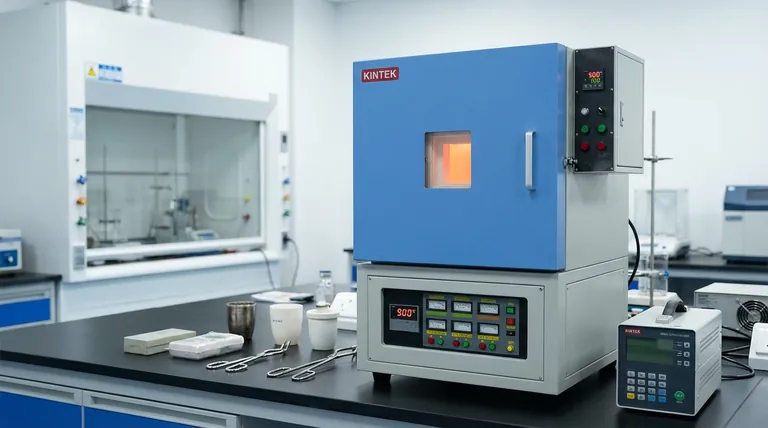
Calcination at 900°C for 13 hours in a muffle furnace functions as the precise thermal driver required to synthesize high-performance P2-type cathode materials. This specific process facilitates a solid-state reaction between precursors and sodium carbonate, forcing sodium ions into a manganese-based oxide lattice to establish a stable hexagonal structure while optimizing internal ion channels.
The muffle furnace provides a controlled thermal environment that coordinates two distinct atomic processes: the embedding of sodium to form the primary P2 framework and the time-dependent substitution of titanium to expand ion transmission pathways.
The Role of Thermal Energy (900°C)
The temperature setting is the primary variable controlling phase formation. In this synthesis, 900°C is not an arbitrary figure; it is the activation energy threshold required for specific lattice modifications.
Driving the Solid-State Reaction
At this temperature, the muffle furnace creates an environment where sodium carbonate and the precursor material react in a solid state.
This thermal energy overcomes the kinetic barriers that usually prevent solid materials from mixing at an atomic level.
Embedding Sodium Ions
The 900°C heat drives sodium ions directly into the manganese-based oxide lattice.
This insertion is the fundamental step that induces the material to reorganize from a disordered state into a stable, hexagonal P2-type layered structure. Without this precise temperature, the P2 phase would likely fail to form or remain unstable.
The Criticality of Duration (13 Hours)
While temperature dictates which phase forms, the 13-hour duration dictates the quality and geometry of that phase. Time acts as a stabilizing agent for atomic substitution.
Ensuring Complete Titanium Occupation
The extended heating period allows Titanium ions ($Ti^{4+}$) to diffuse through the solid and completely occupy specific sites within the manganese lattice.
This is a slow process compared to simple phase formation. Shortening this duration would result in incomplete substitution, leaving the material structurally inferior.
Expanding Transmission Channels
The complete occupation of lattice sites by $Ti^{4+}$ has a physical effect on the crystal structure: it expands the unit cell volume.
This expansion broadens the internal channels used for sodium-ion transmission. Wider channels equate to lower resistance and better electrochemical performance during battery operation.
Understanding the Trade-offs
In materials synthesis, deviation from these precise parameters often leads to diminished performance.
The Risk of Insufficient Heat
If the temperature drops below 900°C, the reaction between the sodium carbonate and the precursor may remain incomplete. This often results in impure phases rather than the desired P2-type structure.
The Consequence of Inadequate Time
If the process is halted before 13 hours, the titanium substitution will be partial. This leads to constricted ion channels, significantly reducing the cathode's ability to transport charge efficiently.
Making the Right Choice for Your Goal
To replicate high-performance cathode characteristics, you must align your thermal protocol with your specific structural goals.
- If your primary focus is Phase Purity: rigorous adherence to the 900°C setpoint is required to embed sodium ions and secure the hexagonal P2 structure.
- If your primary focus is Ion Conductivity: the full 13-hour duration is non-negotiable to ensure complete $Ti^{4+}$ occupation and the widening of sodium transmission channels.
Precise control over both thermal intensity and duration is the difference between a standard oxide mixture and a highly efficient, expanded-lattice cathode material.
Summary Table:
| Parameter | Setting | Role in Synthesis |
|---|---|---|
| Temperature | 900°C | Activates solid-state reaction and embeds Sodium ions into the lattice. |
| Duration | 13 Hours | Ensures complete Titanium substitution and expands unit cell volume. |
| Equipment | Muffle Furnace | Provides stable, controlled thermal environment for phase purity. |
| Structure | P2-Type | Hexagonal layered structure optimized for fast ion transmission. |
Precision Heat Treatment for Advanced Battery Research
Unlock the full potential of your cathode materials with thermal solutions engineered for precision. Backed by expert R&D and manufacturing, KINTEK offers high-performance Muffle, Tube, Rotary, Vacuum, and CVD systems designed to maintain the exact temperature and duration your research demands.
Whether you need customizable lab furnaces or industrial-scale high-temperature systems, we provide the consistency required for stable P2-type structures and optimized ion conductivity. Contact KINTEK today to discuss your unique synthesis needs and elevate your materials performance.
References
- Kexin Zheng, Lu Ju. Effects of Ti4+ Doping on the Structural Stability and Electrochemical Performance of Layered P2-Na0.7MnO2.05 Cathodes for Sodium-Ion Batteries. DOI: 10.3390/nano14241989
This article is also based on technical information from Kintek Furnace Knowledge Base .
Related Products
- 1800℃ High Temperature Muffle Oven Furnace for Laboratory
- High Temperature Muffle Oven Furnace for Laboratory Debinding and Pre Sintering
- 1700℃ High Temperature Muffle Oven Furnace for Laboratory
- 1400℃ Muffle Oven Furnace for Laboratory
- Laboratory Muffle Oven Furnace with Bottom Lifting
People Also Ask
- What is the primary function of a high-temperature laboratory muffle furnace in chemical synthesis? Achieve Precision.
- How does a high-temperature laboratory muffle furnace affect material properties? Transform Anodic Oxide Films Fast
- What is the critical role of a laboratory high-temperature muffle furnace in TiO2/LDH? Unlock Superior Crystallization
- What role does a muffle furnace play in plant bark mineral analysis? Essential for Precise Dry Ashing & Trace Extraction
- Why is a laboratory high-temperature muffle furnace required for LaNixFe1-xO3 catalysts? Optimize Two-Stage Synthesis



















