
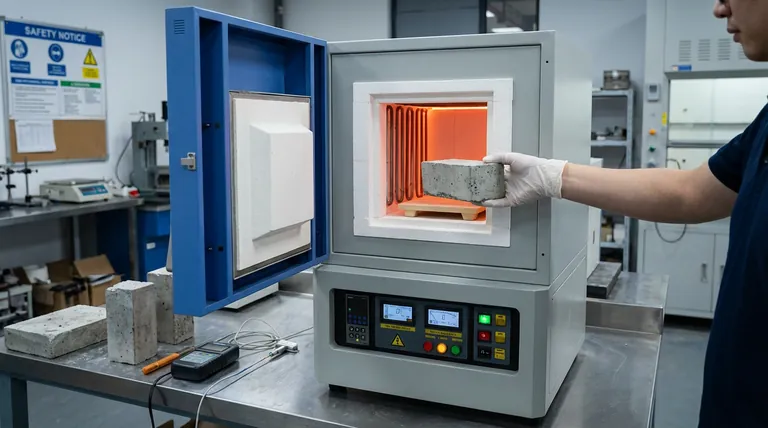
A muffle furnace with precise temperature control is indispensable because Alkali-Activated Slag (AAS) concrete exhibits highly sensitive physical and chemical reactions at high temperatures. Without the ability to strictly execute programmed heating curves and maintain uniform thermal conditions, it is impossible to accurately measure how heat affects the material’s residual strength and durability.
The complexity of AAS concrete degradation—involving dehydration, thermal stress, and pore structure changes—demands exact thermal regulation. A high-precision muffle furnace ensures that these variables are isolated and controlled, allowing for reproducible data regarding the material's high-temperature performance.
The Critical Role of Thermal Uniformity
Managing Complex Material Changes
AAS concrete undergoes significant transformations when exposed to heat, specifically dehydration and the coarsening of its pore structure. These are not simple linear reactions; they are sensitive to the specific environment within the chamber.
If the temperature fluctuates, it induces inconsistent thermal stress within the sample. A muffle furnace prevents this by utilizing high-temperature heating coils embedded in insulation (often glass wool) to create a stable, uniform "muffled" environment.
Eliminating Micro-Defects
Temperature fluctuations during testing can introduce micro-defects that are not inherent to the material's performance but are artifacts of poor equipment.
Advanced insulation and electric heating elements distribute heat evenly across the chamber. This prevents localized hotspots that could cause artificial cracking or warping, ensuring the observed damage is due to the material properties, not the testing apparatus.
The Necessity of Programmable Control
Executing Specific Heating Regimes
Standardizing the rate at which temperature rises is crucial for valid AAS concrete evaluation. The furnace must be capable of executing exact heating curves, such as 5°C/min or 10°C/min.
Digital programmable controls allow researchers to input these specific ramp rates and holding times. This capability is essential because the speed of heating directly influences the severity of internal pressure buildup and consequent cracking.
Ensuring Repeatability
For research to be valid, the process must be repeatable. Modern muffle furnaces with digital controls ensure that a test run today is identical to one run next week.
By using electric heating elements rather than combustion-based methods, these furnaces also eliminate combustion byproducts. This guarantees a contamination-free environment, ensuring that chemical analysis of the post-test concrete remains pure and accurate.
Understanding the Trade-offs
Chamber Size Limitations
While muffle furnaces offer excellent control, they are typically limited in chamber volume compared to industrial kilns. This restricts the size of the concrete specimens that can be tested, potentially requiring scaled-down samples that may not perfectly represent large-scale structural behavior.
Static Testing Conditions
Standard muffle furnaces apply heat in a static environment without mechanical load. While they are perfect for evaluating residual strength after cooling, they do not simulate the synergistic effect of mechanical load and heat simultaneously (fire under load) unless specifically modified.
Making the Right Choice for Your Goal
To select the appropriate testing parameters for your AAS concrete evaluation, consider your specific research objectives:
- If your primary focus is material durability: Prioritize a furnace with granular ramp rate control to simulate specific fire scenarios (e.g., slow vs. fast heating).
- If your primary focus is chemical analysis: Ensure the furnace utilizes electric heating elements to prevent combustion byproducts from contaminating the sample surface.
- If your primary focus is mechanical integrity: Verify the furnace's thermal uniformity specifications to ensure that observed cracks are due to material failure, not uneven heating.
Precision in temperature control is the only way to transform high-temperature testing from a rough estimation into a rigorous scientific evaluation.
Summary Table:
| Feature | Importance for AAS Concrete Testing | Benefit to Researcher |
|---|---|---|
| Precise Ramp Rates | Controls dehydration and internal pressure buildup | Ensures repeatable and standardized data |
| Thermal Uniformity | Prevents localized hotspots and artificial cracking | Isolates material defects from equipment artifacts |
| Electric Heating | Eliminates combustion byproducts and contaminants | Maintains purity for post-test chemical analysis |
| Digital Programming | Executes complex heating and holding curves | Simulates specific fire scenarios accurately |
Elevate Your Material Research with KINTEK Precision
Unlock the full potential of your Alkali-Activated Slag (AAS) studies with equipment designed for scientific rigor. Backed by expert R&D and world-class manufacturing, KINTEK provides high-precision Muffle, Tube, Rotary, Vacuum, and CVD systems tailored for the most demanding lab environments.
Whether you need granular ramp rate control for durability testing or a contamination-free environment for chemical analysis, our high-temperature furnaces are fully customizable to meet your unique research needs. Ensure your data is reproducible and your results are undeniable.
Ready to upgrade your laboratory capabilities? Contact our specialists today to find the perfect thermal solution for your next project.
References
- Baomeng Zhou, Ping Li. Chloride Permeability of Alkali-Activated Slag Concretes after Exposure to High Temperatures. DOI: 10.3390/ma17051028
This article is also based on technical information from Kintek Furnace Knowledge Base .
Related Products
- 1400℃ Muffle Oven Furnace for Laboratory
- 1700℃ High Temperature Muffle Oven Furnace for Laboratory
- 1800℃ High Temperature Muffle Oven Furnace for Laboratory
- 1200℃ Muffle Oven Furnace for Laboratory
- High Temperature Muffle Oven Furnace for Laboratory Debinding and Pre Sintering
People Also Ask
- What is the primary function of a high-temperature laboratory muffle furnace in chemical synthesis? Achieve Precision.
- How does a high-temperature laboratory muffle furnace affect material properties? Transform Anodic Oxide Films Fast
- How does a laboratory high-temperature muffle furnace contribute to the final formation of Bismuth Oxide nanosheets?
- How does a muffle furnace facilitate Ag/ATP catalyst preparation? Optimize Calcination for Superior Performance
- What is the role of a laboratory high-temperature muffle furnace in H13 steel treatment? Optimize Tool Performance



















