
Precise gas flow control is the governing factor in the reactive sputtering of chromium trioxide (Cr2O3) thin films. By rigorously managing the ratio of argon (Ar) to oxygen (O2)—for example, maintaining a specific 20% oxygen content—you ensure the correct oxidation of chromium atoms. This precision dictates both the chemical composition (stoichiometry) and the physical architecture (crystal structure) of the final material.
In reactive sputtering, gas flow control is not merely about system pressure; it is a synthesis tool. The accuracy of the Ar:O2 ratio determines whether the chromium oxidizes correctly to form Cr2O3, directly establishing the film's fundamental quality and performance.
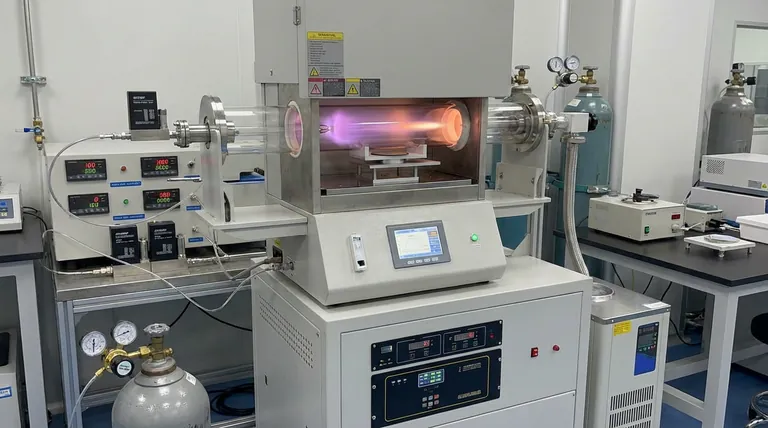
Mechanisms of Reactive Deposition
Controlling the Argon-to-Oxygen Ratio
The core challenge in reactive sputtering is balancing the inert gas (Argon) with the reactive gas (Oxygen).
Argon acts as the physical sputtering agent, knocking chromium atoms loose from the target.
Oxygen must be introduced at a precise percentage—such as the 20% benchmark mentioned in standard processes—to facilitate the chemical reaction necessary to create Cr2O3.
Timing of the Chemical Reaction
Flow control regulates when and where the oxidation occurs.
With the correct gas mixture, chromium atoms undergo appropriate oxidation either while traveling through the vacuum chamber or immediately upon contact with the substrate surface.
If the flow varies, the timing of this reaction shifts, potentially leading to incomplete film formation.
Defining Material Properties
Locking in Stoichiometry
The most critical outcome of gas flow precision is the oxygen-to-chromium stoichiometry (O:Cr).
To achieve pure chromium trioxide, the ratio of oxygen atoms reacting with chromium atoms must be exact.
Fluctuations in gas flow lead to deviations in this ratio, resulting in films that are either metallic-rich or overly oxidized, rather than the target dielectric material.
Determining Crystal Structure
Beyond chemical composition, gas flow governs the physical arrangement of atoms.
The specific gas environment influences the energy and mobility of atoms as they land on the substrate.
Therefore, maintaining a stable flow is essential for ensuring the final crystal structure forms correctly and consistently across the wafer.
Understanding the Trade-offs
Sensitivity to Deviation
The process is highly sensitive to minor drifts in gas flow.
Even a slight variance from the optimal ratio (e.g., drifting away from 20% oxygen) can significantly alter the film's properties.
Process Stability vs. Deposition Rate
While high oxygen flow ensures full oxidation, it often competes with the sputtering efficiency of Argon.
You must balance the need for perfect stoichiometry against the need for an efficient deposition rate.
Prioritizing the exact gas ratio ensures quality but requires precise instrumentation to maintain process stability.
Optimizing Your Process Control
To achieve high-quality Cr2O3 films, you must align your gas flow strategy with your specific material requirements.
- If your primary focus is Chemical Purity: Prioritize the precision of Mass Flow Controllers (MFCs) to lock in the exact O:Cr stoichiometry required for Cr2O3.
- If your primary focus is Crystalline Quality: Focus on the temporal stability of the gas mix to ensure the crystal structure remains uniform from the bottom to the top of the film.
Stable gas flow is the difference between a random coating and a functional electronic material.
Summary Table:
| Parameter | Role in Cr2O3 Sputtering | Impact on Final Film |
|---|---|---|
| Argon (Ar) Flow | Physical sputtering agent | Controls deposition rate and atom ejection |
| Oxygen (O2) Flow | Reactive species | Determines chemical composition (stoichiometry) |
| Gas Ratio (e.g. 20% O2) | Reaction synthesis tool | Defines material phase (metallic vs. dielectric) |
| Flow Stability | Process consistency | Ensures uniform crystal structure and quality |
Elevate Your Thin Film Precision with KINTEK
Achieving the perfect stoichiometry for Cr2O3 thin films requires absolute control over your vacuum environment. Backed by expert R&D and world-class manufacturing, KINTEK provides the high-precision equipment necessary for advanced material synthesis. Whether you need CVD systems, Vacuum furnaces, or customizable lab high-temperature solutions, our technology is designed to meet your most demanding research and production needs.
Ready to optimize your deposition process? Contact our technical experts today to discover how KINTEK’s customizable systems can deliver the stability and precision your laboratory requires.
References
- Quintin Cumston, William E. Kaden. Wafer-scale development, characterization, and high temperature stabilization of epitaxial Cr2O3 films grown on Ru(0001). DOI: 10.1063/5.0201818
This article is also based on technical information from Kintek Furnace Knowledge Base .
Related Products
- RF PECVD System Radio Frequency Plasma Enhanced Chemical Vapor Deposition
- Custom Made Versatile CVD Tube Furnace Chemical Vapor Deposition CVD Equipment Machine
- HFCVD Machine System Equipment for Drawing Die Nano Diamond Coating
- Spark Plasma Sintering SPS Furnace
- Slide PECVD Tube Furnace with Liquid Gasifier PECVD Machine
People Also Ask
- What is RF in PECVD? A Critical Control for Plasma Deposition
- What is the role of RF power in PECVD and how does the RF-PECVD process work? Master Thin Film Deposition Control
- What are the applications of plasma enhanced chemical vapor deposition? Key Uses in Electronics, Optics & Materials
- What are the key advantages of PECVD technology? Achieve Low-Temperature, High-Quality Thin Film Deposition
- How are deposition rates and film properties controlled in PECVD? Master Key Parameters for Optimal Thin Films




