
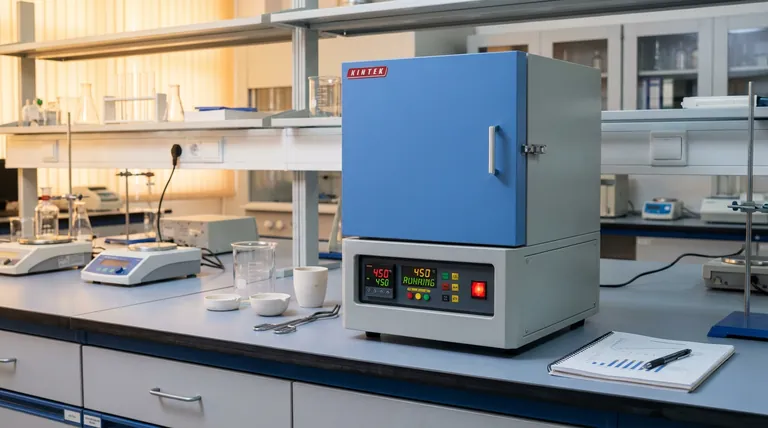
Heat treatment in a muffle furnace at 450 °C is the critical integration step for CuFe2O4–SnO2-rGO composites, serving to transition the material from a mixture of components into a unified functional unit. This thermal process eliminates residual organic ligands and strengthens the physical connection between the copper ferrite, tin oxide, and reduced graphene oxide. The result is a stable ternary heterostructure with significantly improved electron transfer capabilities and operational durability.
Core Insight: The furnace treatment is not merely for drying; it is an architectural step that engineers the interface between components. Without this specific heat-induced bonding, the material lacks the structural integrity and conductivity required for demanding applications like cyanide wastewater treatment.
Mechanisms of Structural Enhancement
Strengthening Interfacial Bonding
The primary outcome of the 450 °C treatment is the facilitation of chemical bonding between CuFe2O4, SnO2, and rGO.
Rather than these materials simply sitting adjacent to one another, the heat energy drives the formation of strong interfacial contacts. This creates a cohesive "ternary heterostructure" where the three distinct components act as a single system.
Removal of Organic Impurities
During synthesis, organic ligands often remain attached to the material surface.
The muffle furnace treatment burns off these residual organics. This "cleaning" of the lattice structure prevents impurities from hindering chemical reactions or blocking active sites on the composite's surface.
Stabilization of the Framework
While specifically cited for precursor stages at 300 °C, the general principle of muffle furnace treatment involves stabilizing the material's physical framework.
The heat allows for the release of internal stresses and effectively adjusts the crystalline state of the oxides. This ensures the material achieves a thermodynamic equilibrium, preventing structural collapse during later use.
Impact on Operational Performance
Accelerated Electron Transfer
The performance of a heterojunction composite relies heavily on how fast electrons can move between its parts.
By solidifying the interface between the conductive rGO and the metal oxides, the heat treatment reduces contact resistance. This allows for a rapid, unimpeded electron transfer rate, which is essential for catalytic efficiency.
Enhanced Cyclic Stability
Durability is often the failure point for composite materials in harsh chemical environments.
The strong chemical bonds formed during the heat treatment prevent the components from detaching or degrading over time. This imparts high cyclic stability, meaning the material can be used repeatedly—such as in continuous wastewater treatment cycles—without significant loss of performance.
Understanding the Trade-offs
Temperature Precision is Critical
While heat treatment is beneficial, the specific temperature of 450 °C is not arbitrary.
If the temperature is too low, the organic ligands may not fully decompose, leaving an insulating layer that hampers electron transfer. Conversely, excessive heat could potentially damage the reduced graphene oxide (rGO) structure or induce unwanted phase changes in the oxides.
Uniformity vs. Speed
Muffle furnaces are designed to maintain precise, constant temperatures to ensure uniform treatment.
Rushing this process or using equipment with uneven heating can lead to "hot spots" or "cold spots" in the batch. This results in a composite with inconsistent catalytic properties, where some sections are fully activated and others remain dormant.
Making the Right Choice for Your Goal
To maximize the utility of CuFe2O4–SnO2-rGO composites, tailor your thermal processing to your specific constraints:
- If your primary focus is Catalytic Efficiency: Ensure the furnace reaches the full 450 °C to completely remove organic ligands, as any residue will act as an insulator and reduce the electron transfer rate.
- If your primary focus is Long-term Durability: Prioritize the "soak time" at the target temperature to allow maximum interfacial bonding, which creates the mechanical robustness needed for repeated cycling.
By strictly controlling the thermal environment, you transform a simple mixture of oxides and carbon into a high-performance catalytic tool.
Summary Table:
| Feature | Impact of 450°C Heat Treatment | Performance Benefit |
|---|---|---|
| Interfacial Bonding | Creates a unified ternary heterostructure | Enhanced structural integrity |
| Purity | Eliminates residual organic ligands | Unblocked active sites for reactions |
| Conductivity | Reduces contact resistance at interfaces | Accelerated electron transfer rate |
| Stability | Relieves internal stress and stabilizes framework | High cyclic durability for reuse |
Elevate Your Material Research with KINTEK
Precise thermal processing is the difference between a simple mixture and a high-performance heterojunction composite. KINTEK provides the advanced heating solutions required to achieve the exact 450°C environments necessary for structural stabilization and organic removal.
Backed by expert R&D and manufacturing, KINTEK offers Muffle, Tube, Rotary, Vacuum, and CVD systems, all customizable for your unique lab needs. Whether you are optimizing catalytic efficiency or improving cyclic stability, our high-temp furnaces ensure the uniformity your research demands.
Ready to engineer superior materials? Contact KINTEK today to find the perfect furnace for your laboratory.
References
- Soumya Mishra, Prangya Ranjan Rout. Construction of a novel ternary synergistic CuFe <sub>2</sub> O <sub>4</sub> –SnO <sub>2</sub> -rGO heterojunction for efficient removal of cyanide from contaminated water. DOI: 10.1039/d4ra02217c
This article is also based on technical information from Kintek Furnace Knowledge Base .
Related Products
- 1400℃ Muffle Oven Furnace for Laboratory
- 1700℃ High Temperature Muffle Oven Furnace for Laboratory
- 1800℃ High Temperature Muffle Oven Furnace for Laboratory
- 1200℃ Muffle Oven Furnace for Laboratory
- High Temperature Muffle Oven Furnace for Laboratory Debinding and Pre Sintering
People Also Ask
- What is the primary function of a high-temperature laboratory muffle furnace in chemical synthesis? Achieve Precision.
- How does a high-temperature laboratory muffle furnace affect material properties? Transform Anodic Oxide Films Fast
- What function does a muffle furnace perform in perovskite formation? Optimize Your Thermal Synthesis
- What is the role of a laboratory high-temperature muffle furnace in H13 steel treatment? Optimize Tool Performance
- How is a laboratory high-temperature muffle furnace utilized in g-C3N4 synthesis? Optimize Your Thermal Polycondensation



















