
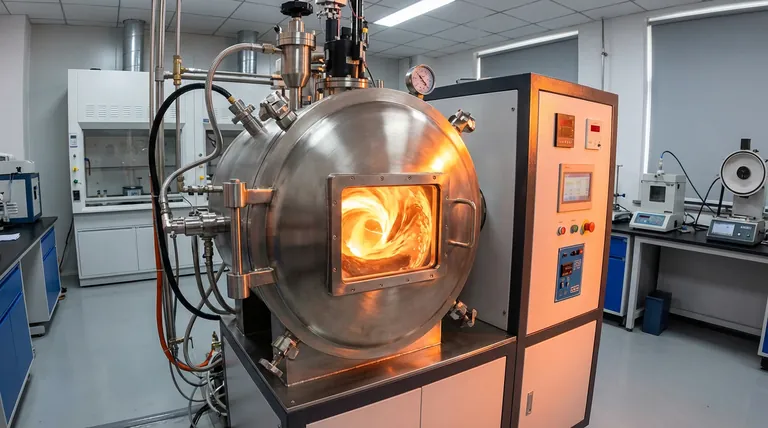
Electromagnetic stirring functions as a non-contact blending agent within a Vacuum Arc Melting Furnace to solve the physical challenges of mixing disparate metals. By utilizing magnetic fields to induce strong convection currents within the molten pool, it forces the liquid metal to circulate continuously, ensuring that heavy and light elements are distributed evenly throughout the alloy.
The Core Takeaway While the electric arc provides the heat to melt the material, electromagnetic stirring provides the kinetic energy required for uniformity. It eliminates the natural tendency of complex elements to segregate, ensuring the final alloy is mixed thoroughly at the thermodynamic level.
The Mechanism of Homogeneity
Inducing Strong Convection
The primary mechanism at work is non-contact fluid dynamics. Rather than using a physical paddle, which could contaminate the melt or melt itself, the furnace uses electromagnetic fields to push the liquid metal.
Creating a Dynamic Molten Pool
This force creates aggressive convection currents within the pool. These currents disrupt stagnant zones where elements might otherwise settle based on their density or melting point.
Solving the "Complex Alloy" Problem
Handling Diverse Elemental Properties
Complex concentrated alloys often consist of a "cocktail" of components, such as Aluminum, Cobalt, Chromium, Iron, Nickel, and Neodymium.
Eliminating Elemental Segregation
Without active stirring, these elements naturally segregate. Heavier atoms may sink, while lighter ones float or drift to the edges. Electromagnetic stirring continually redistributes these atoms, overcoming gravity and thermal gradients.
Thermodynamic Mixing
The result is not just a physical mixture, but a thermodynamically mixed state. The stirring ensures that different metal atoms are interspersed at a microscopic level, resulting in a material that is chemically uniform from edge to center.
The Role of the Furnace Environment
Enabling High-Entropy Synthesis
While stirring handles the mixing, the Vacuum Arc Furnace environment is what makes synthesis possible. The high-temperature electric arcs are responsible for the initial melting of the solid components.
Preventing Oxidation
Active elements in complex alloys are highly prone to oxidation. The furnace utilizes vacuum pumping and inert gas protection to create a barrier against the atmosphere.
Ensuring Compositional Precision
By combining the vacuum environment with electromagnetic stirring, the system prevents the loss of active elements to oxidation. This ensures the final chemical composition matches the intended design precisely.
Understanding the Trade-offs
Arc Melting vs. Stirring
It is a common misconception that the electric arc alone is sufficient for mixing. While the supplementary data notes that the arc provides "initial mixing," rely on this is a risk for complex alloys.
The arc concentrates on heat generation and melting, often creating localized hot spots. Without the secondary system of electromagnetic stirring, the resulting ingot may suffer from macro-segregation, rendering the material inconsistent for high-performance applications.
Making the Right Choice for Your Goal
To achieve the best results with complex concentrated alloys, you must balance the heating mechanism with the mixing mechanism.
- If your primary focus is Chemical Uniformity: Prioritize electromagnetic stirring parameters to ensure convection is strong enough to overcome the density differences of elements like Neodymium and Aluminum.
- If your primary focus is Material Purity: Focus on the integrity of the vacuum and inert gas systems to prevent the oxidation of active elements during the melt.
The combination of electromagnetic stirring and a controlled vacuum environment is the only reliable method to transform a complex mix of metals into a singular, high-performance alloy.
Summary Table:
| Feature | Function in Homogeneity | Benefit for Complex Alloys |
|---|---|---|
| Non-Contact Stirring | Induces magnetic field convection | Prevents contamination from physical tools |
| Dynamic Molten Pool | Continuous liquid metal circulation | Eliminates stagnant zones and density settling |
| Vacuum Environment | Inert gas & atmospheric protection | Prevents oxidation of sensitive elements |
| Thermodynamic Mixing | Microscopic atom redistribution | Ensures edge-to-center chemical consistency |
Elevate Your Material Research with KINTEK Precision
Don't let elemental segregation compromise your complex concentrated alloys. KINTEK’s advanced Vacuum Arc Melting systems integrate powerful electromagnetic stirring with precision vacuum control to ensure absolute chemical uniformity for your most demanding applications.
Backed by expert R&D and manufacturing, KINTEK offers a full range of customizable Muffle, Tube, Rotary, Vacuum, and CVD systems, specifically engineered for lab high-temp processes. Our furnaces are designed to handle the "elemental cocktail" of modern high-entropy alloys while preventing oxidation.
Ready to achieve superior homogeneity? Contact our technical team today to customize a solution for your unique high-performance material needs!
References
- Shimaa El‐Hadad, M. M. Rashad. Magnetic Properties of Al25Co(25-x)CrxFe25-yNi25Ndy Compositionally Complex Alloys. DOI: 10.1007/s11661-025-07818-0
This article is also based on technical information from Kintek Furnace Knowledge Base .
Related Products
- Vacuum Induction Melting Furnace
- Vacuum Heat Treat Sintering and Brazing Furnace
- Small Vacuum Heat Treat and Tungsten Wire Sintering Furnace
- Vacuum Heat Treat Sintering Furnace Molybdenum Wire Vacuum Sintering Furnace
- Vacuum Heat Treat Sintering Furnace with Pressure for Vacuum Sintering
People Also Ask
- What are the core functions of the High Vacuum Induction Melting (VIM) furnace? Optimize DD5 Superalloy Purification
- What are the technical advantages of using a Vacuum Induction Melting furnace in the development of advanced packaging steel?
- What role does a Vacuum Induction Melting furnace play in the production of high-aluminum nickel-based superalloys?
- What are the advantages of using a VIM furnace to control residual oxygen pressure? Achieve Superior Metal Uniformity
- What is the role of VIM and directional solidification in aero-engine blade substrates? Engineering Extreme Durability



















