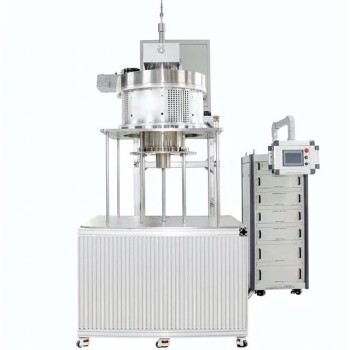
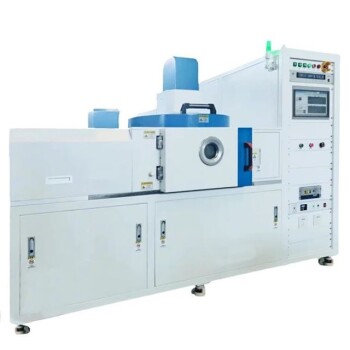
Spark Plasma Sintering (SPS) fundamentally alters the manufacturing landscape by utilizing pulsed direct current and axial pressure to achieve densification in minutes rather than hours. Unlike traditional methods that rely on slow external heating, SPS generates heat internally, allowing for rapid temperature ramp-ups that bypass the thermal lag responsible for grain coarsening.
The core advantage of SPS is its ability to decouple densification from grain growth. By combining extreme heating rates with mechanical pressure, it "locks in" high-performance nanocrystalline features—such as dislocations and nano-precipitates—that are typically destroyed during the prolonged dwell times of conventional sintering.
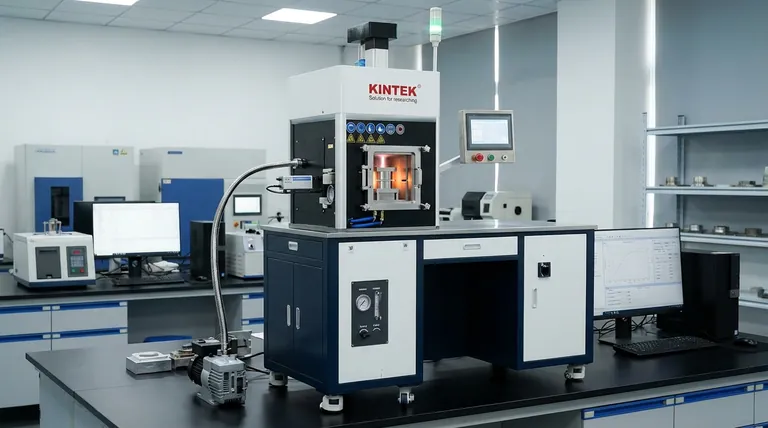
The Mechanics of Rapid Densification
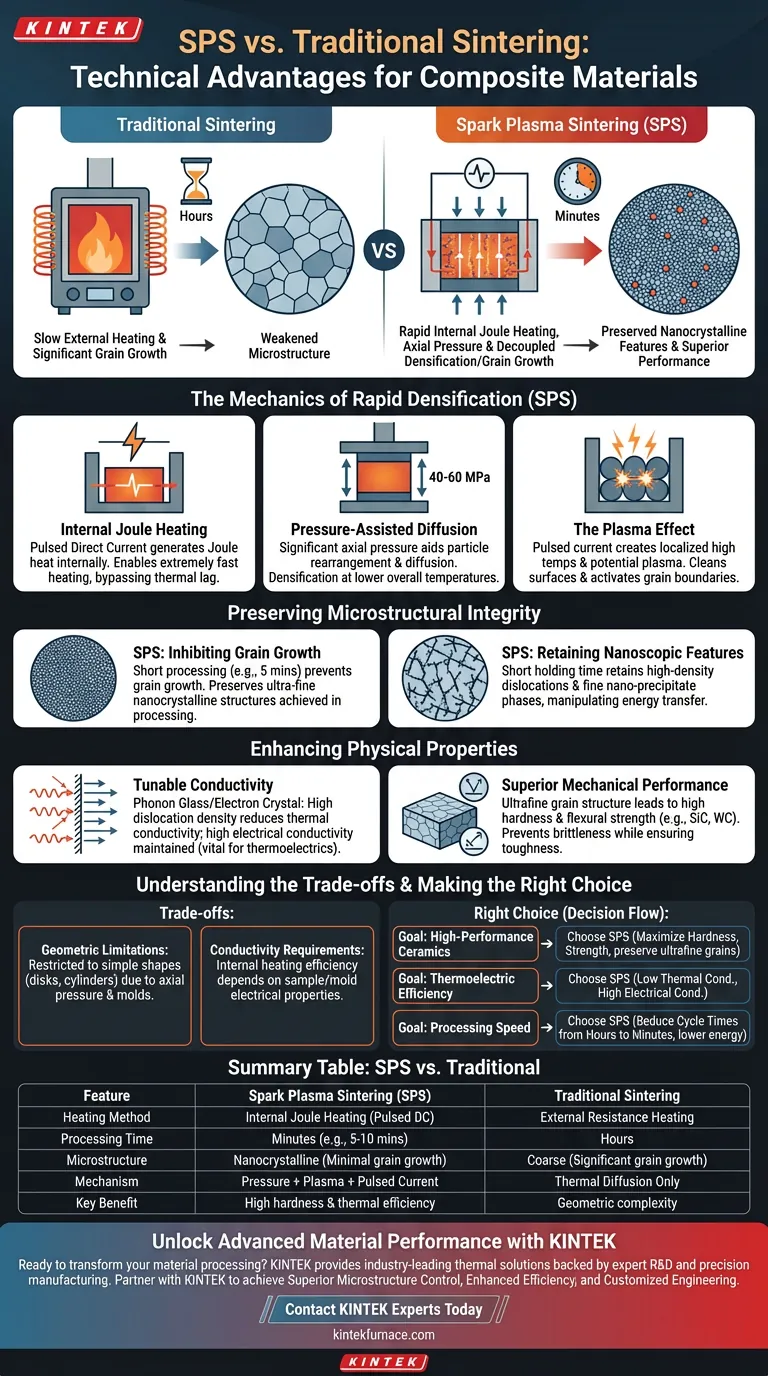
Internal Joule Heating
Traditional resistance furnaces heat a sample from the outside in, which is slow and inefficient.
In contrast, SPS passes pulsed electric current directly through the mold or the conducting sample itself. This generates Joule heat internally, enabling extremely fast heating rates.
Pressure-Assisted Diffusion
SPS does not rely on heat alone; it applies significant axial pressure (e.g., 40–60 MPa) throughout the process.
This pressure physically aids in particle rearrangement and promotes diffusion at grain boundaries. Consequently, full densification can be achieved at lower overall temperatures compared to pressureless sintering.
The Plasma Effect
The pulsed current creates specific conditions at particle contact points, including potential plasma discharge and localized high temperatures.
This effectively cleans particle surfaces and activates grain boundaries, further accelerating the bonding process.
Preserving Microstructural Integrity
Inhibiting Grain Growth
In traditional sintering, keeping a material hot enough to densify usually gives grains time to grow large, which weakens the material.
SPS completes the process so quickly—often within 5 minutes—that grain growth is effectively inhibited. This preserves the ultra-fine or nanocrystalline structures achieved during earlier processing stages, such as mechanical alloying.
Retaining Nanoscopic Features
Because the holding time is short, the material retains high-density dislocations and fine nano-precipitate phases.
These features are critical for advanced applications because they manipulate how energy moves through the material.
Enhancing Physical Properties
Tunable Conductivity (The Phonon Glass/Electron Crystal Concept)
The microstructural features preserved by SPS create a unique advantage for functional composites.
The high density of dislocations and grain boundaries significantly enhances phonon scattering, which reduces thermal conductivity. Simultaneously, the process maintains high electrical conductivity, a rare combination vital for thermoelectric materials.
Superior Mechanical Performance
The ability to maintain an ultrafine grain structure directly translates to mechanical gains.
For ceramics like Silicon Carbide (SiC) or Tungsten Carbide (WC), this results in a material that possesses both high hardness and high flexural strength. By melting binders (like cobalt) locally without overheating the bulk, SPS prevents brittleness while ensuring toughness.
Understanding the Trade-offs
Geometric Limitations
The reliance on axial pressure and specific molds imposes constraints on component geometry.
While SPS is superior for simple shapes like disks or cylinders, it cannot easily replicate the complex 3D geometries achievable with pressureless sintering or slip casting.
Material Conductivity Requirements
The efficiency of the internal heating mechanism depends heavily on the electrical properties of the sample and the mold.
Non-conductive materials must rely entirely on the mold for heat transfer, which can slightly alter the heating dynamics compared to conductive samples that self-heat.
Making the Right Choice for Your Goal
To determine if SPS is the correct manufacturing route for your composite, consider your specific performance targets:
- If your primary focus is High-Performance Ceramics: Choose SPS to achieve maximum hardness and flexural strength by preserving ultrafine grain structures that traditional hot-pressing would destroy.
- If your primary focus is Thermoelectric Efficiency: Choose SPS to engineer materials with low thermal conductivity (via phonon scattering) but high electrical conductivity.
- If your primary focus is Processing Speed: Choose SPS to reduce cycle times from hours to minutes, significantly lowering energy consumption per unit.
SPS is not just a faster heater; it is a tool for freezing non-equilibrium microstructures into fully dense solids.
Summary Table:
| Feature | Spark Plasma Sintering (SPS) | Traditional Sintering |
|---|---|---|
| Heating Method | Internal Joule Heating (Pulsed DC) | External Resistance Heating |
| Processing Time | Minutes (e.g., 5-10 mins) | Hours |
| Microstructure | Nanocrystalline (Minimal grain growth) | Coarse (Significant grain growth) |
| Mechanism | Pressure + Plasma + Pulsed Current | Thermal Diffusion Only |
| Key Benefit | High hardness & thermal efficiency | Geometric complexity |
Unlock Advanced Material Performance with KINTEK
Ready to transform your material processing from hours to minutes? KINTEK provides industry-leading thermal solutions backed by expert R&D and precision manufacturing.
Whether you require Muffle, Tube, Rotary, Vacuum, or CVD systems, our laboratory high-temperature furnaces are fully customizable to meet the unique demands of Spark Plasma Sintering and beyond.
Partner with KINTEK to achieve:
- Superior Microstructure Control: Preserve nanocrystalline features for maximum strength.
- Enhanced Efficiency: Reduce energy consumption with rapid heating cycles.
- Customized Engineering: Solutions tailored specifically to your composite material needs.
Contact KINTEK Experts Today to discover how our advanced sintering technology can elevate your lab's capabilities!
Visual Guide
References
- Xian Yi Tan, Qingyu Yan. Synergistic Combination of Sb <sub>2</sub> Si <sub>2</sub> Te <sub>6</sub> Additives for Enhanced Average ZT and Single‐Leg Device Efficiency of Bi <sub>0.4</sub> Sb <sub>1.6</sub> Te <sub>3</sub> ‐based Composites. DOI: 10.1002/advs.202400870
This article is also based on technical information from Kintek Furnace Knowledge Base .
Related Products
- Spark Plasma Sintering SPS Furnace
- Chairside Dental Porcelain Zirconia Sintering Furnace with Transformer for Ceramic Restorations
- 600T Vacuum Induction Hot Press Vacuum Heat Treat and Sintering Furnace
- 9MPa Air Pressure Vacuum Heat Treat and Sintering Furnace
- Dental Porcelain Zirconia Sintering Ceramic Vacuum Press Furnace
People Also Ask
- How does the heating mechanism of Spark Plasma Sintering (SPS) function? Enhance TiC/SiC Composite Fabrication
- Why is it necessary to maintain a high vacuum environment during the SPS of SiC? Key to High-Density Ceramics
- What are the technical advantages of using an SPS sintering furnace? Elevate Al2O3-TiC Material Performance
- What are the steps in the discharge plasma sintering process? Master Fast, High-Density Material Consolidation
- What are the advantages of spark plasma sintering (SPS) over traditional forging? Precision Microstructural Control