
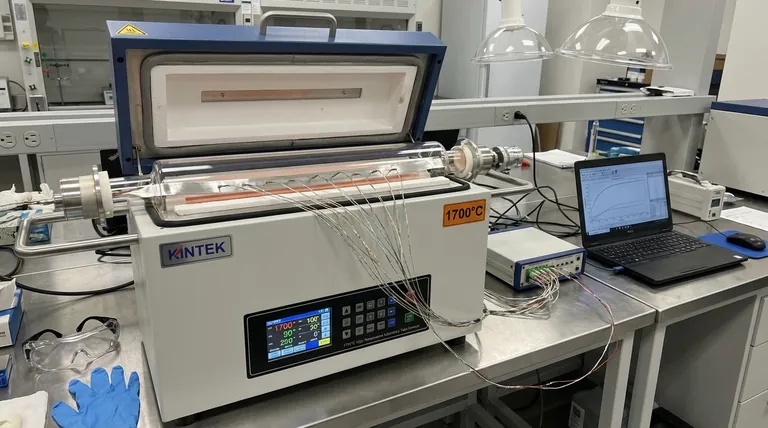
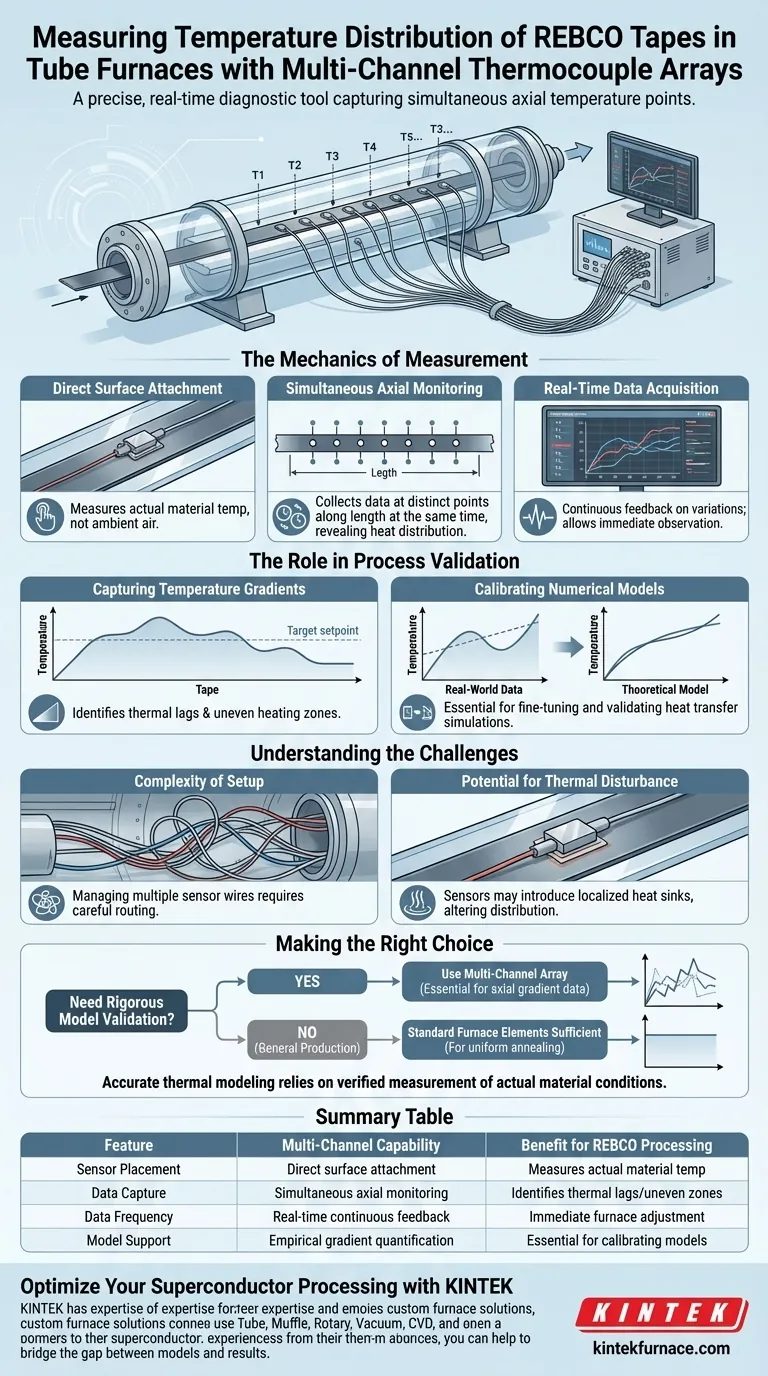
A multi-channel thermocouple array functions as a precise, real-time diagnostic tool. By physically attaching sensors directly to the surface of REBCO tapes, this system captures simultaneous temperature readings at multiple points along the tape’s axial direction. This provides a granular view of thermal conditions that standard single-point furnace sensors cannot offer.
While tube furnaces are designed to create uniform thermal environments, the actual temperature of the material inside often varies. A multi-channel array bridges this gap by providing the specific temperature gradient data required to calibrate and validate heat transfer numerical models.
The Mechanics of Measurement
Direct Surface Attachment
To ensure accuracy, the thermocouples in the array are attached directly to the surface of the REBCO tapes.
This physical contact ensures the sensors measure the actual temperature of the material itself, rather than just the ambient air temperature within the tube.
Simultaneous Axial Monitoring
The array structure allows for data collection at several distinct points along the length (axial direction) of the tape at the exact same time.
This simultaneous monitoring reveals how heat is distributed along the tape, highlighting any uneven heating or thermal lags that occur during the process.
Real-Time Data Acquisition
The system provides continuous, real-time feedback on temperature variations as the furnace operates.
This allows researchers to observe dynamic changes immediately, rather than relying on post-process analysis or theoretical assumptions.
The Role in Process Validation
Capturing Temperature Gradients
Even within a controlled tube furnace, significant temperature gradients can exist along the length of a long tape.
The multi-channel array quantifies these gradients, identifying specific zones where the temperature may deviate from the target setpoint.
Calibrating Numerical Models
The primary strategic value of this data is its use in validating heat transfer numerical models.
By comparing the real-world data from the array against theoretical simulations, researchers can fine-tune their models to ensure they accurately predict the thermal behavior of the REBCO tapes.
Understanding the Challenges
Complexity of Setup
Implementing a multi-channel array increases the physical complexity of the experiment compared to standard furnace operations.
Managing multiple sensor wires within a confined, high-temperature environment requires careful routing to avoid tangling or signal interference.
Potential for Thermal Disturbance
Ideally, measurement tools should not affect the system they are measuring, but physical sensors have mass and thermal conductivity.
Attaching multiple thermocouples to a thin tape can technically introduce small localized heat sinks, potentially altering the very temperature distribution you are trying to measure if not managed correctly.
Making the Right Choice for Your Goal
Whether you need a multi-channel array depends on the precision required by your specific application.
- If your primary focus is rigorous model validation: You must use a multi-channel array to obtain the axial gradient data necessary to prove your numerical simulations are accurate.
- If your primary focus is general production: You may rely on the tube furnace’s standard adjustable heating elements, which are generally sufficient for maintaining uniformity in routine annealing or sintering.
Accurate thermal modeling relies not on assumed uniformity, but on the verified measurement of actual material conditions.
Summary Table:
| Feature | Multi-Channel Array Capability | Benefit for REBCO Processing |
|---|---|---|
| Sensor Placement | Direct surface attachment to tapes | Measures actual material temp vs. ambient air |
| Data Capture | Simultaneous axial monitoring | Identifies thermal lags and uneven heating zones |
| Data Frequency | Real-time continuous feedback | Allows for immediate adjustment of furnace parameters |
| Model Support | Empirical gradient quantification | Essential for calibrating heat transfer numerical models |
Optimize Your Superconductor Processing with KINTEK
Precise thermal control is the backbone of high-performance REBCO tape production. As a leader in laboratory thermal technology, KINTEK provides the advanced equipment necessary to bridge the gap between theoretical models and real-world results.
Backed by expert R&D and manufacturing, we offer high-precision Tube Furnaces, Muffle, Rotary, Vacuum, and CVD systems, all of which are fully customizable to accommodate complex multi-channel sensor arrays and unique diagnostic requirements. Our systems empower researchers to achieve the exact temperature gradients needed for rigorous process validation.
Ready to elevate your thermal precision? Contact us today to discuss your custom furnace needs and see how KINTEK’s engineering expertise can streamline your material development.
Visual Guide
References
- Zili Zhang, Qiuliang Wang. A Tube Furnace Design for the Oxygen Annealing of a REBCO Superconducting Joint. DOI: 10.3390/ma18133053
This article is also based on technical information from Kintek Furnace Knowledge Base .
Related Products
- Multi Heating Zones CVD Tube Furnace Machine for Chemical Vapor Deposition Equipment
- Split Multi Heating Zone Rotary Tube Furnace Rotating Tube Furnace
- Multi Zone Laboratory Quartz Tube Furnace Tubular Furnace
- Laboratory Quartz Tube Furnace RTP Heating Tubular Furnace
- Vertical Laboratory Quartz Tube Furnace Tubular Furnace
People Also Ask
- What is the function of a multi-zone tube furnace in CVD synthesis? Master 2D In2Se3 Nanosheet Precision
- What role do multi zone tube furnaces play in new energy research? Unlock Precise Thermal Control for Innovation
- What temperature-related capabilities make multi zone tube furnaces valuable for research? Unlock Precision Thermal Control
- Why are multi zone tube furnaces particularly useful for nanomaterial research? Unlock Precise Thermal Control for Advanced Synthesis
- What environmental protection applications utilize multi zone tube furnaces? Unlock Precision in Waste Treatment and Green Tech












