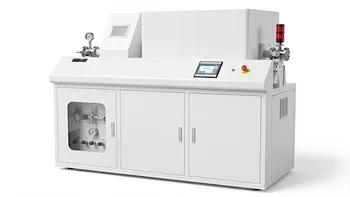
The laboratory tube furnace is the critical catalyst for achieving high-density Strontium Titanate ($SrTiO_3$) ceramics. It provides a highly controlled thermal environment, typically reaching 1425°C, paired with a specialized atmospheric system. This combination allows researchers to drive the solid-state diffusion necessary for densification while simultaneously preserving the material's delicate chemical stoichiometry through oxygen regulation.
A laboratory tube furnace enables the transformation of $SrTiO_3$ powder into a dense ceramic by providing simultaneous control over thermal kinetics and atmospheric chemistry. This dual-control is essential for achieving over 98% theoretical density and preserving the material's specific electronic and structural integrity.
Thermal Dynamics and Microstructural Evolution
Driving Diffusion and Sinter Neck Growth
The furnace provides the high-temperature environment (often ranging from 1350°C to 1425°C) necessary to initiate solid-state diffusion. This thermal energy allows nanoparticles to undergo sinter neck growth, where particles begin to bond at their contact points.
Achieving Maximum Theoretical Density
Precise temperature maintenance is the primary driver for pore migration and elimination. By sustaining these high temperatures, the furnace enables the ceramic to reach 98% or more of its theoretical density. High densification is mandatory for specimens intended for the study of grain boundary energy and electrical conductivity.
Controlling Grain Growth and Phase Formation
The furnace's thermal field determines the microstructural evolution of the ceramic. Consistent heat prevents the formation of unwanted secondary phases, such as $Sr_2TiO_4$, which can degrade the material’s microwave dielectric properties and resonant frequency stability.
Atmospheric Control and Chemical Stability
Maintaining Stoichiometry via Oxygen Flow
One of the most vital roles of a tube furnace is the ability to provide a flowing oxygen atmosphere. This constant flow inhibits reduction reactions that typically occur at high sintering temperatures. By preventing these reactions, the furnace ensures the material retains its intended chemical balance.
Managing Oxygen Defects and Valence States
In specific applications, the furnace’s sealed tube design allows for the introduction of inert or reducing gases like nitrogen or hydrogen-argon mixtures. This allows researchers to deliberately adjust oxygen defects and titanium valence states. These adjustments directly impact the electronic conductivity and surface active sites of the synthesized material.
Precision Engineering for Sintering Cycles
PID Temperature Regulation
Integrated PID control systems allow for the programming of precise heating rates, such as 2°C to 5°C per minute. This level of control is essential to ensure that precursors undergo a complete solid-state reaction without the structural cracks caused by thermal shock.
Isothermal Holding and Cooling Curves
The furnace enables sustained isothermal holding—typically for 3 to 4 hours—which provides the necessary kinetics for full grain growth. Furthermore, controlled cooling curves prevent internal stresses and ensure the structural evolution from a tetragonal to a pseudo-cubic phase is completed successfully.
Understanding the Trade-offs and Pitfalls
Atmospheric Sensitivity and Material Alteration
While a tube furnace offers atmospheric flexibility, it requires strict monitoring; an accidental shift from an oxidizing to a reducing atmosphere can transform $SrTiO_3$ from an insulator into a semiconductor. This change is often irreversible once the sintering process is complete.
Thermal Uniformity Limitations
The thermal field uniformity within the furnace tube is a critical variable. If the sample is placed outside the "hot zone," or if the tube is poorly insulated, the resulting ceramic will suffer from non-uniform grain size. This leads to inconsistent dielectric constants and weakened mechanical toughness across the sample.
Optimizing the Sintering Process for Your Project
How to Apply This to Your Research
- If your primary focus is achieving maximum specimen density: Utilize a high-precision furnace capable of sustaining 1425°C with a PID-controlled ramp-up to ensure you exceed 98% theoretical density.
- If your primary focus is maintaining dielectric purity: Prioritize a furnace setup with a continuous, regulated oxygen flow to prevent reduction and the formation of secondary phases.
- If your primary focus is electronic property modification: Leverage the furnace’s sealed environment to introduce controlled reducing atmospheres, allowing you to manipulate oxygen vacancies and conductivity.
Mastering the interplay between thermal kinetics and atmospheric chemistry within the tube furnace is the definitive step toward producing high-performance strontium titanate ceramics.
Summary Table:
| Parameter | Role in $SrTiO_3$ Sintering | Key Benefit |
|---|---|---|
| Temperature (up to 1425°C) | Drives solid-state diffusion & sinter neck growth | Achievement of >98% theoretical density |
| Atmospheric Control | Regulates oxygen flow to prevent reduction | Maintains chemical stoichiometry & dielectric purity |
| PID Regulation | Precise heating (2-5°C/min) & isothermal holds | Prevents thermal shock & ensures phase stability |
| Sealed Design | Allows inert or reducing gas introduction | Enables precise tuning of oxygen defects/conductivity |
Elevate Your Material Research with KINTEK Precision
Achieving the perfect microstructural evolution in $SrTiO_3$ ceramics requires more than just heat—it requires absolute control. KINTEK specializes in high-performance laboratory equipment, offering a comprehensive range of customizable high-temperature furnaces, including tube, muffle, vacuum, CVD, and atmosphere models.
Whether you are a researcher aiming for 98% theoretical density or a lab manager requiring reliable atmospheric regulation, our furnaces provide the PID precision and thermal uniformity your projects demand. From dental to induction melting and rotary furnaces, KINTEK delivers the tools to ensure your materials retain their critical electronic and structural integrity.
Ready to optimize your sintering cycles? Contact our technical experts today to find the ideal furnace solution for your unique laboratory needs.
References
- Vivekanand Muralikrishnan, Amanda R. Krause. Engineering grain boundary energy with thermal profiles to control grain growth in SrTiO <sub>3</sub>. DOI: 10.1111/jace.19982
This article is also based on technical information from Kintek Furnace Knowledge Base .
Related Products
- Dental Porcelain Zirconia Sintering Ceramic Vacuum Press Furnace
- Chairside Dental Porcelain Zirconia Sintering Furnace with Transformer for Ceramic Restorations
- Vacuum Dental Porcelain Sintering Furnace for Dental Laboratories
- Vacuum Hot Press Furnace Machine Heated Vacuum Press Tube Furnace
- Vertical Laboratory Quartz Tube Furnace Tubular Furnace
People Also Ask
- What factors determine the quality of sintered zirconia restorations? Master Material, Equipment, and Technique
- How do conventional vs rapid sintering in dental furnaces affect zirconia? Optimize Efficiency Without Sacrificing Strength
- What is the purpose of dental sintering furnaces? Transform Zirconia into Durable, High-Quality Dental Restorations
- What precautions should be taken when sintering zirconia in the Fast Slow Dental Sintering Furnace? Master Key Steps for Perfect Results
- What temperature range is used for sintering zirconia ceramics? Achieve Optimal Strength and Translucency