
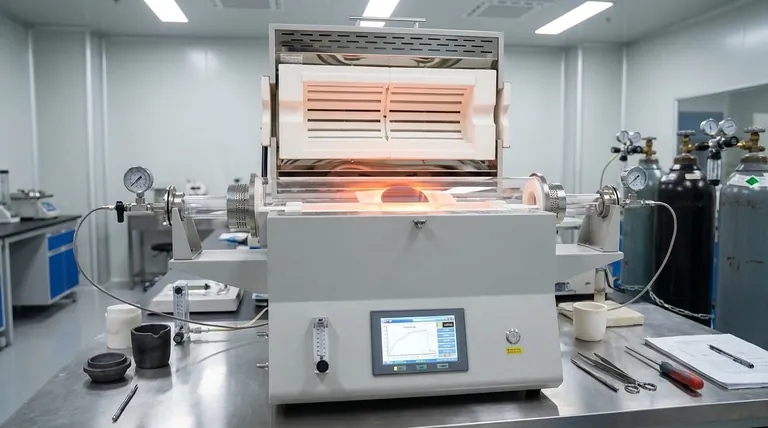
A laboratory tube diffusion furnace functions as a precise thermal reactor that facilitates pre-deposition by maintaining a stable, high-temperature environment, typically around 1000°C. By strictly controlling this thermal profile, the furnace enables the dopant source (such as phosphorus) to reach its solid solubility limit at the silicon wafer surface, thereby establishing a constant surface concentration throughout the process.
Core Insight: The furnace’s primary utility in this step is not just heating, but establishing a thermodynamic equilibrium where the silicon surface is saturated with dopants. This precise temperature control directly dictates the total quantity of atoms entering the silicon lattice, which is the mathematical foundation for determining the final junction depth.
The Mechanics of Pre-Deposition
To understand how the furnace facilitates this process, one must look beyond the heat and focus on the interaction between the dopant and the silicon lattice.
Achieving the Solid Solubility Limit
The fundamental goal of the pre-deposition step is to introduce dopant atoms into the silicon. The tube furnace creates the conditions necessary for the dopant to reach its solid solubility limit.
At this limit, the silicon surface accepts the maximum possible number of dopant atoms it can hold at that specific temperature. This creates a predictable "constant source" of dopants at the surface, which drives the diffusion process inward.
The Role of Temperature in Junction Depth
The furnace's ability to hold a specific temperature (e.g., 1000°C) is the control variable for the entire process. The temperature determines the diffusion coefficient and the maximum solubility of the dopant.
Consequently, the thermal precision of the furnace determines the total amount of phosphorus or other dopant atoms that enter the silicon lattice. This total amount is a critical factor used to calculate and control the final junction depth of the semiconductor device.
Ensuring Atmospheric Stability
Beyond temperature, the furnace provides a stable atmosphere. While supplementary applications of tube furnaces (like oxidation) rely on oxygen flow to grow SiO2 layers, the pre-deposition step relies on this stability to ensure the dopant gas flow is uniform.
This uniformity ensures that the saturation at the silicon surface is consistent across the entire wafer, preventing localized variations in electrical properties.
Understanding the Trade-offs
While the tube furnace provides a robust method for doping, relying on the solid solubility limit introduces specific constraints that must be managed.
Temperature Sensitivity
The process is highly sensitive to thermal fluctuations. Because the "total amount" of dopant is derived from the temperature-dependent solubility limit, even minor deviations in the furnace's heat profile can alter the dopant concentration.
If the furnace cannot maintain a uniform "constant-temperature zone," the junction depth will vary across the wafer, potentially leading to device failure.
The Saturation Ceiling
The pre-deposition method is inherently limited by the physics of the silicon crystal. You cannot force a surface concentration higher than the solid solubility limit for a given temperature.
If a specific device architecture requires a surface concentration higher than what silicon can accept at 1000°C, a standard thermal pre-deposition process in a tube furnace may not be sufficient without altering the thermal parameters.
Making the Right Choice for Your Goal
When configuring a laboratory tube furnace for pre-deposition, your operational parameters should be dictated by the specific physical requirements of your target device.
- If your primary focus is precise junction depth: Prioritize the calibration of the furnace's constant-temperature zone, as temperature directly dictates the diffusion rate and total dopant intake.
- If your primary focus is maximum surface concentration: Ensure your process temperature is set to the point where the specific dopant's solid solubility is highest, recognizing that this is a physical ceiling.
Ultimately, the tube furnace acts as a precision instrument that translates thermal energy into specific electrical characteristics within the silicon lattice.
Summary Table:
| Feature | Function in Pre-Deposition | Impact on Silicon Wafer |
|---|---|---|
| Temperature Stability | Maintains ~1000°C thermal profile | Ensures constant surface concentration and dopant solubility |
| Atmospheric Control | Manages uniform gas flow | Guarantees consistent dopant distribution across the entire wafer |
| Thermal Precision | Regulates diffusion coefficient | Dictates total dopant atoms and final junction depth accuracy |
| Constant-Temp Zone | Eliminates thermal fluctuations | Prevents localized variations in electrical properties |
Elevate Your Semiconductor Research with KINTEK
Precise junction depths and consistent surface concentrations start with superior thermal control. Backed by expert R&D and manufacturing, KINTEK offers high-performance Tube, Muffle, Vacuum, and CVD systems—all fully customizable to meet the rigorous demands of your silicon wafer processing.
Don't let thermal fluctuations compromise your device architecture. Partner with KINTEK for laboratory high-temperature furnaces designed for peak stability and reliability.
Contact our experts today to find your custom furnace solution!
Visual Guide

References
- Jyotirmoy Sarker. Investigating Diffusion in Silicon Wafers: A Study of Doping and Sheet Resistance Measurement.. DOI: 10.21203/rs.3.rs-7884440/v1
This article is also based on technical information from Kintek Furnace Knowledge Base .
Related Products
- 1400℃ High Temperature Laboratory Tube Furnace with Alumina Tube
- Laboratory Vacuum Tilt Rotary Tube Furnace Rotating Tube Furnace
- 1700℃ High Temperature Laboratory Tube Furnace with Alumina Tube
- Vertical Laboratory Quartz Tube Furnace Tubular Furnace
- Laboratory Quartz Tube Furnace RTP Heating Tubular Furnace
People Also Ask
- How does zone-melting in tube furnaces synthesize bismuth micro-wires? Master Single-Crystal Thermoelectric Growth
- How are high-temp tube furnaces used to measure diffusion coefficients per Fick's law? Master Precision Annealing
- How are high-temperature laboratory tube furnaces applied in long-term vacuum homogenization heat treatments for intermetallic samples?
- How do high-temperature laboratory tube furnaces ensure environmental stability? Precision Thermal Reduction Tips
- How are high-temperature tube furnaces applied in testing ceramic-supported alloy membranes? Insights



















