
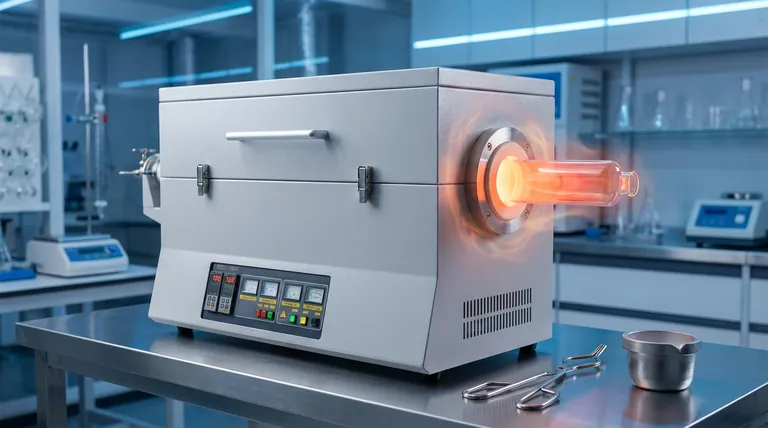
A laboratory high-temperature tube resistance furnace functions as the critical control environment for the aging treatment of Ni-W-Co-Ta alloys. Specifically, it maintains a precise, isothermal environment at 700°C to facilitate the controlled precipitation of strengthening phases in the alloy following cold rolling operations.
Core Insight: The furnace’s primary value lies in its ability to provide a uniform thermal field that drives the precipitation of the Ni4W phase. By maintaining strict temperature stability, it allows operators to systematically tune the alloy's hardness and strength by varying holding times between 2 and 32 hours.
The Mechanism of Property Enhancement
Precise Isothermal Control
The fundamental requirement for aging Ni-W-Co-Ta alloys is a stable thermal environment.
The tube resistance furnace is designed to maintain a constant temperature of 700°C.
This stability is essential to ensure that the recovery processes and chemical reactions within the alloy occur at a predictable, constant rate.
Regulation of the Strengthening Phase
The aging process is driven by the precipitation of the Ni4W strengthening phase.
Inside the uniform thermal field of the furnace, the supersaturated solid solution formed during previous processing steps begins to decompose.
This results in the nucleation and growth of Ni4W precipitates, which are directly responsible for the material's enhanced mechanical properties.
Tuning via Holding Time
The furnace allows for the precise manipulation of "holding time," which is the duration the alloy remains at 700°C.
According to experimental data, this duration ranges from 2 hours to 32 hours.
By adjusting this variable, researchers can control the volume fraction and size of the Ni4W precipitates, thereby customizing the final hardness and strength of the material to meet specific requirements.
Understanding Process Distinctions
Aging vs. Melting
It is critical to distinguish the role of the tube furnace from other equipment in the alloy's lifecycle.
While a Vacuum Induction Melting (VIM) furnace is used for the initial melting and alloying to prevent oxidation of reactive elements like Tungsten (W) and Tantalum (Ta), the tube furnace is strictly for solid-state heat treatment.
Attempting to use a standard tube resistance furnace for melting these high-melting-point alloys would be ineffective and potentially damaging to the equipment.
The Necessity of Uniformity
The "tube" design of the furnace is not arbitrary; it promotes a highly uniform thermal field.
If the temperature were to fluctuate across the length of the sample, the precipitation of the Ni4W phase would be inconsistent.
This would lead to heterogeneous mechanical properties, where some sections of the alloy are harder or more brittle than others.
Optimization Strategy for Material Performance
If your primary focus is Maximizing Strength:
- Utilize the furnace to test the upper limits of the holding time (approaching 32 hours) to maximize the volume fraction of the Ni4W phase, provided coarsening does not occur.
If your primary focus is Process Efficiency:
- Conduct tests at the lower end of the time spectrum (starting at 2 hours) to identify the earliest point at which the Ni4W precipitation yields acceptable hardness, minimizing energy consumption.
If your primary focus is Alloy Purity:
- Ensure the precursor material was processed in a VIM furnace to remove volatile impurities before entering the tube furnace for aging.
Precision in thermal regulation is the single most important factor in translating raw alloy potential into reliable mechanical performance.
Summary Table:
| Parameter | Specification/Role |
|---|---|
| Target Temperature | 700°C (Isothermal Control) |
| Holding Time Range | 2 to 32 Hours |
| Key Mechanism | Precipitation of Ni4W Strengthening Phase |
| Primary Goal | Enhanced Hardness & Mechanical Strength |
| Equipment Type | High-Temperature Tube Resistance Furnace |
Elevate Your Material Research with KINTEK Precision
Unlock the full potential of your Ni-W-Co-Ta alloys with KINTEK’s high-performance laboratory furnaces. Backed by expert R&D and world-class manufacturing, we provide high-temperature Tube, Muffle, Rotary, Vacuum, and CVD systems tailored for precise thermal regulation and uniform heat distribution.
Whether you are tuning precipitation phases or optimizing mechanical strength, our customizable systems ensure your research is supported by industry-leading stability.
Ready to optimize your heat treatment process? Contact our technical experts today to find the perfect furnace solution for your unique laboratory needs.
References
- Yong Li, Chunxu Wang. Effect of Aging Time on Microstructure and Properties of Cold-Rolled Ni-W-Co-Ta Medium–Heavy Alloy. DOI: 10.3390/coatings14020230
This article is also based on technical information from Kintek Furnace Knowledge Base .
Related Products
- 1700℃ High Temperature Laboratory Tube Furnace with Alumina Tube
- 1400℃ High Temperature Laboratory Tube Furnace with Alumina Tube
- 1200℃ Split Tube Furnace Laboratory Quartz Tube Furnace with Quartz Tube
- Vertical Laboratory Quartz Tube Furnace Tubular Furnace
- 1200℃ Muffle Oven Furnace for Laboratory
People Also Ask
- How does zone-melting in tube furnaces synthesize bismuth micro-wires? Master Single-Crystal Thermoelectric Growth
- How are high-temperature laboratory tube furnaces applied in long-term vacuum homogenization heat treatments for intermetallic samples?
- How do high-temperature laboratory tube furnaces ensure environmental stability? Precision Thermal Reduction Tips
- How are high-temp tube furnaces used to measure diffusion coefficients per Fick's law? Master Precision Annealing
- How are high-temperature tube furnaces applied in testing ceramic-supported alloy membranes? Insights



















