
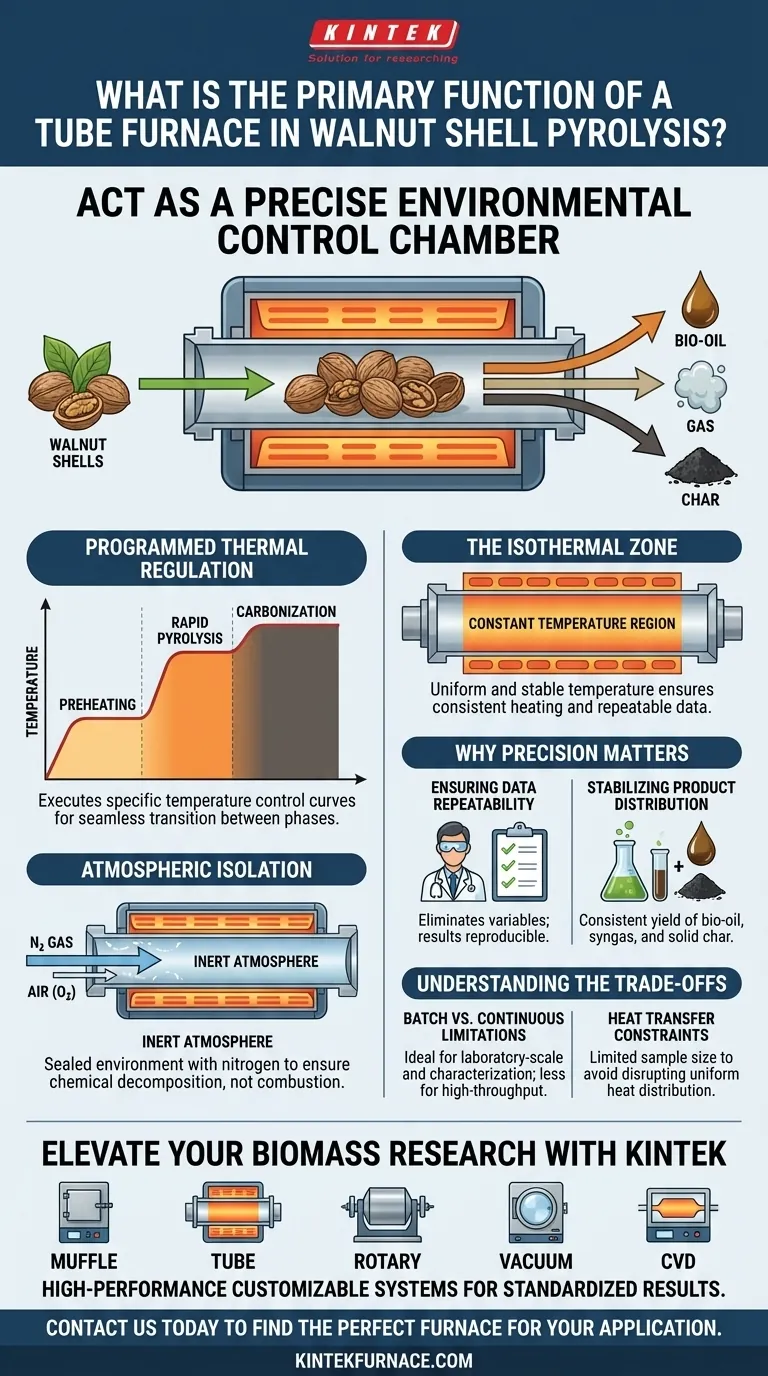
The primary function of a tube furnace in walnut shell pyrolysis is to act as a precise environmental control chamber. It facilitates the complete thermochemical transformation of the biomass by maintaining a programmed high-temperature profile within a nitrogen atmosphere. This equipment manages every stage of the process—including preheating, rapid pyrolysis, and carbonization—to ensure the reaction occurs under strictly regulated conditions.
The tube furnace is not merely a heat source; it is the instrument of standardization. By creating a constant isothermal zone, it guarantees the repeatability of experimental data and ensures the stable distribution of end products like bio-oil, gas, and char.
The Mechanics of Controlled Transformation
Programmed Thermal Regulation
The tube furnace goes beyond simple heating by executing a specific, programmed temperature control curve. This allows for the seamless transition between critical phases: preheating the biomass, initiating rapid pyrolysis, and sustaining carbonization. The ability to ramp temperature at specific rates is essential for influencing how the walnut shells decompose.
Atmospheric Isolation
To achieve pyrolysis rather than combustion, the reaction must occur in the absence of oxygen. The tube furnace creates a sealed environment where nitrogen gas is introduced to displace air. This inert atmosphere ensures that the walnut shells undergo thermal decomposition chemically, rather than burning physically.
The Isothermal Zone
A critical feature of the tube furnace is the creation of a constant temperature isothermal zone. Within this specific region of the tube, the temperature is uniform and stable. This ensures that the entire sample of walnut shells is subjected to the exact same thermal energy, preventing uneven processing or incomplete reactions.
Why Precision Matters for Biomass
Ensuring Data Repeatability
In scientific experimentation, results must be reproducible to be valid. The tube furnace eliminates variables by strictly controlling the heating rate and peak temperature. This allows researchers to attribute changes in the output solely to the material properties of the walnut shells, rather than fluctuations in the equipment.
Stabilizing Product Distribution
The yield of bio-oil, syngas, and solid char is highly sensitive to temperature fluctuations. By maintaining strict thermal stability, the tube furnace ensures a consistent distribution of these products. This stability is required to characterize the material accurately or to optimize the process for a specific product, such as high-quality biochar.
Understanding the Trade-offs
Batch vs. Continuous Limitations
While tube furnaces offer exceptional control, they are typically designed for batch or semi-continuous processing. This makes them ideal for laboratory-scale experiments and material characterization but less suitable for high-throughput industrial production without modification.
Heat Transfer Constraints
The reliance on conductive and radiative heat transfer within a tube means that sample size is limited. Overloading the tube can disrupt the uniform heat distribution, leading to thermal gradients within the biomass sample that compromise the data.
Making the Right Choice for Your Goal
To maximize the utility of a tube furnace for biomass pyrolysis, consider your specific objectives:
- If your primary focus is Fundamental Research: Prioritize the precision of the programmed temperature control to isolate specific reaction kinetics and ensure data reproducibility.
- If your primary focus is Material Engineering: Focus on the atmosphere control and isothermal stability to optimize the pore structure and carbonization degree of the resulting char.
The tube furnace is the defining tool for converting raw biomass into standardized, analyzable data and materials.
Summary Table:
| Feature | Function in Biomass Pyrolysis | Benefit to Research |
|---|---|---|
| Programmed Heating | Executes specific temperature ramps | Enables precise control over decomposition kinetics |
| Atmospheric Control | Displaces oxygen with inert nitrogen | Prevents combustion to ensure pure thermochemical pyrolysis |
| Isothermal Zone | Maintains a uniform temperature region | Ensures consistent heating and repeatable experimental data |
| Process Management | Controls preheating and carbonization | Optimizes the yield of bio-oil, syngas, and biochar |
Elevate Your Biomass Research with KINTEK
Maximize the precision of your thermochemical transformations with KINTEK’s industry-leading thermal solutions. Backed by expert R&D and manufacturing, KINTEK offers high-performance Muffle, Tube, Rotary, Vacuum, and CVD systems—all fully customizable to meet the unique demands of your lab. Whether you are optimizing biochar quality or analyzing reaction kinetics, our furnaces provide the isothermal stability and atmospheric control necessary for standardized results.
Ready to standardize your experimental data? Contact us today to find the perfect furnace for your application.
Visual Guide
References
- Wenjing He, Yibo Zhao. Catalytic pyrolysis and <i>in situ</i> carbonization of walnut shells: poly-generation and enhanced electrochemical performance of carbons. DOI: 10.1039/d4ra01608d
This article is also based on technical information from Kintek Furnace Knowledge Base .
Related Products
- Electric Rotary Kiln Small Rotary Furnace Biomass Pyrolysis Plant Rotating Furnace
- Electric Rotary Kiln Continuous Working Small Rotary Furnace Kiln for Pyrolysis Plant Heating
- Electric Rotary Kiln Pyrolysis Furnace Plant Machine Small Rotary Kiln Calciner
- Vertical Laboratory Quartz Tube Furnace Tubular Furnace
- High Pressure Laboratory Vacuum Tube Furnace
People Also Ask
- What are the main applications of a rotary kiln electric furnace? Achieve Uniform Heat Treatment for Powders
- What are the key components of a rotary kiln electric furnace? Unlock Efficient Thermal Processing
- What is the significance of the refractory lining in a rotary kiln electric furnace? Unlock Efficiency and Longevity
- What is the benefit of adjustable speed control in rotary kilns? Optimize Efficiency and Quality
- What are the main advantages of using rotary kilns for bulk solids processing? Achieve High-Volume, Uniform Thermal Processing



















