
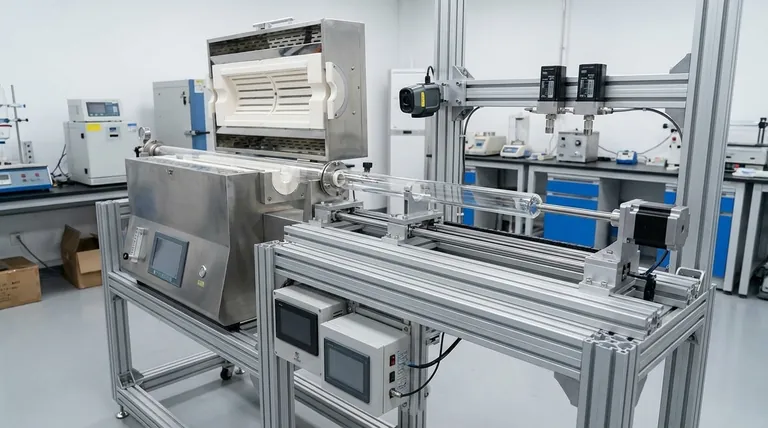
Industrial-grade aluminum profiles provide a robust and highly adaptable structural foundation for tube furnace systems. They deliver immediate mechanical stability while offering versatile mounting interfaces for essential components such as linear drive shafts, quartz tube supports, and electronic control units.
The core value of this material system is its modularity; standard T-slots enable precise adjustments and the seamless integration of new instruments, allowing the framework to evolve alongside your experimental requirements.
Engineering a Stable Platform
Mechanical Integrity
The profiles create a stable mechanical base, ensuring that the heavy and sensitive components of a furnace system remain secure during operation. This rigidity is critical for maintaining the alignment of the heating zone and the sample carrier.
Optimized Component Integration
The design specifically accommodates mounting interfaces for linear drive shafts and quartz tube supports without requiring complex custom fabrication. This streamlines the assembly process for the core mechanics of the furnace.
The Advantage of Modularity
Standardized T-Slots
The inclusion of standard T-slots acts as a universal interface for hardware and fasteners. This feature eliminates the need for drilling or welding when adding new components to the frame.
Adjustable Spans
Researchers can easily perform adjustments of support spans to accommodate tubes of different lengths or diameters. This flexibility is essential for labs that run various types of thermal experiments using a single infrastructure.
Scalability for Experimental Needs
Integrating Auxiliary Devices
The framework easily supports the addition of peripheral tools, such as sensors or cameras, for real-time process monitoring. These devices can be mounted anywhere along the profile grooves for optimal positioning.
Future-Proofing the Setup
This high level of customization and scalability ensures the setup remains useful as experimental parameters change. You can expand or reconfigure the electronic control boxes and physical supports without discarding the original frame.
Understanding the Trade-offs
Assembly Precision
While modularity is a strength, achieving perfect alignment requires careful assembly compared to pre-welded structures. You must ensure all connections are squared properly during the build to prevent binding in linear drive shafts.
Maintenance of Connections
Unlike welded steel frames, bolted T-slot connections can loosen over time if subjected to vibration. Regular checks of the fasteners are necessary to maintain the mechanical stability of the system.
Making the Right Choice for Your Project
To determine if aluminum profiles are the right fit for your tube furnace application, consider your operational goals:
- If your primary focus is Research and Development: Choose aluminum profiles for their adaptability, allowing you to frequently change tube sizes and add sensors without rebuilding the frame.
- If your primary focus is Heavy Industrial Production: Evaluate if the bolted connections provide sufficient permanent rigidity, or if a hybrid approach with welded steel bases is required for extreme loads.
Leveraging modular aluminum profiles transforms your furnace framework from a static structure into a dynamic experimental tool.
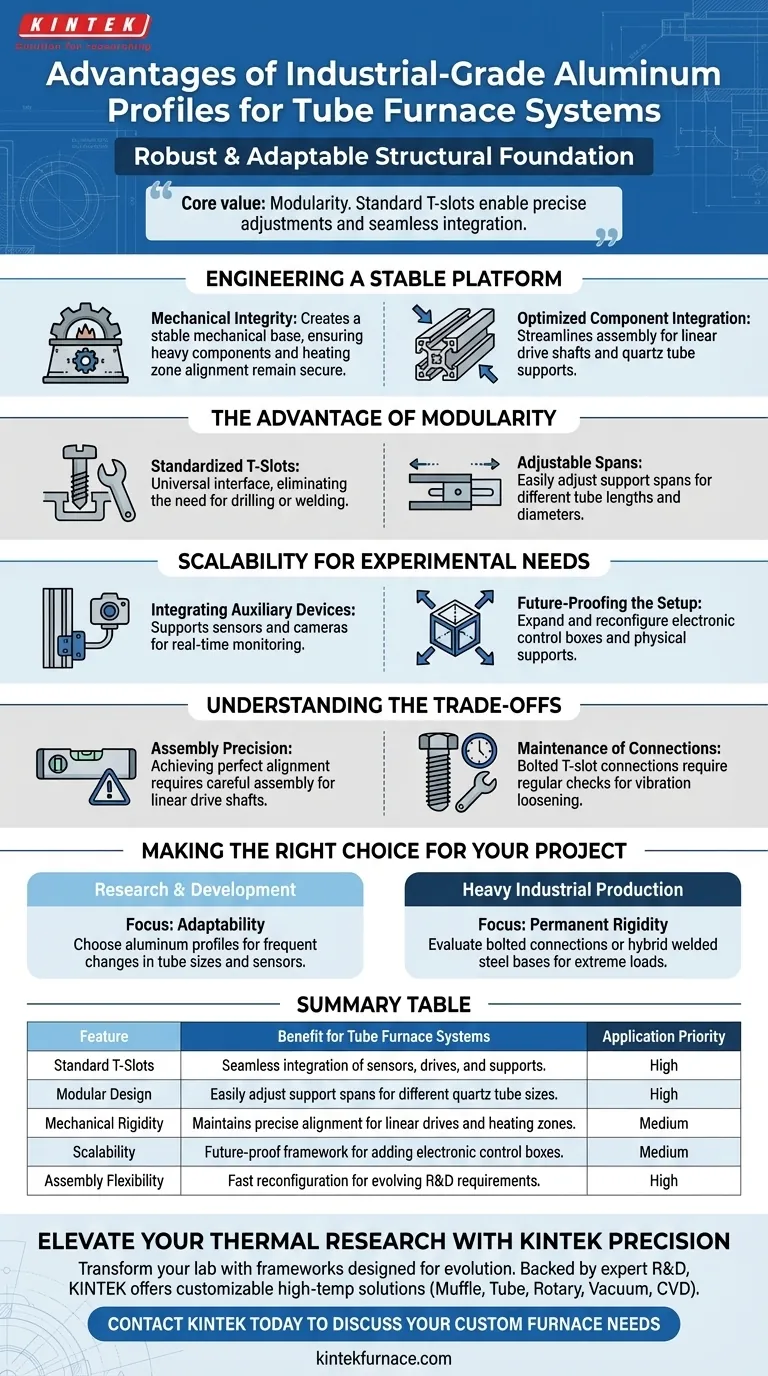
Summary Table:
| Feature | Benefit for Tube Furnace Systems | Application Priority |
|---|---|---|
| Standard T-Slots | Seamless integration of sensors, drives, and supports without welding. | High |
| Modular Design | Easily adjust support spans for different quartz tube sizes. | High |
| Mechanical Rigidity | Maintains precise alignment for linear drives and heating zones. | Medium |
| Scalability | Future-proof framework for adding electronic control boxes and cameras. | Medium |
| Assembly Flexibility | Fast reconfiguration for evolving R&D experimental requirements. | High |
Elevate Your Thermal Research with KINTEK Precision
Transform your laboratory setup with frameworks designed for evolution. Backed by expert R&D and manufacturing, KINTEK offers high-performance Muffle, Tube, Rotary, Vacuum, and CVD systems, all fully customizable to meet your unique experimental needs. Whether you require the modular adaptability of aluminum profiles for R&D or the robust stability of heavy industrial production, our engineering team is ready to deliver the perfect high-temp solution.
Ready to build a more flexible and efficient lab?
Contact KINTEK Today to Discuss Your Custom Furnace Needs
Visual Guide
References
- Casey Coffland, Elliott T. Gall. An open-source linear actuated-quartz tube furnace with programmable ceramic heater movement for laboratory-scale studies of combustion and emission. DOI: 10.2139/ssrn.5687995
This article is also based on technical information from Kintek Furnace Knowledge Base .
Related Products
- Vacuum Sealed Continuous Working Rotary Tube Furnace Rotating Tube Furnace
- 1400℃ High Temperature Laboratory Tube Furnace with Alumina Tube
- 1700℃ High Temperature Laboratory Tube Furnace with Alumina Tube
- Magnesium Extraction and Purification Condensing Tube Furnace
- High Pressure Laboratory Vacuum Tube Furnace
People Also Ask
- What is the purpose of rotary tube furnaces? Achieve Uniform Heat Treatment for Powders and Granules
- What are the key advantages of using a rotary tube furnace? Achieve Dynamic, Uniform Heating for Powders
- How does the amount of material processed vary between batch and continuous rotary tube furnaces? Scale Your Production Efficiently
- What are the advantages of rotary tube furnaces in fuel compatibility? Boost Efficiency and Cut Costs
- What is the temperature range of some rotary tube furnaces? Achieve Uniform Heating Up to 1200°C



















