
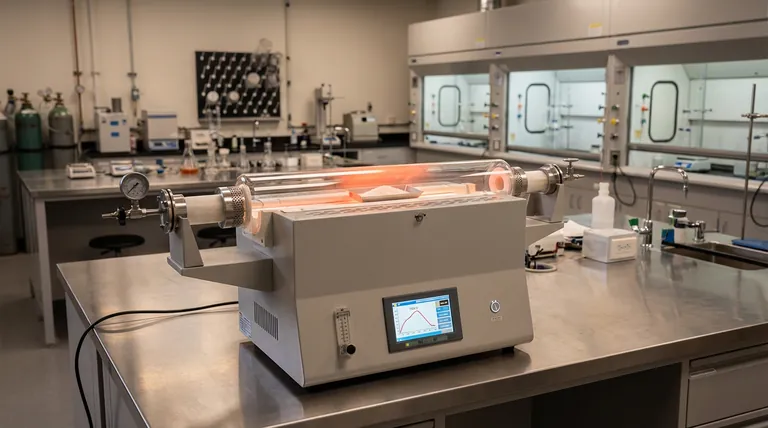
A horizontal tube furnace acts as a precision instrument for the single-step annealing of BZSM nanophosphors by maintaining a stable air atmosphere within a strict temperature range of 700 to 1000 °C. Its primary role is to provide a uniform thermal field that enables partial crystallization, allowing the synthesis process to be halted at the exact moment the material reaches its desired metastable state.
Success in BZSM synthesis relies on arresting the crystallization process before it completes. The tube furnace provides the thermal stability required to "lock" the material in the metastable beta-phase, preventing its conversion into the stable but unwanted alpha-phase.
The Challenge of Metastability
Nature of Beta-Phase Zinc Silicate
The beta-phase of zinc silicate (BZSM) is metastable, meaning it is thermodynamically unstable compared to the alpha-phase.
Without precise intervention, the material naturally tends to transform completely into the more stable alpha-phase during heating.
The Goal of Partial Crystallization
To successfully synthesize BZSM nanophosphors, you must achieve partial crystallization.
This process requires heating the precursor enough to form the crystalline structure but stopping the energy input before the phase transformation goes too far.
Mechanism of Furnace Control
Stable Thermal Field
The horizontal tube furnace provides a highly consistent thermal field distribution throughout the heating zone.
This uniformity ensures that the entire sample is subjected to the exact same temperature conditions (700 to 1000 °C), eliminating hot spots that could trigger unwanted phase changes.
Precise Time Regulation
The furnace allows for exacting control over the duration of the anneal, which typically ranges from 3 to 20 minutes.
This short, defined timeframe is the critical variable that allows you to "lock" the material in the beta-phase before the transition to the alpha-phase occurs.
Understanding the Trade-offs
The Risk of Phase Conversion
The primary trade-off in this process is the narrow margin for error regarding time and temperature.
If the annealing time exceeds the 20-minute upper limit or the thermal field fluctuates, the material will likely convert to the alpha-phase.
Once this conversion happens, the unique properties of the metastable BZSM nanophosphors are lost, and the process cannot be reversed.
Optimization for Your Synthesis Goals
To effectively utilize a horizontal tube furnace for BZSM synthesis, apply the following parameters:
- If your primary focus is phase purity: Strictly monitor the annealing duration, keeping it within the 3 to 20-minute window to effectively freeze the metastable state.
- If your primary focus is reproducibility: Calibrate the furnace to ensure the thermal field is perfectly stable between 700 and 1000 °C to prevent localized alpha-phase contamination.
Precise thermal interruption is the only way to secure the metastable beta-phase structure.
Summary Table:
| Parameter | Range/Target | Purpose |
|---|---|---|
| Temperature Range | 700 - 1000 °C | Ensure partial crystallization of nanophosphors |
| Annealing Duration | 3 - 20 Minutes | Arrest crystallization to lock metastable beta-phase |
| Thermal Atmosphere | Stable Air | Maintains sample integrity during heat treatment |
| Critical Phase | Metastable Beta-Phase | Prevents conversion to unwanted alpha-phase |
Unlock Precision in Your Nanomaterial Synthesis
Achieving the perfect metastable state requires more than just heat—it requires absolute thermal stability. Backed by expert R&D and manufacturing, KINTEK offers high-performance Horizontal Tube, Muffle, Vacuum, and CVD systems designed to meet the rigorous demands of material science.
Whether you are synthesizing BZSM nanophosphors or developing next-generation ceramics, our customizable lab high-temp furnaces provide the uniform thermal field needed to ensure reproducibility and phase purity.
Ready to elevate your lab's capabilities? Contact KINTEK today to discuss your unique synthesis needs with our technical team.
References
- Mohammad M. Afandi, Jongsu Kim. Bright Yellow Luminescence from Mn2+-Doped Metastable Zinc Silicate Nanophosphor with Facile Preparation and Its Practical Application. DOI: 10.3390/nano14171395
This article is also based on technical information from Kintek Furnace Knowledge Base .
Related Products
- Vertical Laboratory Quartz Tube Furnace Tubular Furnace
- 1700℃ High Temperature Laboratory Tube Furnace with Alumina Tube
- Vacuum Sealed Continuous Working Rotary Tube Furnace Rotating Tube Furnace
- Split Multi Heating Zone Rotary Tube Furnace Rotating Tube Furnace
- Laboratory Vacuum Tilt Rotary Tube Furnace Rotating Tube Furnace
People Also Ask
- What are the key differences between single-zone and multi-zone vertical tube furnaces? Choose the Right Furnace for Your Lab
- What makes a vertical tube furnace easy to operate? Discover Intuitive Automation for Precision Heating
- What physical conditions does a vertical tube furnace provide for desulfurization experiments? Precision Heat Control
- How does a vertical tube furnace achieve precise temperature control? Unlock Superior Thermal Stability for Your Lab
- How do heat treatment processes influence the configuration of a vertical tube furnace? Optimize for Quenching, Annealing, and More



















