
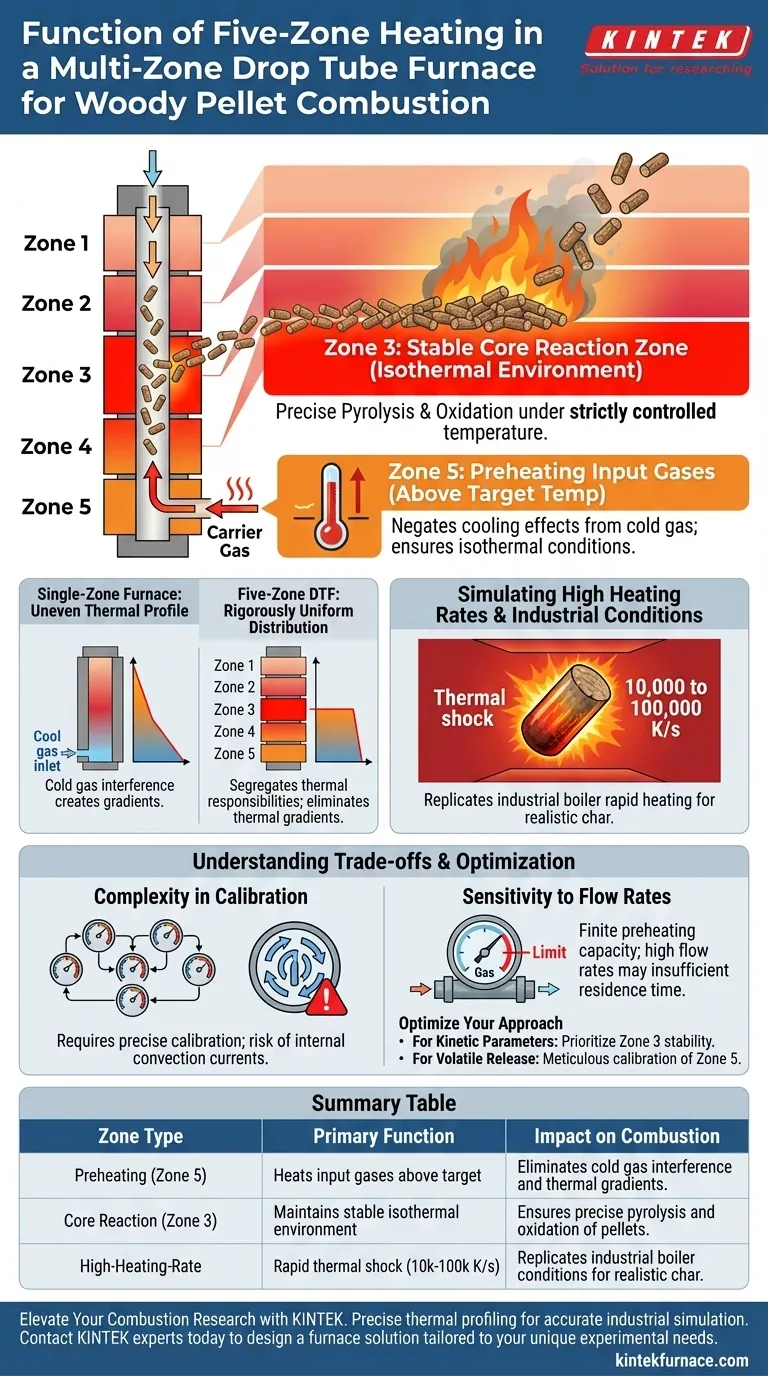
The five-zone heating layout functions primarily to establish a rigorously uniform temperature distribution across the reactor by segregating thermal responsibilities. It utilizes specific zones, such as Zone 5, to preheat input gases above the experimental target to negate cooling effects, while creating a stable, isothermal environment in central zones (like Zone 3) for the precise pyrolysis and oxidation of woody pellets.
The multi-zone configuration is designed to decouple gas heating from the reaction environment. By pre-conditioning gases before they reach the sample, the system eliminates thermal gradients, ensuring the fuel particles undergo combustion under the strictly controlled, high-heating-rate conditions required to mimic industrial boilers.
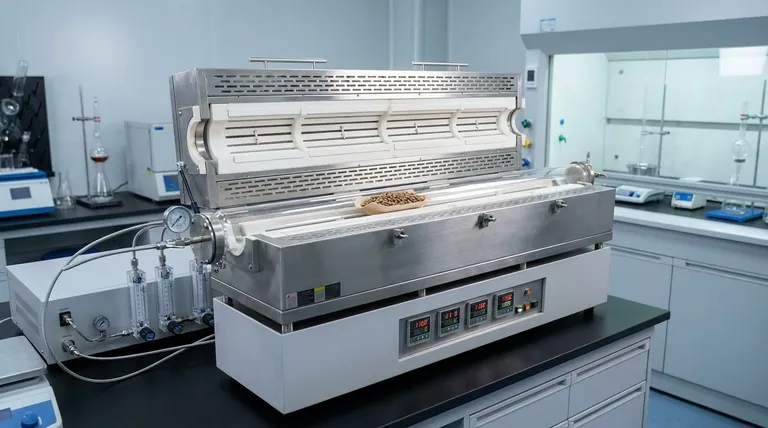
Achieving Thermal Precision in Combustion
The Drop Tube Furnace (DTF) is not merely a heater; it is a simulator for the extreme conditions found in industrial power plants. The five-zone layout is the mechanism that allows this simulation to be accurate and repeatable.
Eliminating Cold Gas Interference
In single-zone furnaces, introducing carrier gases can lower the temperature at the inlet, creating an uneven thermal profile. The five-zone layout addresses this by designating specific areas, such as Zone 5, for preheating.
By heating input gases to a temperature slightly higher than the target experimental temperature, the system compensates for potential heat loss. This ensures that when the gas stream reaches the reaction area, it does not act as a coolant.
Creating a Stable Core Reaction Zone
The central section of the furnace, typically Zone 3, functions as the primary reaction chamber. Because the gases entering this zone are already thermally equilibrated, Zone 3 maintains a highly stable thermal environment.
This stability is critical for observing the behavior of woody pellets. It ensures that the pyrolysis and oxidation processes occur under controlled isothermal conditions, unaffected by external fluctuations or thermal shock from cold air.
Simulating High Heating Rates
The ultimate goal of this thermal stability is to replicate the rapid heating rates of industrial boilers. Within the stable environment of the core zone, particles experience heating rates as high as 10,000 to 100,000 K/s.
This intense thermal shock drives rapid devolatilization and char oxidation. The five-zone layout ensures that these rates are achieved consistently, allowing researchers to produce char that closely resembles that of actual industrial combustion.
Understanding the Trade-offs
While a five-zone layout offers superior precision, it introduces complexity into the experimental setup.
Complexity in Calibration
Achieving a perfectly flat temperature profile requires the precise calibration of five independent heating elements. If the interaction between zones is not carefully managed, you may inadvertently create internal convection currents that disturb the laminar flow required for accurate particle trajectory.
Sensitivity to Flow Rates
The preheating capacity of zones like Zone 5 is finite. If the experiment requires exceptionally high gas flow rates, the residence time in the preheating zone may be insufficient, potentially reintroducing thermal gradients into the core reaction zone.
Optimizing Your Experimental Approach
To leverage the full potential of a five-zone Drop Tube Furnace, align your configuration with your specific research objectives.
- If your primary focus is determining kinetic parameters: Prioritize the stability of Zone 3, ensuring the temperature deviation is negligible to validate thermogravimetric indices.
- If your primary focus is studying volatile release: meticulous calibration of Zone 5 is essential to ensure gases are fully preheated, guaranteeing that ignition occurs exactly when the particle enters the reaction zone.
The five-zone layout is the difference between simply burning a sample and accurately simulating the physics of industrial power generation.
Summary Table:
| Zone Type | Primary Function | Impact on Combustion |
|---|---|---|
| Preheating (Zone 5) | Heats input gases above target | Eliminates cold gas interference and thermal gradients. |
| Core Reaction (Zone 3) | Maintains stable isothermal environment | Ensures precise pyrolysis and oxidation of pellets. |
| High-Heating-Rate | Rapid thermal shock (10k-100k K/s) | Replicates industrial boiler conditions for realistic char. |
Elevate Your Combustion Research with KINTEK
Precise thermal profiling is the cornerstone of accurate industrial simulation. Backed by expert R&D and world-class manufacturing, KINTEK provides high-performance Muffle, Tube, Rotary, Vacuum, and CVD systems, including sophisticated multi-zone Drop Tube Furnaces. Our systems are fully customizable to meet the rigorous demands of your woody pellet and fuel research.
Ready to eliminate thermal gradients in your lab? Contact KINTEK experts today to design a furnace solution tailored to your unique experimental needs.
Visual Guide
References
- Guillaume Gerandi, Valérie Tschamber. Particulate and gaseous emissions during combustion of wood pellets under low and high heating rates in a drop tube furnace. DOI: 10.2139/ssrn.5600417
This article is also based on technical information from Kintek Furnace Knowledge Base .
Related Products
- Vacuum Sealed Continuous Working Rotary Tube Furnace Rotating Tube Furnace
- Slide PECVD Tube Furnace with Liquid Gasifier PECVD Machine
- Custom Made Versatile CVD Tube Furnace Chemical Vapor Deposition CVD Equipment Machine
- 1200℃ Split Tube Furnace Laboratory Quartz Tube Furnace with Quartz Tube
- Laboratory Vacuum Tilt Rotary Tube Furnace Rotating Tube Furnace
People Also Ask
- What is the purpose of rotary tube furnaces? Achieve Uniform Heat Treatment for Powders and Granules
- What are the key advantages of using a rotary tube furnace? Achieve Dynamic, Uniform Heating for Powders
- How does the amount of material processed vary between batch and continuous rotary tube furnaces? Scale Your Production Efficiently
- What are the advantages of rotary tube furnaces in fuel compatibility? Boost Efficiency and Cut Costs
- What is the temperature range of some rotary tube furnaces? Achieve Uniform Heating Up to 1200°C



















