
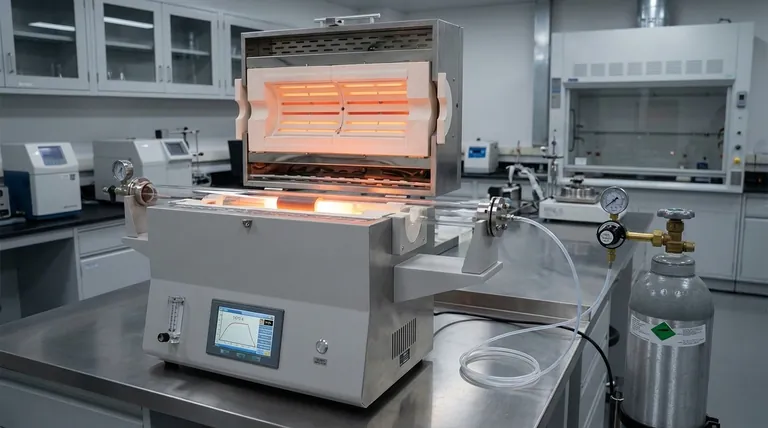
Tube resistance and high-temperature box furnaces guarantee Fe60 alloy quality by combining ultra-precise thermal cycling with controlled atmospheric isolation. Specifically, these furnaces maintain a uniform temperature of 1473 K for extended periods (typically 6 hours) to force complete elemental diffusion, while shielding the material with a low-flow argon atmosphere to prevent oxidation and decarburization.
Core Insight: Success in treating Fe60 alloys relies on the synchronization of thermal stability and atmospheric purity. These furnaces provide the strict environment necessary for recrystallization and diffusion without the risk of surface contamination or structural inconsistencies.
The Role of Precise Temperature Control
Facilitating Complete Diffusion
For Fe60 alloys, achieving material homogeneity is the primary goal.
The furnace must maintain a specific soak temperature, such as 1473 K, for an extended duration of roughly 6 hours. This sustained heat energy allows the alloy components to diffuse fully throughout the matrix.
Ensuring Uniform Heating
Inconsistencies in the thermal profile can lead to weak points in the final material.
Tube and box furnaces differ from standard ovens by providing a uniform temperature field. This ensures that every part of the Fe60 sample experiences the exact same thermal history, preventing gradients that could cause localized stress or incomplete phase changes.
Regulating Recrystallization
The heat treatment process drives the recrystallization of the alloy's microstructure.
By adhering to specific temperature curves, the furnace allows the internal structure of the metal to reorganize. This improves mechanical properties such as hardness and toughness by eliminating defects introduced during prior processing.
The Importance of Atmospheric Protection
Preventing Oxidation
Fe60 alloys are susceptible to reacting with oxygen at high temperatures.
To combat this, these furnaces utilize a low-flow argon atmosphere. This creates an inert environment that effectively blocks oxygen from contacting the metal surface, preserving the material's integrity.
Eliminating Decarburization
Beyond simple oxidation, carbon loss (decarburization) is a critical risk that softens the alloy's surface.
The controlled atmosphere ensures the chemical composition of the surface remains identical to the core. This is essential for maintaining the wear resistance and hardness expected from Fe60 alloys.
Understanding the Trade-offs
Soak Time vs. Grain Growth
While a 6-hour soak at 1473 K ensures diffusion, it pushes the material toward its thermal limits.
If the furnace temperature drifts even slightly higher, you risk excessive grain coarsening. Large grains can reduce the material's yield strength, making the precision of the furnace controller (often PID-based) absolutely critical.
Atmosphere Sensitivity
The quality of the result is entirely dependent on the integrity of the furnace seal and gas flow.
Even a minor leak or interruption in the low-flow argon supply will lead to immediate surface degradation. The "low-flow" nature requires precise metering; too high a flow can cause turbulence or cooling, while too low fails to purge impurities.
Making the Right Choice for Your Goal
To maximize the performance of your Fe60 alloy, align your furnace settings with your specific mechanical requirements.
- If your primary focus is Compositional Homogeneity: Prioritize the duration and stability of the soak phase (e.g., 6 hours at 1473 K) to ensure full diffusion.
- If your primary focus is Surface Hardness: Focus heavily on the integrity of the argon atmosphere to prevent any decarburization of the surface layer.
- If your primary focus is Structural Toughness: Ensure strict adherence to programmable ramp rates to control the rate of recrystallization and avoid thermal shock.
True material quality is achieved when the furnace acts not just as a heater, but as a precision instrument for microstructural engineering.
Summary Table:
| Feature | Parameter for Fe60 | Impact on Material Quality |
|---|---|---|
| Soak Temperature | 1473 K | Facilitates complete elemental diffusion and homogeneity |
| Soak Duration | ~6 Hours | Ensures uniform internal structure and recrystallization |
| Atmosphere | Low-flow Argon | Prevents surface oxidation and critical decarburization |
| Control System | High-precision PID | Prevents excessive grain coarsening and thermal drift |
Elevate Your Material Engineering with KINTEK
Precise heat treatment is the difference between an average alloy and a high-performance material. Backed by expert R&D and manufacturing, KINTEK offers high-precision Muffle, Tube, Rotary, Vacuum, and CVD systems, all customizable to meet the rigorous demands of Fe60 alloy processing.
Whether you need absolute atmospheric purity or strict 1473 K thermal stability, our laboratory high-temperature furnaces provide the reliability your research requires. Contact our technical experts today to discuss your custom furnace solution and ensure the integrity of your next project.
References
- Yemao Lu, Yulia Ivanisenko. Overcoming plasticity reduction in a severely deformed nano-grained metastable alloy. DOI: 10.1080/21663831.2024.2356761
This article is also based on technical information from Kintek Furnace Knowledge Base .
Related Products
- 1700℃ High Temperature Laboratory Tube Furnace with Alumina Tube
- 1400℃ High Temperature Laboratory Tube Furnace with Alumina Tube
- Laboratory Quartz Tube Furnace RTP Heating Tubular Furnace
- 2200 ℃ Graphite Vacuum Heat Treat Furnace
- Vacuum Heat Treat Furnace with Ceramic Fiber Liner
People Also Ask
- How does zone-melting in tube furnaces synthesize bismuth micro-wires? Master Single-Crystal Thermoelectric Growth
- How are high-temperature laboratory tube furnaces applied in long-term vacuum homogenization heat treatments for intermetallic samples?
- How are high-temp tube furnaces used to measure diffusion coefficients per Fick's law? Master Precision Annealing
- How do high-temperature laboratory tube furnaces ensure environmental stability? Precision Thermal Reduction Tips
- How are high-temperature tube furnaces applied in testing ceramic-supported alloy membranes? Insights


















