
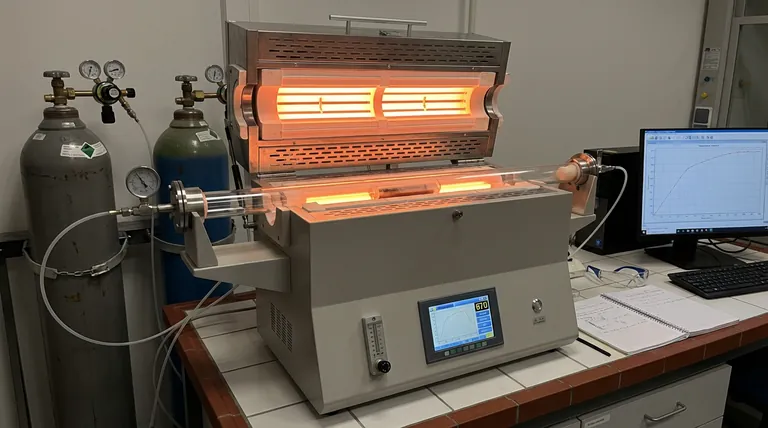
The primary role of a high-temperature tube furnace in Ti3AuC2 preparation is to facilitate a precise atomic exchange reaction between gold and silicon atoms. By maintaining a strictly controlled temperature of 670 °C for a continuous 12-hour period, the furnace enables the transformation of a Ti3SiC2 thin film into Ti3AuC2 while safeguarding the material's essential layered structure.
The tube furnace serves as a precision reactor, balancing the thermal energy required to drive atomic substitution with the stability needed to preserve the precursor's delicate structural integrity.
The Mechanics of Atomic Exchange
Driving the Substitution Reaction
The synthesis of Ti3AuC2 relies on a specific chemical mechanism known as an atomic exchange reaction. The high-temperature tube furnace provides the thermal activation energy necessary for gold atoms to diffuse into the material and replace the existing silicon atoms within the Ti3SiC2 lattice.
Preserving Layered Architecture
This process is not a simple melting or sintering event; it is a structural transformation. The furnace must hold the temperature at exactly 670 °C. This specific thermal point is critical because it is hot enough to induce the exchange but controlled enough to prevent the collapse of the material's original layered framework.
The Role of Dwell Time
Temperature alone is insufficient; time is the second critical variable. The furnace allows for an extended dwell time of 12 hours. This duration ensures the reaction propagates fully throughout the thin film, resulting in a complete transformation rather than a partial surface coating.
Understanding the Trade-offs
Process Speed vs. Material Quality
The primary trade-off in using this method is the time investment. A 12-hour dwell time at 670 °C is a slow, energy-intensive process compared to rapid thermal annealing techniques used in other contexts. However, accelerating this process (e.g., via flash annealing) would likely destabilize the lattice and fail to produce the high-quality goldene precursors required.
Stability Requirements
While tube furnaces offer excellent stability, they require precise calibration. Any significant fluctuation away from the 670 °C setpoint could lead to incomplete exchange (if too low) or structural degradation (if too high). The equipment must be capable of maintaining a uniform thermal profile across the entire length of the sample zone.
Making the Right Choice for Your Goal
To ensure successful synthesis of Ti3AuC2, align your process parameters with your specific objectives:
- If your primary focus is Phase Purity: Ensure your furnace can maintain the 670 °C setpoint with minimal fluctuation (< ±1°C) to guarantee a complete atomic exchange without secondary phase formation.
- If your primary focus is Structural Integrity: Strictly adhere to the 12-hour dwell time; shortening this duration to save time will likely result in a chemically incomplete core and a comprised layered structure.
Ultimately, the high-temperature tube furnace provides the non-negotiable stability required to turn a theoretical atomic exchange into a tangible, high-quality material.
Summary Table:
| Parameter | Specification | Purpose in Ti3AuC2 Synthesis |
|---|---|---|
| Temperature | 670 °C | Provides activation energy for Au/Si atomic substitution |
| Dwell Time | 12 Hours | Ensures complete transformation throughout the thin film |
| Environment | Controlled Atmosphere | Prevents oxidation and maintains layered lattice integrity |
| Thermal Stability | High (±1°C) | Prevents structural degradation or incomplete reaction |
Elevate Your Material Synthesis with KINTEK
Precise thermal control is the difference between a failed experiment and a high-purity Ti3AuC2 phase. KINTEK provides industry-leading Tube, Muffle, and Vacuum furnaces designed to meet the rigorous demands of advanced material research. Backed by expert R&D and manufacturing, our systems offer the unmatched stability and uniform heating required for delicate atomic exchange reactions. Whether you need standard lab equipment or a fully customizable high-temperature system, KINTEK is your partner in innovation.
Ready to optimize your annealing process? Contact KINTEK today to find the perfect furnace for your unique needs!
References
- Shun Kashiwaya, Lars Hultman. Synthesis of goldene comprising single-atom layer gold. DOI: 10.1038/s44160-024-00518-4
This article is also based on technical information from Kintek Furnace Knowledge Base .
Related Products
- 1400℃ High Temperature Laboratory Tube Furnace with Alumina Tube
- 1700℃ High Temperature Laboratory Tube Furnace with Alumina Tube
- 1200℃ Split Tube Furnace Laboratory Quartz Tube Furnace with Quartz Tube
- 2200 ℃ Tungsten Vacuum Heat Treat and Sintering Furnace
- 1700℃ Controlled Inert Nitrogen Atmosphere Furnace
People Also Ask
- How does zone-melting in tube furnaces synthesize bismuth micro-wires? Master Single-Crystal Thermoelectric Growth
- How are high-temperature laboratory tube furnaces applied in long-term vacuum homogenization heat treatments for intermetallic samples?
- How are high-temp tube furnaces used to measure diffusion coefficients per Fick's law? Master Precision Annealing
- How do high-temperature laboratory tube furnaces ensure environmental stability? Precision Thermal Reduction Tips
- How are high-temperature tube furnaces applied in testing ceramic-supported alloy membranes? Insights



















