
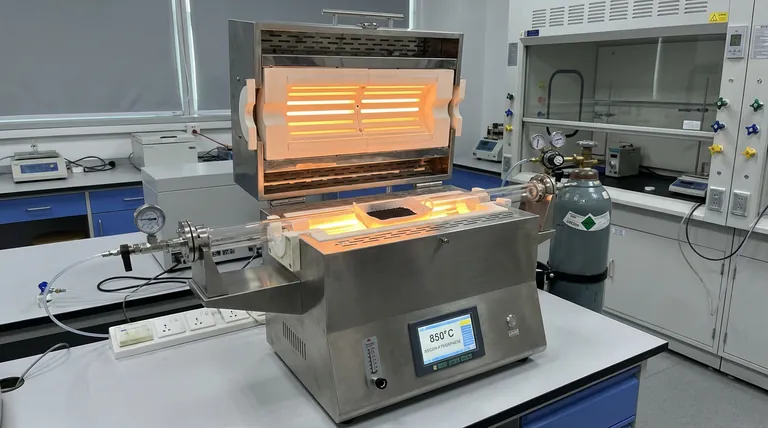
A high-temperature tube furnace facilitates the final ceramization of EG/LTO (expanded graphite/lithium titanate) composites by maintaining a stable 850 °C thermal environment within a protective argon atmosphere. This precise application of thermal energy drives in-situ solid-state reactions, converting precursors into high-purity Li4Ti5O12 spinel phases essential for electrochemical stability.
The tube furnace functions not just as a heater, but as a strictly controlled reaction chamber that enforces the phase transformation of precursors into a dense, ion-conductive structure. This process directly lowers charge transfer resistance, unlocking superior high-rate performance in the final battery material.
The Role of Controlled Thermal Environments
Precision Heating at 850 °C
The primary function of the tube furnace in this application is to provide a consistent thermal baseline at 850 °C.
This specific temperature is the activation threshold required to drive the ceramization process. It ensures the complete conversion of chemical precursors into the desired crystal structure without degrading the material.
The Necessity of an Inert Atmosphere
The tube furnace allows for the creation of a strictly sealed environment pumped with argon gas.
Operating under an inert atmosphere is critical to prevent unwanted oxidation during the high-temperature phase. This protection preserves the chemical integrity of the Expanded Graphite (EG) and ensures the purity of the final composite.
Material Transformation and Electrochemical Impact
Driving In-Situ Solid-State Reactions
The thermal energy provided by the furnace triggers in-situ solid-state reactions.
Unlike liquid-phase reactions, this process occurs directly within the solid material, rearranging the atomic structure to form the Li4Ti5O12 spinel phase. This specific crystal phase is renowned for its "zero-strain" property, which ensures structural stability during battery cycling.
Formation of a Dense Conductive Layer
The ultimate goal of this ceramization stage is the formation of a dense lithium-ion conductive layer on the electrode interface.
By strictly controlling the temperature profile, the furnace facilitates the creation of a layer that significantly reduces charge transfer resistance. This reduction is the key factor that allows the material to perform well at high discharge rates (high-rate performance).
Understanding the Trade-offs
The Risk of Thermal Inconsistency
While tube furnaces generally offer uniform heating, any deviation from the target 850 °C can lead to incomplete crystallization.
If the temperature is too low, the spinel phase conversion will be incomplete, resulting in poor conductivity. If the temperature fluctuates too high, it may cause particle agglomeration, reducing the active surface area available for lithium-ion storage.
Atmosphere Sensitivity
The process is entirely dependent on the integrity of the argon atmosphere.
A compromise in the tube furnace's seal allows oxygen ingress, which will degrade the carbon components (Expanded Graphite) and contaminate the LTO phase. This renders the material significantly less conductive and increases internal resistance.
Making the Right Choice for Your Goal
To maximize the performance of EG/LTO composites, you must align your furnace parameters with your specific electrochemical targets.
- If your primary focus is Phase Purity: Ensure your thermal profile includes a sufficient hold time at exactly 850 °C to guarantee complete conversion to the spinel phase.
- If your primary focus is High-Rate Capability: Prioritize the integrity of the argon flow and seal to protect the formation of the dense conductive layer, which minimizes resistance.
Precise thermal management is the critical bridge between raw precursors and high-performance energy storage materials.
Summary Table:
| Process Parameter | Role in Ceramization | Impact on EG/LTO Performance |
|---|---|---|
| Temperature (850 °C) | Drives in-situ solid-state reactions | Ensures complete Li4Ti5O12 spinel phase conversion |
| Inert Atmosphere (Argon) | Prevents oxidation of Expanded Graphite | Maintains chemical integrity and material purity |
| Controlled Heating | Facilitates dense conductive layer formation | Lowers charge transfer resistance for high-rate performance |
| Sealed Reaction Chamber | Enforces atomic structure rearrangement | Provides structural stability and zero-strain properties |
Elevate Your Material Research with KINTEK
Precise thermal control is the difference between experimental success and material failure. Backed by expert R&D and world-class manufacturing, KINTEK offers high-performance Tube, Muffle, Rotary, Vacuum, and CVD systems specifically designed for demanding ceramization and battery research.
Whether you need to maintain a strict argon atmosphere or achieve uniform heating at 850 °C, our customizable lab high-temperature furnaces provide the reliability your unique project requires. Optimize your electrochemical results today—contact our technical experts now to find the perfect solution for your lab.
References
- Junkang Zhao, Yu Xiang. Expanded graphite incorporated with Li <sub>4</sub> Ti <sub>5</sub> O <sub>12</sub> nanoparticles as a high-rate lithium-ion battery anode. DOI: 10.1039/d4ra00832d
This article is also based on technical information from Kintek Furnace Knowledge Base .
Related Products
- 1400℃ High Temperature Laboratory Tube Furnace with Alumina Tube
- 1700℃ High Temperature Laboratory Tube Furnace with Alumina Tube
- 1200℃ Split Tube Furnace Laboratory Quartz Tube Furnace with Quartz Tube
- Vertical Laboratory Quartz Tube Furnace Tubular Furnace
- High Temperature Muffle Oven Furnace for Laboratory Debinding and Pre Sintering
People Also Ask
- How does zone-melting in tube furnaces synthesize bismuth micro-wires? Master Single-Crystal Thermoelectric Growth
- How are high-temperature laboratory tube furnaces applied in long-term vacuum homogenization heat treatments for intermetallic samples?
- How are high-temp tube furnaces used to measure diffusion coefficients per Fick's law? Master Precision Annealing
- How do high-temperature laboratory tube furnaces ensure environmental stability? Precision Thermal Reduction Tips
- How are high-temperature tube furnaces applied in testing ceramic-supported alloy membranes? Insights



















