
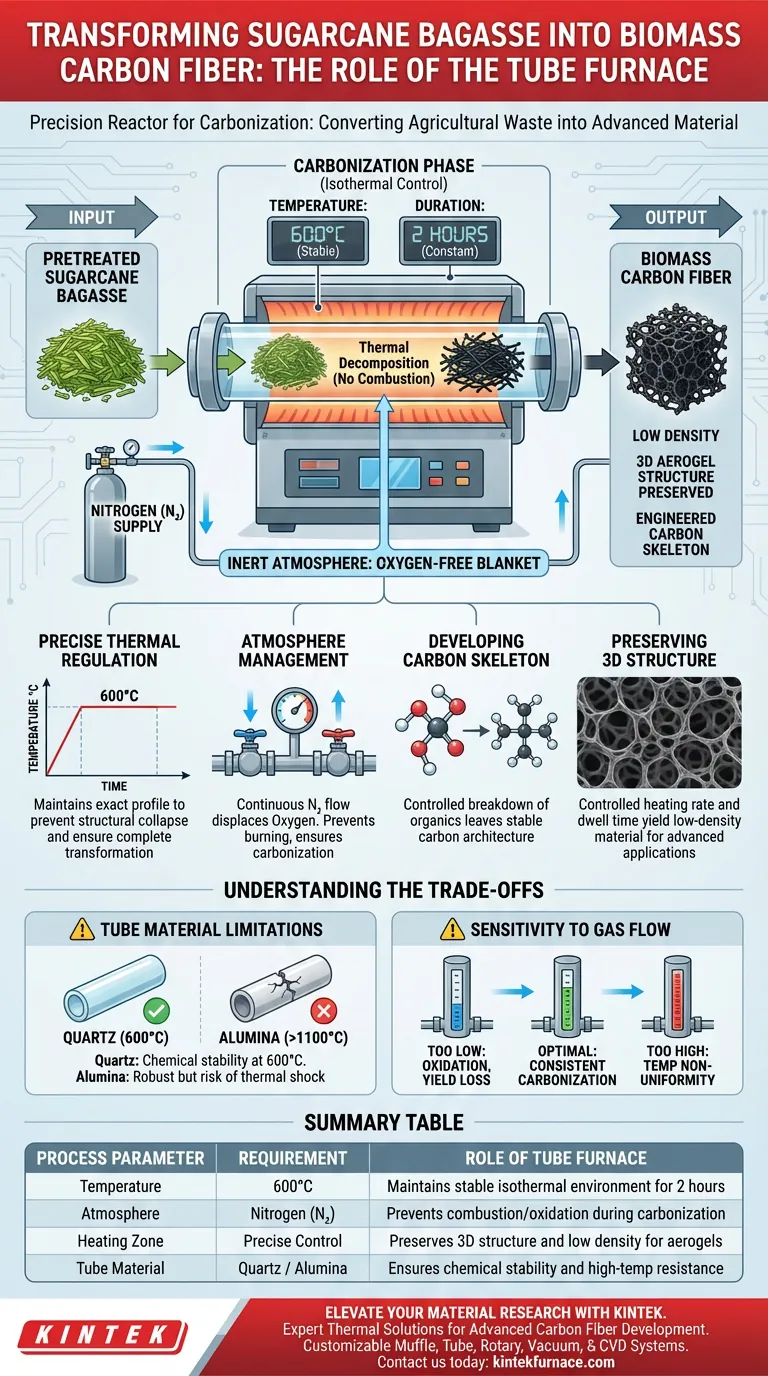
The tube furnace functions as a precision reactor for the carbonization phase, specifically converting chemically pretreated sugarcane bagasse into biomass carbon fiber. By maintaining a constant temperature of 600°C for two hours within a protective nitrogen atmosphere, the furnace facilitates the thermal decomposition of the biomass without combustion.
The tube furnace enables the successful transition from organic plant matter to engineered carbon material. Its primary role is to provide a stable, oxygen-free thermal environment that preserves a low-density, three-dimensional structure essential for aerogel frameworks.
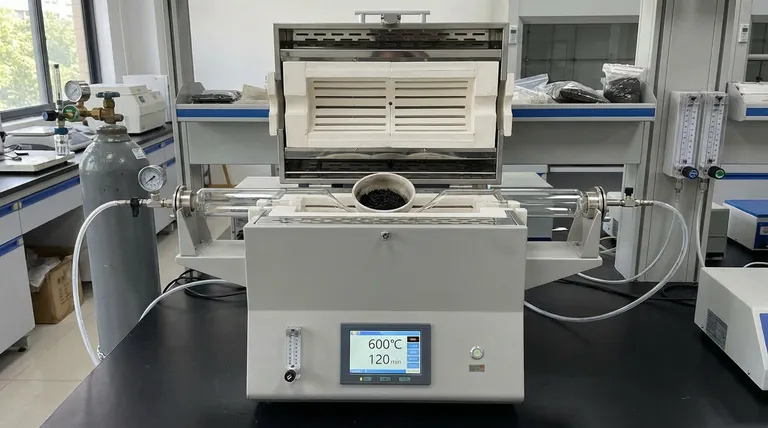
Creating the Carbonization Environment
Precise Thermal Regulation
The fundamental role of the tube furnace in this process is isothermal control.
For sugarcane bagasse conversion, the furnace must hold the sample at exactly 600°C for a duration of two hours. This specific thermal profile ensures the complete transformation of the pretreated fiber into carbon while preventing the structural collapse that could occur at excessive temperatures.
Atmosphere Management
A tube furnace distinguishes itself from a standard oven through its ability to control the reaction atmosphere.
In this application, the furnace tube—typically made of high-temperature-resistant quartz or alumina—is sealed to create an anaerobic environment. A continuous flow of nitrogen gas is introduced to displace oxygen. This "inert blanket" is critical; without it, the high temperatures would simply burn the sugarcane bagasse to ash rather than carbonizing it into fiber.
Material Transformation and Outcome
Developing the Carbon Skeleton
Inside the furnace, the bagasse undergoes thermochemical changes, such as dehydration and decarbonization.
Because the environment is strictly controlled, the organic components break down predictably. This leaves behind a stable biomass carbon fiber that retains a specific architecture.
Preserving Three-Dimensional Structure
The ultimate goal of using a tube furnace is to produce a material suitable for advanced applications, such as aerogel construction.
The controlled heating rate and stable dwell time result in a final product with low density and a preserved three-dimensional structure. This structural integrity is the physical foundation required for subsequent activation steps or use as a structural framework.
Understanding the Trade-offs
Tube Material Limitations
While tube furnaces offer precision, the core component—the furnace tube—has physical limits.
Quartz tubes offer excellent chemical stability and are ideal for the 600°C range required for this bagasse process. However, if your research expands to higher temperatures (above 1100°C), quartz may degrade, necessitating a switch to alumina, which is more robust but susceptible to thermal shock.
Sensitivity to Gas Flow
The success of the carbonization relies heavily on the consistency of the nitrogen flow.
If the flow rate is too low, residual oxygen may remain, leading to partial combustion and loss of yield. Conversely, an excessively high flow rate can disturb the temperature uniformity within the heating zone, leading to inconsistent carbonization across the sample batch.
Making the Right Choice for Your Goal
To maximize the quality of biomass carbon fiber derived from sugarcane bagasse, apply these principles:
- If your primary focus is Structural Integrity: Ensure your furnace can maintain a strict 600°C profile to preserve the three-dimensional framework required for aerogels.
- If your primary focus is Chemical Purity: Verify that your nitrogen gas supply is free of contaminants and that the furnace seals are airtight to prevent oxidation during the two-hour dwell time.
The tube furnace is not merely a heating element; it is the vessel that orchestrates the delicate chemistry required to turn agricultural waste into advanced engineering material.
Summary Table:
| Process Parameter | Requirement | Role of Tube Furnace |
|---|---|---|
| Temperature | 600°C | Maintains stable isothermal environment for 2 hours |
| Atmosphere | Nitrogen (N₂) | Prevents combustion/oxidation during carbonization |
| Heating Zone | Precise Control | Preserves 3D structure and low density for aerogels |
| Tube Material | Quartz / Alumina | Ensures chemical stability and high-temperature resistance |
Elevate Your Material Research with KINTEK
Transform agricultural waste into high-performance biomass carbon fibers with KINTEK’s industry-leading thermal solutions. Backed by expert R&D and precision manufacturing, KINTEK offers a wide range of Muffle, Tube, Rotary, Vacuum, and CVD systems—all fully customizable to meet your specific isothermal and atmospheric requirements.
Whether you are developing aerogel frameworks or advanced carbon skeletons, our furnaces provide the stability and control your research demands. Contact us today to find the perfect high-temp furnace for your laboratory!
Visual Guide
References
- Mengxuan Zhu, Yong Jiang. MXene/carbonized bagasse fiber aerogel thermal insulation material. DOI: 10.1063/5.0194659
This article is also based on technical information from Kintek Furnace Knowledge Base .
Related Products
- Electric Rotary Kiln Small Rotary Furnace Biomass Pyrolysis Plant Rotating Furnace
- Vertical Laboratory Quartz Tube Furnace Tubular Furnace
- Slide PECVD Tube Furnace with Liquid Gasifier PECVD Machine
- Laboratory Quartz Tube Furnace RTP Heating Tubular Furnace
- Split Chamber CVD Tube Furnace with Vacuum Station CVD Machine
People Also Ask
- What are the main applications of a rotary kiln electric furnace? Achieve Uniform Heat Treatment for Powders
- What are the key components of a rotary kiln electric furnace? Unlock Efficient Thermal Processing
- What is the significance of the refractory lining in a rotary kiln electric furnace? Unlock Efficiency and Longevity
- What is the benefit of adjustable speed control in rotary kilns? Optimize Efficiency and Quality
- What are the main advantages of using rotary kilns for bulk solids processing? Achieve High-Volume, Uniform Thermal Processing



















