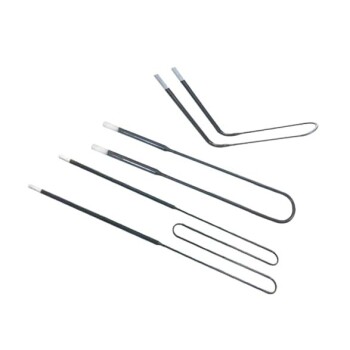
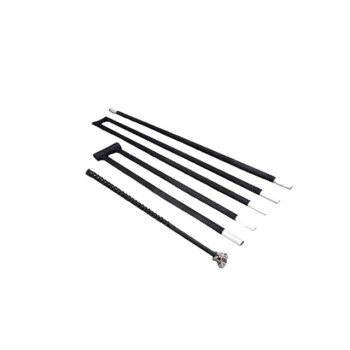
Temperature accuracy in desulfurization research is achieved through the integration of Molybdenum Disilicide (MoSi2) heating elements with high-precision feedback loops. By utilizing Type B thermocouples and advanced PID (Proportional-Integral-Derivative) controllers, these furnaces maintain a stable thermal environment, often within a precision of ±2 K at temperatures as high as 1623 K. This level of control is vital because desulfurization kinetics are highly sensitive to even minor thermal fluctuations, which can skew reaction rate data.
Core Takeaway: To ensure reliable kinetic data, high-temperature tube furnaces combine the high-watt density of MoSi2 elements with closed-loop PID control and Type B thermocouples to create a strictly regulated constant temperature zone.
The Role of MoSi2 Heating Elements
High-Temperature Capability and Stability
MoSi2 heating elements are capable of reaching surface temperatures between 1800°C and 1900°C, allowing furnaces to operate comfortably at the 1600°C+ levels required for molten steel desulfurization. These elements provide a stable and continuous heat source that does not degrade quickly in oxidizing or inert atmospheres.
Superior Oxidation Resistance
Unlike other materials, MoSi2 forms a protective quartz glass coating when heated, which prevents further oxidation. This chemical stability ensures that the heating efficiency remains consistent over long experimental durations, such as 24-hour phase equilibrium reactions.
Longevity in Extreme Environments
At temperatures exceeding 1500°C, MoSi2 elements outlast alternatives like Silicon Carbide (SiC). Their ability to maintain structural integrity under intense thermal stress makes them the industry standard for long-term kinetic studies.
Advanced Thermal Control Mechanisms
Precision Through Type B Thermocouples
To monitor these extreme temperatures, furnaces utilize Type B thermocouples (composed of Platinum-Rhodium alloys). These sensors are specifically designed for high-temperature accuracy and are less prone to "drift" than lower-grade thermocouples.
PID Control Logic
The furnace uses a PID (Proportional-Integral-Derivative) controller to process data from the thermocouple. This system constantly calculates the difference between the desired setpoint and the actual temperature, adjusting power delivery in real-time to maintain a precision of ±2 K.
Creating a Constant Temperature Zone
The physical arrangement of the MoSi2 elements is designed to produce a constant temperature zone (often 100 mm or more in length). This ensures that the slag and metal samples are heated uniformly, preventing thermal gradients that would otherwise invalidate kinetic measurements.
Understanding the Trade-offs
Susceptibility to Contamination
While MoSi2 is durable, it is highly sensitive to chemical contamination. If samples are not properly dried or if they release aggressive vapors (like certain fluorides or lead), the protective silica layer on the elements can break down, leading to premature failure.
Mechanical Fragility
MoSi2 elements are extremely brittle at room temperature and can easily snap if handled roughly or subjected to mechanical vibration. They must be supported correctly within the furnace architecture to prevent stress fractures during thermal cycling.
Low-Temperature Oxidation ("Pest")
Interestingly, MoSi2 can suffer from "pest" oxidation at temperatures around 400°C to 600°C, where the material turns to powder. To avoid this, furnaces must be transitioned through this critical temperature range quickly to reach the stable high-temperature operating zone.
Making the Right Choice for Your Research
Implementation Guidelines
- If your primary focus is precise reaction rates: Prioritize a furnace with a verified constant temperature zone of at least 100 mm to ensure your entire sample remains at the target temperature.
- If your primary focus is long-duration equilibrium: Invest in high-grade MoSi2 elements and Type B thermocouples, as these components provide the best resistance to thermal drift over 24-hour periods.
- If your primary focus is slag-volatile interactions: Ensure the tube furnace is equipped with a high-quality protective tube (like alumina) to shield the MoSi2 elements from corrosive vapors released during the reaction.
By aligning the high-wattage output of MoSi2 elements with sophisticated PID feedback, researchers can isolate chemical kinetics from thermal noise, ensuring repeatable and accurate desulfurization data.
Summary Table:
| Feature | Component/Mechanism | Impact on Desulfurization Research |
|---|---|---|
| Heating Source | MoSi2 Heating Elements | Provides stable, continuous heat up to 1900°C; resists oxidation. |
| Temperature Sensor | Type B Thermocouple | High-accuracy Platinum-Rhodium alloy reduces thermal drift. |
| Control Logic | PID Controller | Maintains thermal precision of ±2 K through real-time feedback. |
| Uniformity | Constant Temp Zone | Ensures samples (100mm+) are heated without invalidating gradients. |
Elevate Your Research Precision with KINTEK
Don't let thermal fluctuations compromise your kinetic data. KINTEK specializes in precision laboratory equipment, offering a comprehensive range of high-temperature furnaces, including tube, muffle, rotary, vacuum, CVD, and atmosphere furnaces. Whether you are conducting desulfurization kinetics or dental material testing, our MoSi2-powered systems are fully customizable to meet your unique temperature and atmospheric requirements.
Why choose KINTEK?
- Superior Accuracy: Achieve stable environments with high-precision PID control and advanced thermocouples.
- Built for Durability: Our furnaces utilize premium MoSi2 and SiC elements for long-term experimental reliability.
- Custom Engineering: We tailor heating zones and tube materials to protect against chemical contamination.
Ready to optimize your lab’s performance? Contact us today to discuss your custom furnace needs!
References
- Biwen Yang, Hao Ma. Influence of Top Slag Containing TiO2 and VOx on Hot Metal Pre-Desulfurization. DOI: 10.3390/met14080910
This article is also based on technical information from Kintek Furnace Knowledge Base .
Related Products
- Molybdenum Disilicide MoSi2 Thermal Heating Elements for Electric Furnace
- Molybdenum Vacuum Heat Treat Furnace
- Vacuum Heat Treat Sintering Furnace Molybdenum Wire Vacuum Sintering Furnace
- 1700℃ High Temperature Laboratory Tube Furnace with Alumina Tube
- 1400℃ High Temperature Laboratory Tube Furnace with Alumina Tube
People Also Ask
- What are the typical application temperatures for molybdenum disilicide (MoSi2) heating elements? Master High-Temp Performance
- What is the primary use of molybdenum disilicide? Ideal for High-Temp Heating Elements
- What are the characteristics of molybdenum disilicide heating elements? Unlock High-Temp Performance
- What are the properties of molybdenum disilicide (MoSi2) that make it suitable for high-temperature applications? Discover Its High-Temp Resilience
- What are the applications of molybdenum disilicide heating elements? Achieve Extreme Heat Stability for Industrial Processes