
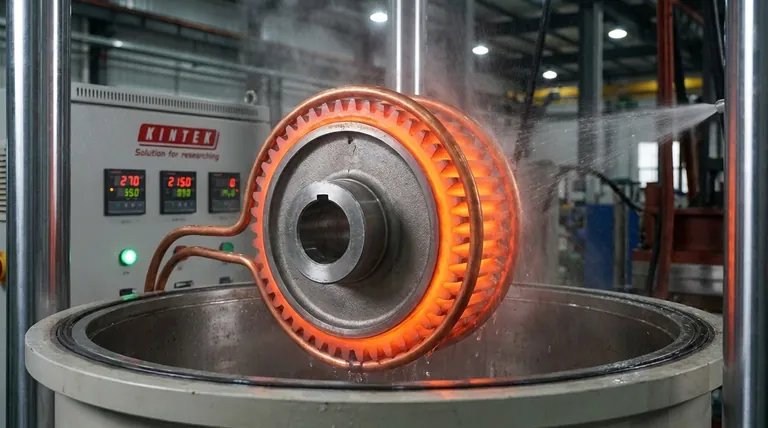
High-frequency induction heating systems utilize electromagnetic induction to selectively harden steel surfaces through a phenomenon known as the "skin effect." By rapidly bringing a thin outer layer (typically 1 to 6 mm) to austenitizing temperatures and immediately cooling it, this process creates a wear-resistant surface while leaving the underlying core material completely unchanged.
The core advantage of this technology is the ability to decouple surface properties from core properties. It allows engineers to create a component that is extremely hard on the outside for wear resistance, yet remains tough and ductile on the inside to withstand impact and fatigue.
The Mechanics of Surface Hardening
Harnessing the Skin Effect
The primary mechanism behind this process is the skin effect. High-frequency currents are generated by inductors and directed at the steel component.
Because of the high frequency, the current density—and therefore the heat—concentrates heavily on the surface of the metal rather than penetrating deep into the part.
Reaching Austenitizing Temperature
To achieve hardening, the steel must be heated to its austenitizing temperature. This is the critical thermal point where the steel's internal crystalline structure changes.
Induction systems achieve this temperature almost instantly within that targeted surface layer.
Rapid Cooling and Transformation
Once the surface reaches the required temperature, it is subjected to rapid cooling (often called quenching).
This sudden drop in temperature "freezes" the microstructure, transforming the austenite into martensite, which is the hard, wear-resistant phase of steel.
Why Localization Matters
Controlled Depth
The system allows for precise control over how deep the hardening extends. Based on the frequency and power settings, the hardened layer is usually restricted to a depth of 1 to 6 mm.
This precision ensures that only the material intended for wear needs to be hardened.
Short Dwell Times
Induction heating is defined by a very short dwell time. The energy transfer is so fast that the heat does not have time to conduct inward to the center of the component.
This speed is critical for preventing thermal distortion in the rest of the part.
Preservation of Core Properties
The most significant contribution of this method is that the original properties of the material core remain unaffected.
While the surface becomes brittle and hard, the core retains the toughness and ductility required to absorb shock without snapping.
Understanding the Trade-offs
Depth Limitations
This process is specifically designed for surface modification. If your application requires through-hardening (changing the properties of the entire cross-section), high-frequency induction is likely the wrong tool, as it is limited to that 1-6 mm range.
Component Geometry
While effective for cylindrical parts or specific zones, complex geometries can sometimes present challenges. The inductor design must match the part profile closely to ensure the skin effect is applied uniformly across irregular surfaces.
Making the Right Choice for Your Goal
If you are evaluating heat treatment options for steel components, consider these specific parameters:
- If your primary focus is Wear Resistance with Impact Tolerance: Choose high-frequency induction to create a hard shell while keeping the core tough to prevent catastrophic failure under load.
- If your primary focus is Dimensional Accuracy: Rely on this method's short dwell times and localized heating to minimize the warping and distortion common in furnace heating.
- If your primary focus is Deep Structural Change: Re-evaluate conventional furnace methods, as the skin effect will not penetrate deeply enough to alter the core structure.
Select high-frequency induction when you need to surgically enhance the durability of a surface without compromising the structural integrity of the part beneath it.
Summary Table:
| Feature | Induction Surface Hardening | Traditional Through-Hardening |
|---|---|---|
| Hardening Depth | Precise (1 - 6 mm) | Full cross-section |
| Core Properties | Tough & Ductile (Unchanged) | Brittle & Hard |
| Heating Time | Seconds (Short dwell time) | Minutes to Hours |
| Distortion Risk | Low (Localized heat) | High (Global heat) |
| Microstructure | Martensitic surface layer | Uniform throughout |
Optimize Your Steel Components with KINTEK Technology
Are you looking to achieve the perfect balance of surface durability and core toughness? Backed by expert R&D and manufacturing, KINTEK offers cutting-edge induction solutions, including Muffle, Tube, Rotary, Vacuum, and CVD systems. Our lab high-temp furnaces are fully customizable to meet your unique metallurgical needs, ensuring superior wear resistance without compromising structural integrity.
Ready to enhance your lab’s efficiency and precision? Contact KINTEK today to discuss your custom project!
References
- František Nový, Miloš Mičian. The Influence of Induction Hardening, Nitriding and Boronising on the Mechanical Properties of Conventional and Sintered Steels. DOI: 10.3390/coatings14121602
This article is also based on technical information from Kintek Furnace Knowledge Base .
Related Products
- Vacuum Induction Melting Furnace
- 600T Vacuum Induction Hot Press Vacuum Heat Treat and Sintering Furnace
- Multi Heating Zones CVD Tube Furnace Machine for Chemical Vapor Deposition Equipment
People Also Ask
- What are the core functions of the High Vacuum Induction Melting (VIM) furnace? Optimize DD5 Superalloy Purification
- What is the role of VIM and directional solidification in aero-engine blade substrates? Engineering Extreme Durability
- What are the advantages of using a VIM furnace to control residual oxygen pressure? Achieve Superior Metal Uniformity
- Why is a Vacuum Induction Melting furnace (VIM) used for Cu-Zn-Al-Sn alloys? Achieve Precision Composition Control
- What role does a Vacuum Induction Melting furnace play in the production of high-aluminum nickel-based superalloys?


