
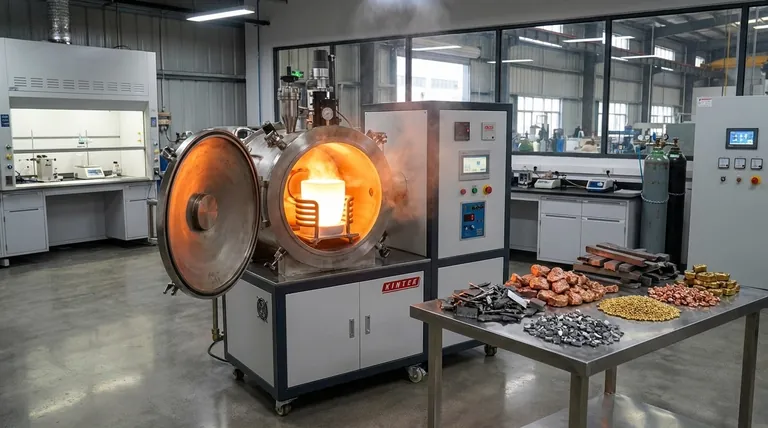
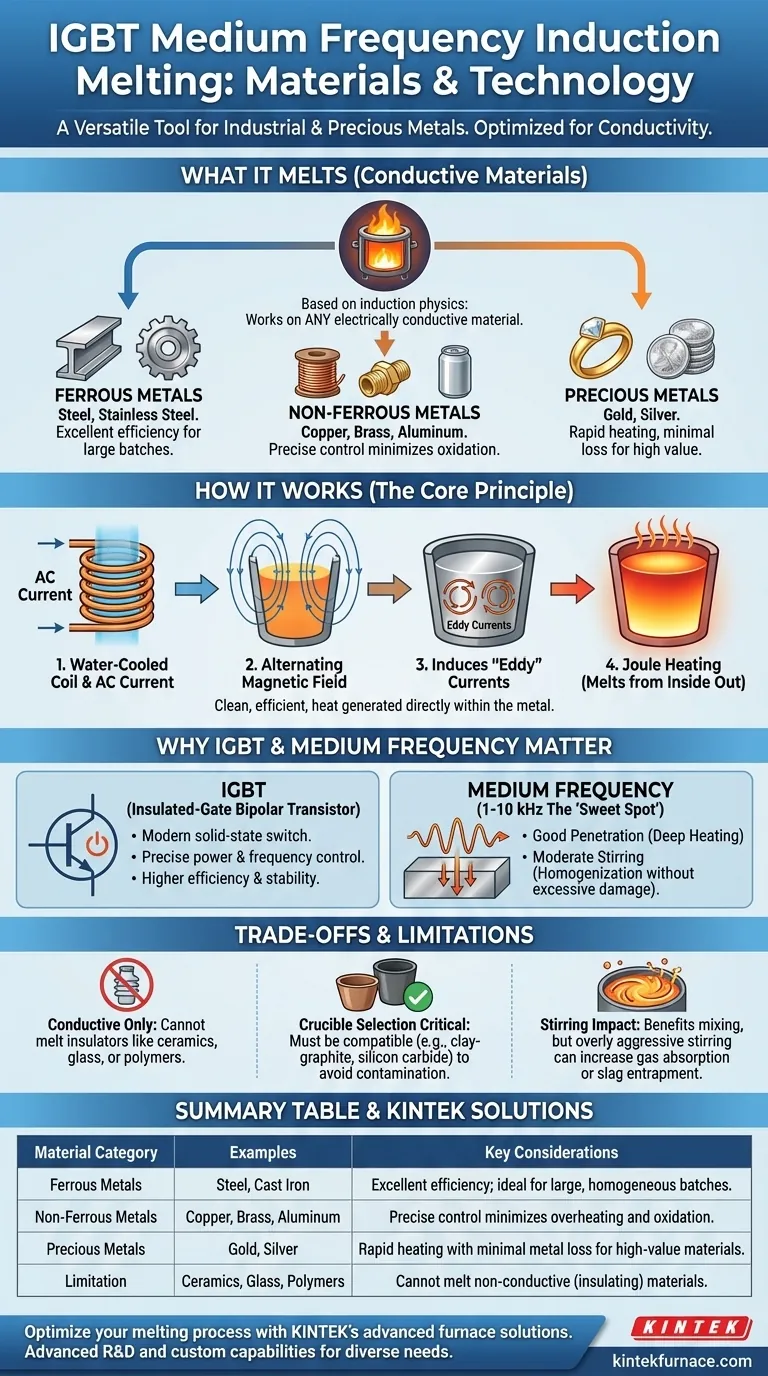
At its core, an IGBT medium frequency induction melting furnace is a highly versatile tool. It is capable of melting a wide range of common industrial metals, including steel, stainless steel, copper, brass, aluminum, and aluminum alloys. It is also well-suited for processing precious metals like gold and silver.
The furnace's flexibility comes from the fundamental physics of induction heating, which works on any electrically conductive material. The "medium frequency" and "IGBT" specifications refer to the technology used to optimize this process, providing a powerful balance of heating depth and efficiency for the most common ferrous and non-ferrous metals.
How Induction Melting Works: The Core Principle
Induction melting is a clean, efficient, and highly controllable process. It does not rely on external flames or heating elements; instead, it generates heat directly within the metal itself.
The Electromagnetic Field
The furnace uses a water-cooled copper coil. A powerful alternating electric current flows through this coil, creating a strong and rapidly changing magnetic field in the space at the center of the coil where the crucible is placed.
Inducing "Eddy" Currents
This magnetic field penetrates the metal charge placed inside the crucible. As the magnetic field rapidly changes, it induces small, circular electric currents within the metal. These are known as eddy currents.
Heat from Resistance
Every metal has some natural resistance to the flow of electricity. As these powerful eddy currents flow through the metal, they are opposed by this resistance, which generates immense heat. This phenomenon, known as Joule heating, causes the metal to heat up and melt from the inside out.
Why "IGBT" and "Medium Frequency" Matter
The terms in the furnace's name are not just jargon; they define its performance and versatility. They refer to the power supply technology that creates the alternating current.
IGBT: The Modern Power Source
IGBT stands for Insulated-Gate Bipolar Transistor. This is a modern, solid-state electronic switch that is far more efficient and controllable than older technologies like SCRs (Silicon-Controlled Rectifiers). Using IGBTs allows the furnace's power supply to precisely control both the power output and the operating frequency, leading to lower energy consumption and a more stable, repeatable melting process.
Medium Frequency: The Versatile Sweet Spot
Medium frequency typically refers to a range between 1 and 10 kHz. This frequency range is considered a "sweet spot" for general-purpose melting for two key reasons:
- Good Penetration: The frequency is low enough to allow the magnetic field to penetrate deeply into the metal charge, ensuring efficient heating of the entire batch.
- Moderate Stirring: The electromagnetic forces create a natural stirring action in the molten metal. In the medium frequency range, this stirring is strong enough to homogenize the alloy and temperature but not so violent that it causes excessive oxidation or damage to the crucible lining.
This balance makes medium frequency ideal for a wide range of crucible sizes and metal types, from magnetic steels to non-magnetic aluminum.
Understanding the Trade-offs and Limitations
While highly versatile, this technology is not without its operational considerations. Understanding them is key to successful implementation.
Conductive Materials Only
The most fundamental limitation is that induction heating only works on materials that are electrically conductive. It cannot be used to directly melt insulators like ceramics, glass, or polymers.
Crucible Selection is Critical
The crucible, which holds the metal, must be made of a material that is compatible with the target metal and temperature. It is typically made of a non-conductive refractory material like clay-graphite or silicon carbide. The choice of crucible is critical to avoid chemical reactions that could contaminate the melt.
The Impact of Stirring
The inherent stirring action is usually a benefit, as it helps mix alloys and maintain a uniform temperature. However, for certain sensitive alloys, overly aggressive stirring can increase gas absorption from the atmosphere or entrap slag in the melt. The power and frequency can be adjusted to manage this effect.
Making the Right Choice for Your Application
An IGBT medium frequency furnace is a robust and flexible choice, but your specific material dictates how you use it.
- If your primary focus is melting ferrous metals like steel or iron: This furnace is an industry standard, offering excellent efficiency and the stirring action needed to create homogeneous batches.
- If your primary focus is non-ferrous metals like aluminum or copper: The precise power control of an IGBT unit is a major advantage, allowing you to melt quickly while minimizing the risk of overheating, gas pickup, and metal loss to oxidation.
- If your primary focus is small batches or precious metals: The rapid heating and high efficiency of induction make it ideal for quickly melting gold, silver, or other high-value materials with minimal waste.
By understanding the principles of induction and the role of frequency, you can confidently determine if this technology aligns with your specific production goals.
Summary Table:
| Material Category | Examples | Key Considerations |
|---|---|---|
| Ferrous Metals | Steel, Cast Iron | Excellent efficiency; ideal for large, homogeneous batches. |
| Non-Ferrous Metals | Copper, Brass, Aluminum | Precise control minimizes overheating and oxidation. |
| Precious Metals | Gold, Silver | Rapid heating with minimal metal loss for high-value materials. |
| Limitation | Ceramics, Glass, Polymers | Cannot melt non-conductive (insulating) materials. |
Optimize your melting process with KINTEK's advanced furnace solutions.
Whether you are processing ferrous, non-ferrous, or precious metals, the right equipment is crucial for efficiency and quality. Leveraging exceptional R&D and in-house manufacturing, KINTEK provides diverse laboratories and foundries with advanced high-temperature furnace solutions.
Our product line, including Muffle, Tube, Rotary Furnaces, Vacuum & Atmosphere Furnaces, and CVD/PECVD Systems, is complemented by our strong deep customization capability to precisely meet unique experimental and production requirements.
Ready to enhance your capabilities? Contact our experts today to discuss how our tailored solutions can meet your specific melting needs.
Visual Guide
Related Products
- Vacuum Induction Melting Furnace
- 600T Vacuum Induction Hot Press Vacuum Heat Treat and Sintering Furnace
- 1200℃ Controlled Inert Nitrogen Atmosphere Furnace
- Controlled Inert Nitrogen Hydrogen Atmosphere Furnace
- 1700℃ Controlled Inert Nitrogen Atmosphere Furnace
People Also Ask
- What are the core functions of the High Vacuum Induction Melting (VIM) furnace? Optimize DD5 Superalloy Purification
- What role does a Vacuum Induction Melting furnace play in the production of high-aluminum nickel-based superalloys?
- Why is a Vacuum Induction Melting furnace (VIM) used for Cu-Zn-Al-Sn alloys? Achieve Precision Composition Control
- What is the role of VIM and directional solidification in aero-engine blade substrates? Engineering Extreme Durability
- What are the technical advantages of using a Vacuum Induction Melting furnace in the development of advanced packaging steel?



















