
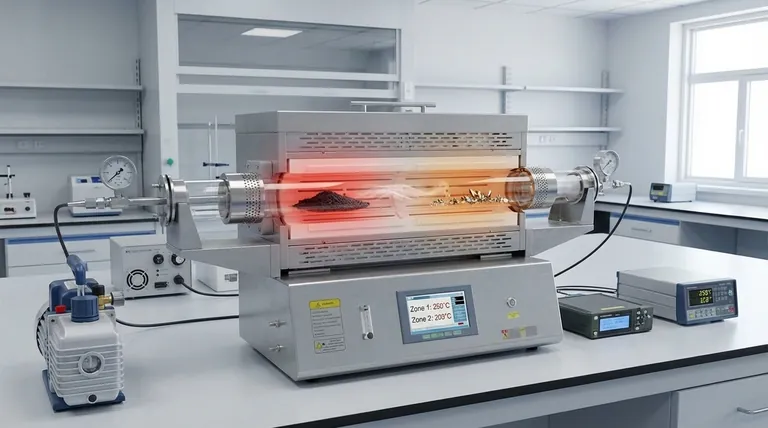
A dual-zone tube furnace drives Bi4I4 growth by establishing a precise thermal gradient between a 250 °C source zone and a 200 °C crystallization zone. This 50 °C differential creates the thermodynamic force necessary to transport gaseous raw materials from the heated source to the cooler deposition region while maintaining a specific tilt angle to regulate the flow.
Core Takeaway The dual-zone furnace functions not just as a heater, but as a regulator of thermodynamic equilibrium. By independently controlling the evaporation and condensation temperatures, it forces the raw material to migrate via the gas phase and precipitate slowly, ensuring the structural integrity of the resulting single crystal.
Establishing the Thermal Drive
The Role of Independent Zones
The fundamental mechanism of the furnace is the creation of two distinct thermal environments within a single sealed system.
For Bi4I4, the source zone is maintained at 250 °C. At this temperature, the solid raw material reacts (often with a transport agent) and sublimates into a gaseous phase.
The crystallization zone is held at 200 °C. This lower temperature creates a "sink" for the vapor, forcing the gaseous species to become supersaturated and recrystallize.
The Thermal Gradient as a Conveyor
The difference between these two zones creates a strictly controlled temperature gradient.
This gradient acts as the driving force for the Chemical Vapor Transport (CVT) process. It dictates the direction of mass transport, ensuring materials move exclusively from the hot source to the cold sink.
Without this precise differential, the vapor pressure would equalize throughout the tube, stalling the transport and preventing crystal growth.
Regulating Crystal Quality
Importance of the Tilt Angle
Beyond temperature, the furnace facilitates growth by maintaining a specific tilt angle.
This physical orientation works in tandem with the thermal field to regulate the convection and movement of the gaseous substances. It ensures that the transport is directional and consistent, preventing stagnation of the vapor.
Time and Stability
The dual-zone setup allows for long-term thermal stability, which is essential for the specific kinetics of Bi4I4.
The growth process requires a duration of approximately two weeks. The furnace must maintain the 250 °C / 200 °C profile without fluctuation for this entire period.
This stability allows the Bi4I4 single crystals to precipitate slowly. Slow precipitation is critical for minimizing defects and ensuring the crystals form uniformly.
The Vacuum Environment
Preventing Contamination
While the furnace provides the heat, the process occurs inside a vacuum-sealed quartz tube.
The furnace facilitates the creation of a high-vacuum environment (typically around 1 x 10^-8 bar). This isolates the Bi4I4 from atmospheric oxygen and moisture.
Controlled Pressure
The quartz tube acts as an inert reaction vessel. It allows the pressure generated by the sublimating materials to build up in a controlled manner, independent of external atmospheric pressure.
Understanding the Trade-offs
The Cost of Precision
The primary trade-off in this method is time versus yield. The process is inherently slow (taking weeks) to ensure high quality.
Attempting to accelerate growth by increasing the temperature gradient often leads to rapid, uncontrolled nucleation. This results in polycrystalline clusters rather than large, distinct single crystals.
Sensitivity to Fluctuations
The system is highly sensitive to thermal instability. Even minor fluctuations in the source or sink temperatures can disrupt the vapor pressure balance, causing growth striations or halting transport entirely.
Making the Right Choice for Your Goal
To maximize the effectiveness of a dual-zone furnace for Bi4I4 growth, align your parameters with your specific research objectives.
- If your primary focus is Crystal Size: Prioritize extreme thermal stability and extend the growth time beyond the standard two weeks to allow for larger, slower accumulation.
- If your primary focus is Purity: Ensure the vacuum seal is optimal (10^-8 bar range) before heating, as the furnace's heat will accelerate oxidation if any leaks exist.
Success in Bi4I4 growth relies less on high temperatures and more on the unwavering precision of the gradient between them.
Summary Table:
| Parameter | Source Zone | Crystallization Zone | Purpose |
|---|---|---|---|
| Temperature | 250 °C | 200 °C | Creates the thermodynamic drive for vapor transport |
| Environment | High Vacuum | High Vacuum | Prevents oxidation and ensures chemical purity |
| Duration | ~2 Weeks | ~2 Weeks | Allows for slow precipitation and minimal defects |
| Gradient | 50 °C Differential | 50 °C Differential | Regulates the direction and rate of mass transport |
| Orientation | Tilt Angle | Tilt Angle | Manages convection and prevents vapor stagnation |
Elevate Your Material Synthesis with KINTEK Precision
Achieving perfect Bi4I4 single crystals requires unwavering thermal stability and precise control. Backed by expert R&D and world-class manufacturing, KINTEK offers advanced Tube, Muffle, Rotary, Vacuum, and CVD systems—all fully customizable to meet your unique laboratory requirements.
Whether you need independent dual-zone control or specialized vacuum environments, our high-temperature furnaces provide the reliability your research demands. Contact us today to find your custom furnace solution and see how our expertise can accelerate your next breakthrough.
Visual Guide

References
- Dong Chen, Claudia Felser. Observation of Surface 2D Electron Gas in Highly Bulk‐Insulating Bi<sub>4</sub>I<sub>4</sub>. DOI: 10.1002/andp.202500136
This article is also based on technical information from Kintek Furnace Knowledge Base .
Related Products
- Magnesium Extraction and Purification Condensing Tube Furnace
- Split Multi Heating Zone Rotary Tube Furnace Rotating Tube Furnace
- Multi Heating Zones CVD Tube Furnace Machine for Chemical Vapor Deposition Equipment
- Multi Zone Laboratory Quartz Tube Furnace Tubular Furnace
- Split Chamber CVD Tube Furnace with Vacuum Station CVD Machine
People Also Ask
- What are the advantages of using a condensing tube furnace for magnesium extraction? Achieve High Purity and Efficient Metal Recovery
- What advanced control features do modern tube furnaces have? Precision Temperature, Atmosphere, and Data Control
- Why use a tube furnace for TiO2–TiN/S heat treatment? Achieve Perfect Sulfur Infusion and Purity
- Why is a tube furnace essential for the reduction treatment of Y-NiMo/MoO2-x? Master Precision Synthesis
- What other types of reactions can tube furnaces be used for? Explore Versatile Thermal Processes for Your Lab



















