
A high-precision gas flow control system is strictly required to stabilize the chemical environment during the heat treatment of vermiculite. By maintaining an exact flow rate of reducing gases—such as pure hydrogen or hydrogen-argon mixtures—the system ensures the furnace atmosphere remains consistent, preventing fluctuations that would alter the outcome of the experiment.
Precision flow control is the mechanism that maintains a constant chemical potential within the furnace. This thermodynamic stability is the absolute prerequisite for achieving high repeatability in the mass loss and phase transitions of vermiculite.
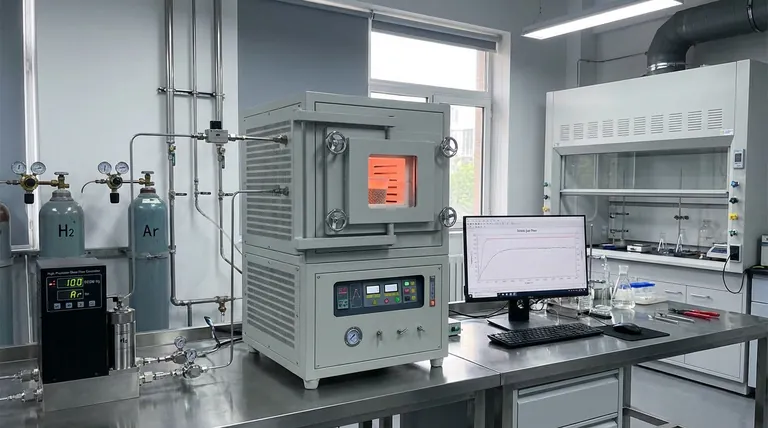
The Critical Role of Chemical Potential
Defining the Reactive Environment
In a reducing atmosphere, the gas is not merely a passive medium; it is an active participant in the chemical reaction. The concentration and supply rate of the gas directly dictate the chemical potential inside the furnace.
Stability Through Precision
A high-precision system, often operating at rates around 100 sccm, locks this chemical potential in place. Without this control, the driving force behind the chemical reduction would vary, leading to unpredictable results.
Ensuring Experimental Repeatability
Controlling Mass Loss
The reduction of vermiculite involves specific mass loss events that must be measured accurately. A stable gas supply ensures that the rate of reduction is governed by the material properties, not by erratic changes in gas availability.
Managing Phase Transitions
Vermiculite undergoes distinct phase transitions when subjected to heat in a reducing atmosphere. These transitions are sensitive to the immediate chemical environment; consistent flow ensures these structural changes occur at predictable and repeatable intervals.
Understanding the Risks of Flow Instability
The Impact of Fluctuations
Even minor deviations in gas flow can disrupt the chemical equilibrium at the sample surface. This can lead to incomplete reduction or non-uniform phase changes, rendering experimental data unreliable.
Sensitivity at Low Flow Rates
The requirement for specific flow rates, such as 100 sccm, highlights the process sensitivity. At these relatively low volumes, standard flow meters may lack the resolution required to prevent significant percentage errors in the gas mixture supply.
Making the Right Choice for Your Goal
To ensure the validity of your vermiculite heat treatment data, select your equipment based on your specific experimental priorities.
- If your primary focus is reproducing phase transitions: Prioritize a mass flow controller that guarantees zero drift over long duration runs to maintain constant chemical potential.
- If your primary focus is quantifying mass loss: Ensure the system offers rapid response times to maintain stable flow (e.g., 100 sccm) even as furnace pressures or temperatures fluctuate.
Reliable material characterization is impossible without the absolute atmospheric stability provided by high-precision flow control.
Summary Table:
| Feature | Impact on Vermiculite Treatment | Benefit of Precision Control |
|---|---|---|
| Chemical Potential | Dictates the driving force of reduction | Maintains a stable, constant reactive environment |
| Flow Rate (e.g. 100 sccm) | Low volume sensitivity to fluctuations | Prevents atmospheric drift and experimental error |
| Phase Transitions | Highly sensitive to local gas concentration | Ensures predictable and repeatable structural changes |
| Mass Loss | Governed by gas availability and reaction rate | Allows for accurate quantification of material reduction |
Elevate Your Thermal Research with KINTEK Precision
Don't let atmospheric instability compromise your experimental data. At KINTEK, we understand that high-precision control is the difference between breakthrough results and failed trials. Backed by expert R&D and world-class manufacturing, we provide high-performance Muffle, Tube, Rotary, Vacuum, and CVD systems—all fully customizable to integrate high-precision mass flow controllers for your specific vermiculite or material science applications.
Ready to achieve absolute thermodynamic stability? Contact our technical experts today to design a custom high-temperature solution tailored to your laboratory's unique needs.
References
- Ayoub Lahchich, Celia Marcos. Heat Treatment at 1000 °C under Reducing Atmosphere of Commercial Vermiculites. DOI: 10.3390/min14030232
This article is also based on technical information from Kintek Furnace Knowledge Base .
Related Products
People Also Ask
- What controlled-atmosphere furnace conditions are required for sintering powder metallurgy copper alloy compacts? Ideal Setup
- What causes discrepancies between theoretical and experimental grain boundary mobility during ceramic sintering? Explained
- What are the key benefits of precise temperature control in a controlled atmosphere furnace? Unlock Superior Quality and Efficiency
- What types of gases are used in controlled atmosphere furnaces? Optimize Material Protection and Transformation
- How Sintering Temp Affects Density & Resistivity of Cu-Oxide Composites
