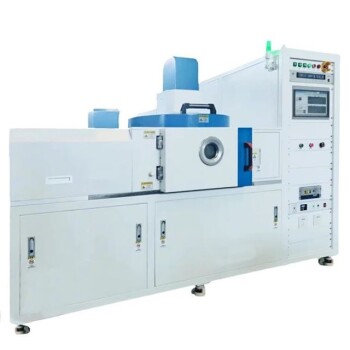
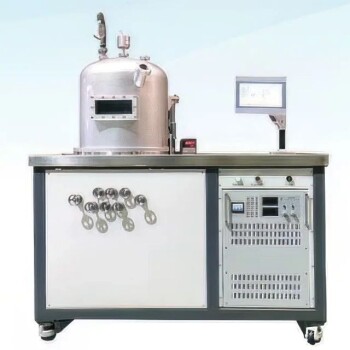
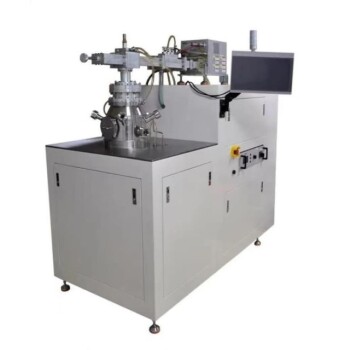
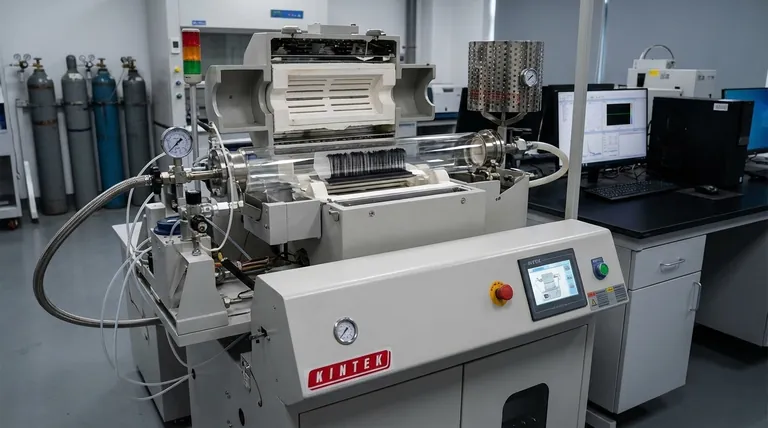
A Chemical Vapor Deposition (CVD) system serves as the precise regulatory environment required to transform gaseous carbon precursors into solid, high-performance nanostructures. By rigorously controlling thermal zone temperatures, reaction duration, and specific gas ratios (such as acetylene and hydrogen), the system facilitates the directional growth of carbon atoms at catalyst sites. This control is the deciding factor in producing vertically aligned carbon nanotubes (VACNTs) with the high purity and crystallinity necessary for advanced applications like dry spinning.
The CVD system contributes to high-performance synthesis not merely by heating materials, but by orchestrating the exact kinetic environment—temperature, flow, and time—required for carbon atoms to self-assemble into defect-free, vertically aligned structures.
The Mechanics of Controlled Synthesis
To understand how a CVD system creates "high-performance" nanotubes rather than standard carbon soot, one must look at the specific parameters it regulates.
Precise Thermal Zone Management
The system does not just heat the chamber; it maintains specific thermal zone temperatures.
This capability allows for the creation of precise reaction environments (often between 800°C and 1100°C depending on the specific tube configuration).
By controlling the temperature profile, the system ensures the catalyst is active enough to crack the carbon source but not so hot that it causes uncontrolled agglomeration or defects.
Optimization of Precursor Ratios
High-performance synthesis relies heavily on the ratio of precursor gases, specifically the balance between carbon sources (like acetylene) and carrier/reducing gases (like hydrogen).
The CVD system regulates these flows to ensure the carbon supply matches the catalyst's uptake rate.
This balance prevents the catalyst from being "poisoned" by excess amorphous carbon, ensuring the nanotubes continue to grow without structural termination.
Achieving High-Performance Material Properties
The physical architecture of the CVD system directly translates into the physical properties of the carbon nanotubes (CNTs).
Directional Growth and Alignment
A critical contribution of the CVD system is its ability to foster directional growth at catalyst sites on a substrate.
Through advanced airflow control and vertical configurations, the system encourages nanotubes to grow perpendicular to the substrate.
This results in Vertically Aligned Carbon Nanotubes (VACNTs), which are essential for applications requiring organized arrays rather than tangled messes.
Purity and Crystallinity
The ultimate measure of a CNT's performance is its crystallinity—the degree of order in its atomic lattice.
By maintaining a stable reaction environment over a set duration, the CVD system minimizes defects in the carbon wall structure.
High crystallinity correlates directly with high purity, making these nanotubes robust enough for mechanical processes like dry spinning into fibers.
Understanding the Trade-offs
While CVD systems are powerful, they are sensitive to variable interactions.
The Complexity of Upscaling
Achieving high crystallinity often requires slower growth rates or highly specific gas ratios.
Pushing the system for faster output (higher throughput) can disrupt the thermal equilibrium, leading to lower graphitization degrees or increased defects.
Parameter Sensitivity
The system's strength—precision—is also its operational challenge.
Slight deviations in the acetylene-to-hydrogen ratio or minor fluctuations in thermal zones can drastically alter the aspect ratio and alignment of the resulting nanotubes.
Making the Right Choice for Your Goal
When evaluating CVD parameters for CNT synthesis, align the system's capabilities with your end-use requirements.
- If your primary focus is Fiber Production (Dry Spinning): Prioritize systems that demonstrate excellent control over vertical alignment and high crystallinity to ensure mechanical strength.
- If your primary focus is Electronic Grade Material: Focus on systems capable of higher temperature ranges (e.g., 1100°C) and precise liquid source injection to minimize bundle diameter and maximize purity.
Ultimately, the value of a CVD system lies in its ability to maintain a thermodynamically stable environment that forces carbon atoms to assemble into ordered, crystalline structures rather than amorphous soot.
Summary Table:
| Key Parameter | Impact on CNT Synthesis | Benefit to Performance |
|---|---|---|
| Thermal Zone Management | Maintains optimal catalyst activity (800°C - 1100°C) | Prevents defects and catalyst agglomeration |
| Gas Precursor Ratios | Balances carbon supply with catalyst uptake | Ensures high purity and prevents catalyst poisoning |
| Directional Control | Fosters growth perpendicular to the substrate | Produces Vertically Aligned CNTs (VACNTs) |
| Reaction Stability | Facilitates ordered atomic lattice formation | Enhances crystallinity for mechanical dry spinning |
Elevate Your Nanomaterial Research with KINTEK
Precision is the difference between amorphous soot and high-performance carbon nanotubes. Backed by expert R&D and world-class manufacturing, KINTEK provides advanced CVD systems, Muffle, Tube, Rotary, and Vacuum furnaces designed to master the exact kinetic environments your research demands.
Whether you are scaling up fiber production or developing electronic-grade materials, our systems are fully customizable to meet your unique thermal and gas-flow requirements. Don't leave your synthesis to chance.
Contact our furnace experts today to optimize your CVD process.
Visual Guide

References
- Yeonggwon Kim, Hyung Woo Lee. All‐Dry Fabricated Core–Sheath Carbon Nanotube Yarn Electrode for Fiber‐Shaped Dye‐Sensitized Solar Cells. DOI: 10.1002/sstr.202500302
This article is also based on technical information from Kintek Furnace Knowledge Base .
Related Products
- 915MHz MPCVD Diamond Machine Microwave Plasma Chemical Vapor Deposition System Reactor
- Custom Made Versatile CVD Tube Furnace Chemical Vapor Deposition CVD Equipment Machine
- RF PECVD System Radio Frequency Plasma Enhanced Chemical Vapor Deposition
- MPCVD Machine System Reactor Bell-jar Resonator for Lab and Diamond Growth
- HFCVD Machine System Equipment for Drawing Die Nano Diamond Coating
People Also Ask
- What is the MPCVD method and why is it considered effective for diamond deposition? Superior Purity & High Growth Rates
- What factors influence the quality of diamond deposition in the MPCVD method? Master the Critical Parameters for High-Quality Diamond Growth
- What are some key features and benefits of the microwave plasma chemical vapor deposition system? Achieve Unmatched Material Synthesis
- What is the purpose of a microwave plasma chemical vapor deposition system? Grow High-Purity Diamonds and Advanced Materials
- What is the basic principle of operation for the microwave plasma chemical vapor deposition system? Unlock High-Purity Material Growth