
Comparing air and nitrogen atmospheres allows researchers to isolate the specific impact of oxygen on device performance. While nitrogen annealing reveals the effects of heat on crystallinity and elemental diffusion, annealing in air introduces oxidative passivation. By contrasting these two environments, you can determine exactly which mechanism is driving improvements in the solar cell's open-circuit voltage ($V_{oc}$).
This comparison is essential for deconstructing performance gains: Nitrogen tests thermal effects on structure, while air tests chemical passivation, enabling precise attribution of efficiency improvements.
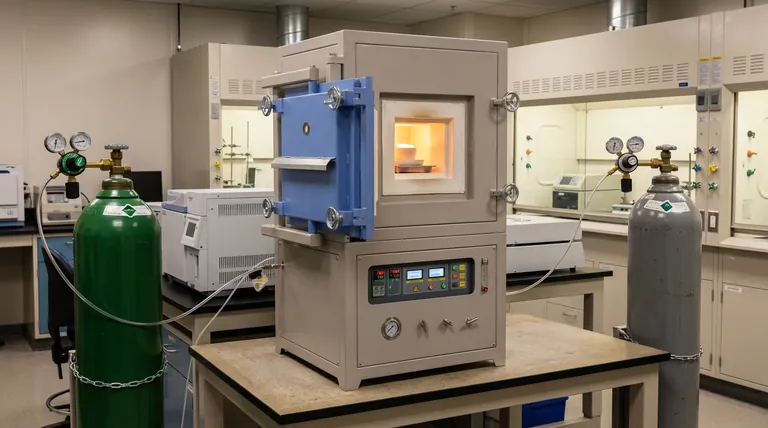
The Role of the Nitrogen Atmosphere
Thermal Effects on Crystallinity
In a nitrogen ($N_2$) environment, the post-annealing process is dominated by thermal dynamics rather than chemical reactions. The primary outcome of this treatment is the modification of the crystallinity of the CdS layer. This allows you to observe how heat alone improves the structural integrity of the buffer layer.
Interfacial Diffusion
Nitrogen annealing also facilitates the mutual diffusion of elements at the interface between layers. Because the environment is inert, you can study how elements migrate and settle at the junction without the interference of surface oxidation. This establishes a baseline for how the device structure evolves under heat.
The Role of the Air Atmosphere
Introducing Oxidative Passivation
The critical variable introduced by an air atmosphere is oxygen. Unlike the inert nitrogen environment, air annealing actively modifies the chemistry of the device through oxidative passivation. This process addresses surface states that thermal annealing alone cannot fix.
Targeting the Absorber Surface
This passivation specifically targets the surface of the CZTS absorption layer. By exposing the device to oxygen during heat treatment, you effectively reduce surface defects. This chemical modification is a key contributor to minimizing recombination losses.
Understanding the Trade-offs
The Problem of Combined Variables
If you only perform annealing in air, you cannot distinguish the source of your improvements. A gain in performance could be due to better crystallinity (thermal) or reduced surface defects (chemical).
The Necessity of Deconstruction
Comparing the two atmospheres solves this analytical problem. It allows for the deconstruction of processing factors. By subtracting the baseline effects observed in nitrogen from the results observed in air, you isolate the exact contribution of oxygen to the device's open-circuit voltage.
Deciphering Your Device Performance
To effectively optimize your CZTS solar cells, you must treat these atmospheres as diagnostic tools rather than just processing steps.
- If your primary focus is structural analysis: Use the nitrogen atmosphere results to evaluate changes in CdS crystallinity and elemental diffusion at the interface.
- If your primary focus is maximizing voltage: Use the air atmosphere results to measure the specific gain provided by oxidative passivation of the CZTS surface.
Systematically comparing these atmospheres transforms post-annealing from a general heat treatment into a precise method for engineering higher-efficiency solar cells.
Summary Table:
| Feature | Nitrogen (N2) Atmosphere | Air Atmosphere |
|---|---|---|
| Primary Role | Inert Thermal Treatment | Oxidative Passivation |
| Impact on Layer | Improves CdS Crystallinity | Targets CZTS Absorber Surface |
| Mechanism | Elemental Mutual Diffusion | Chemical Surface Modification |
| Key Outcome | Establishes Structural Baseline | Minimizes Recombination Losses |
| Target Metric | Interface Integrity | Open-Circuit Voltage ($V_{oc}$) |
Precision Heat Treatment for High-Efficiency Devices
Optimizing CZTS performance requires more than just heat; it requires exact atmospheric control. Backed by expert R&D and manufacturing, KINTEK offers high-performance Muffle, Tube, Rotary, Vacuum, and CVD systems designed to handle diverse gas environments. Our customizable lab high-temp furnaces provide the stability and precision needed to isolate variables like oxidative passivation and thermal diffusion.
Ready to elevate your solar cell research? Contact KINTEK today to find the perfect customizable solution for your unique materials processing needs!
Visual Guide

References
- Mungunshagai Gansukh, Stela Canulescu. The effect of post-annealing on the performance of the Cu2ZnSnS4 solar cells. DOI: 10.1038/s41598-024-70865-x
This article is also based on technical information from Kintek Furnace Knowledge Base .
Related Products
- Controlled Inert Nitrogen Hydrogen Atmosphere Furnace
- Vacuum Heat Treat Furnace with Ceramic Fiber Liner
- 2200 ℃ Graphite Vacuum Heat Treat Furnace
- Vacuum Heat Treat Sintering Furnace with Pressure for Vacuum Sintering
- Vacuum Heat Treat Sintering and Brazing Furnace
People Also Ask
- What are the characteristics and uses of hydrogen atmosphere in furnaces? Achieve Superior Surface Purity and Bonding
- What are the characteristics and uses of hydrogen atmospheres in furnaces? Unlock Clean Metal Processing
- Mechanism of Fe81Ga19 Secondary Recrystallization? High-Precision Furnace Control for Goss Grain Growth
- How does a controlled atmosphere furnace contribute to energy efficiency? Lower Costs with Advanced Thermal Management
- Why is controlled atmosphere capability important in an atmosphere furnace? Unlock Precise Material Processing











