
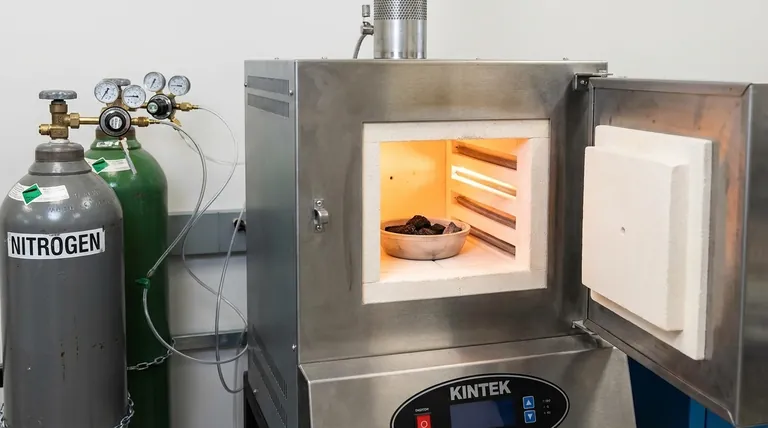
Industrial-grade nitrogen functions as a critical isolation barrier throughout the biochar production process. Its primary purpose is to displace normal atmospheric air within the furnace, creating an oxygen-free environment that prevents the raw biomass from igniting into flames and burning down to ash.
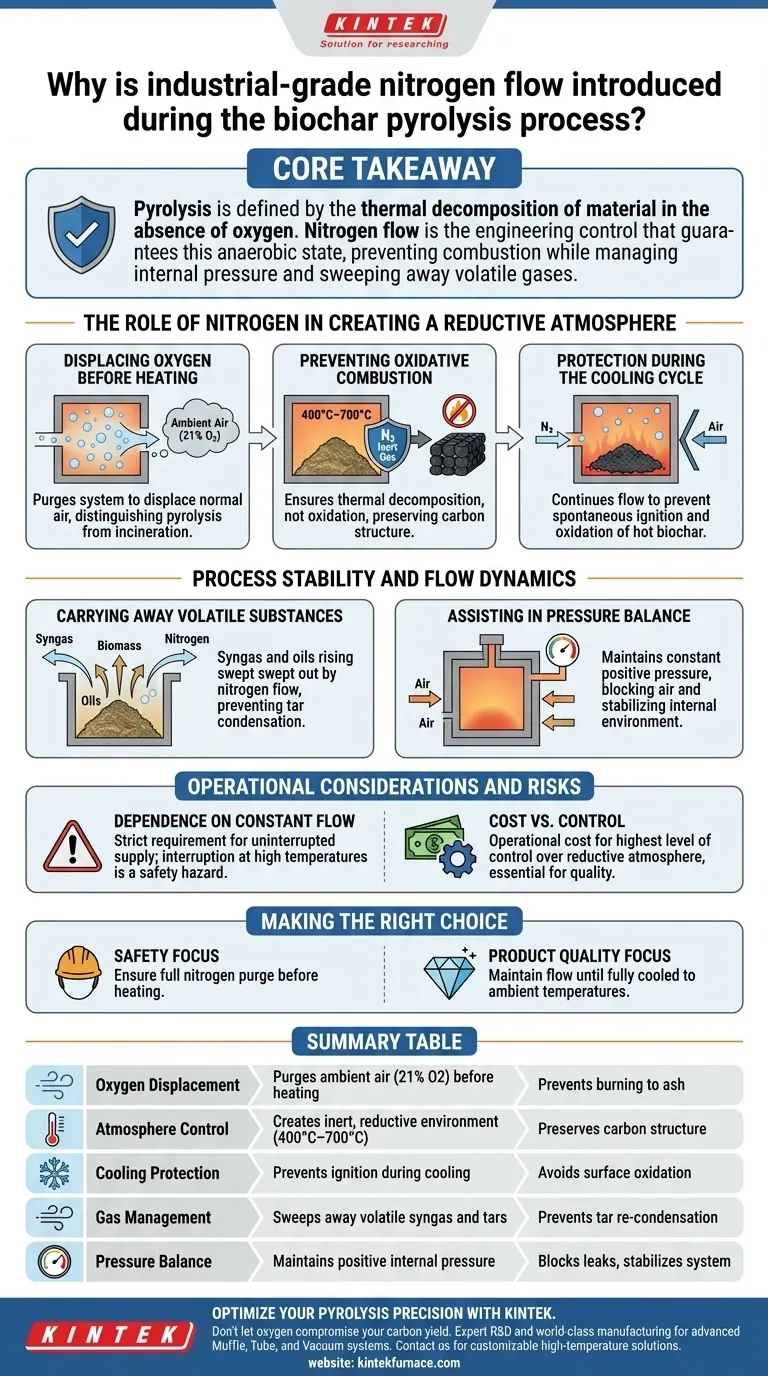
Core Takeaway Pyrolysis is defined by the thermal decomposition of material in the absence of oxygen. Nitrogen flow is the engineering control that guarantees this anaerobic state, preventing combustion while managing internal pressure and sweeping away volatile gases.
The Role of Nitrogen in Creating a Reductive Atmosphere
Displacing Oxygen Before Heating
Before the heating elements are ever engaged, nitrogen is pumped into the furnace to purge the system.
This initial flush pushes out the ambient air, which contains roughly 21% oxygen. Removing this oxygen is the foundational step that distinguishes pyrolysis from simple incineration.
Preventing Oxidative Combustion
If biomass is heated to pyrolysis temperatures (often 400°C–700°C) in the presence of oxygen, it will combust.
Nitrogen serves as an inert protective gas, ensuring the material undergoes thermal decomposition rather than oxidation. This preserves the carbon structure of the biomass, resulting in solid biochar rather than white ash.
Protection During the Cooling Cycle
The need for nitrogen extends beyond the active heating phase.
Nitrogen flow must continue during the cooling cycle to protect the newly formed hot biochar. If air enters the chamber while the biochar is still hot, the material can spontaneously ignite or oxidize, ruining the final product quality.
Process Stability and Flow Dynamics
Carrying Away Volatile Substances
As biomass heats up, it releases a significant volume of volatile gases (syngas) and oils.
The continuous flow of nitrogen helps sweep these released substances out of the reaction zone. This prevents the re-condensation of tars on the biochar and keeps the reaction pathways clear.
Assisting in Pressure Balance
Pyrolysis reactors are closed systems that can experience rapid pressure changes as gases are generated.
The regulated input of nitrogen assists in maintaining a constant, positive pressure balance within the furnace. This prevents external air from leaking in and helps stabilize the internal environment against dangerous pressure spikes.
Operational Considerations and Risks
Dependence on Constant Flow
The primary trade-off of using nitrogen is the strict requirement for uninterrupted supply.
Because nitrogen is the only barrier preventing fire, any interruption in flow during high temperatures can lead to immediate safety hazards. Operators must ensure a consistent source of industrial-grade nitrogen is available for the entire duration of the heating and cooling timeline.
Cost vs. Control
Using industrial-grade nitrogen introduces an operational cost compared to systems that might use self-generated gases.
However, this cost is the price of precision; it offers the highest level of control over the reductive atmosphere, which is essential for producing standardized, high-quality biochar.
Making the Right Choice for Your Goal
To maximize the effectiveness of nitrogen in your pyrolysis system, focus on the timing and consistency of the flow.
- If your primary focus is Safety: Ensure the furnace is fully purged with nitrogen to displace all air before the temperature begins to rise.
- If your primary focus is Product Quality: Maintain nitrogen flow until the biochar has fully cooled to ambient temperatures to prevent surface oxidation.
Nitrogen is not just a utility; it is the defining variable that allows pyrolysis to occur safely and effectively.
Summary Table:
| Function of Nitrogen | Purpose in Pyrolysis Process | Impact on Biochar Quality |
|---|---|---|
| Oxygen Displacement | Purges ambient air (21% O2) before heating starts | Prevents biomass from burning to ash |
| Atmosphere Control | Creates an inert, reductive environment (400°C–700°C) | Preserves carbon structure and integrity |
| Cooling Protection | Prevents spontaneous ignition during the cooling cycle | Avoids surface oxidation of hot biochar |
| Gas Management | Sweeps away volatile syngas and condensable tars | Prevents tar re-condensation on products |
| Pressure Balance | Maintains positive internal furnace pressure | Blocks external air leaks and stabilizes system |
Optimize Your Pyrolysis Precision with KINTEK
Don't let oxygen compromise your carbon yield. At KINTEK, we understand that the difference between high-quality biochar and waste ash lies in precise atmospheric control. Backed by expert R&D and world-class manufacturing, we provide advanced Muffle, Tube, and Vacuum systems specifically designed to handle rigorous nitrogen flow requirements. Whether you need a standard laboratory furnace or a customizable high-temperature solution, our equipment ensures the anaerobic stability your research and production demand.
Ready to elevate your material processing? Contact KINTEK today to consult with our experts on the perfect furnace for your unique pyrolysis needs.
Visual Guide
References
- João Arthur Antonângelo, Hailin Zhang. Fertilizer potential of biochar and ryegrass productivity in metal-contaminated soil. DOI: 10.3389/fpls.2024.1475939
This article is also based on technical information from Kintek Furnace Knowledge Base .
Related Products
- Electric Rotary Kiln Small Rotary Furnace Biomass Pyrolysis Plant Rotating Furnace
- Electric Rotary Kiln Continuous Working Small Rotary Furnace Kiln for Pyrolysis Plant Heating
- Electric Rotary Kiln Pyrolysis Furnace Plant Machine Small Rotary Kiln Calciner
- Vacuum Dental Porcelain Sintering Furnace for Dental Laboratories
- 1200℃ Controlled Inert Nitrogen Atmosphere Furnace
People Also Ask
- What are the main applications of a rotary kiln electric furnace? Achieve Uniform Heat Treatment for Powders
- What are the key components of a rotary kiln electric furnace? Unlock Efficient Thermal Processing
- What is the significance of the refractory lining in a rotary kiln electric furnace? Unlock Efficiency and Longevity
- What is the benefit of adjustable speed control in rotary kilns? Optimize Efficiency and Quality
- What are the main advantages of using rotary kilns for bulk solids processing? Achieve High-Volume, Uniform Thermal Processing







