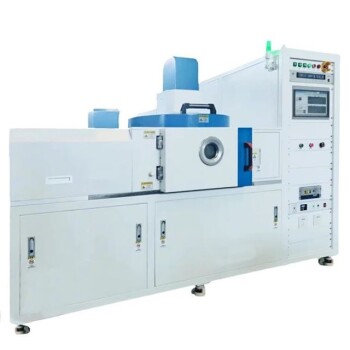
During Temperature Programmed Oxidation (TPO) tests, a mass spectrometer functions as a real-time exhaust analyzer synchronized with a precision heating system. As the catalyst is heated linearly in an oxidative atmosphere, the mass spectrometer continuously monitors the off-gas to detect and quantify reaction products, specifically Carbon Monoxide (CO) and Carbon Dioxide (CO2).
By correlating the release of specific gases with the exact temperature at which they appear, this setup allows researchers to distinguish between different types of carbon deposits. It provides a definitive, objective metric for evaluating a catalyst's ability to resist fouling.
The Mechanics of the Setup
Controlled Linear Heating
The process begins with the heating equipment. The catalyst sample is subjected to a linear temperature ramp, meaning the temperature increases at a constant, controlled rate.
This heating occurs within an oxidative atmosphere. The presence of oxygen is required to convert solid carbon deposits on the catalyst surface into gaseous byproducts.
Real-Time Gas Detection
As the temperature rises, an online mass spectrometer "sniffs" the gas leaving the reactor.
Its primary role is to monitor the intensity of signals corresponding to oxidation products. In this context, it is specifically looking for the emergence of CO and CO2.
Deciphering the "Carbon Fingerprint"
Distinguishing Carbon Species
The combination of heating and mass spectrometry does more than just detect carbon; it characterizes it.
Different forms of carbon possess different chemical stabilities. The system can differentiate between amorphous carbon (less stable) and graphitic carbon (more stable).
Temperature as an Identifier
The mass spectrometer identifies these types based on their oxidation temperatures.
Amorphous carbon will oxidize (burn off) and release CO/CO2 at lower temperatures. Graphitic carbon requires higher temperatures to react. By analyzing when the mass spec signal peaks, researchers identify what type of carbon is present.
Evaluating Catalyst Performance
Objective Structural Analysis
This method provides an objective evaluation of advanced materials, such as the CeAlOx inverse composite structure.
By quantifying the carbon burn-off, researchers can verify the technical advantages of the structure. Specifically, they assess its effectiveness in inhibiting carbon deposition that results from methane (CH4) decomposition.
Interpreting Signal Intensity
The intensity of the mass spectrometry signals serves as a proxy for quantity.
A sharp, intense peak indicates a significant accumulation of a specific carbon type. Conversely, low signal intensity confirms that the catalyst successfully minimized deposition during operation.
Understanding the Analytical Context
The Importance of Resolution
The value of this method relies on the separation of peaks.
If different carbon species oxidize at very similar temperatures, the mass spec signals may overlap.
However, for distinct phases like amorphous versus graphitic carbon, the thermal separation is usually sufficient to provide clear, actionable data regarding the catalyst's condition.
Making the Right Choice for Your Goal
If your primary focus is Catalyst Durability:
- Analyze the total intensity of the CO/CO2 signals to determine the overall volume of carbon deposition caused by CH4 decomposition.
If your primary focus is Material Characterization:
- Examine the temperature points where signals peak to distinguish between soft (amorphous) and hard (graphitic) carbon formations.
If your primary focus is Structural Validation:
- Use the absence of high-temperature peaks to prove that your specific structure (e.g., CeAlOx) successfully inhibits stable carbon formation.
This synchronized approach transforms simple exhaust gas into a detailed map of your catalyst's surface chemistry.
Summary Table:
| Feature | Role in TPO Analysis |
|---|---|
| Heating Equipment | Provides precise linear temperature ramps in oxidative atmospheres. |
| Mass Spectrometer | Performs real-time detection and quantification of CO and CO2 signals. |
| Data Correlation | Matches gas release peaks to specific oxidation temperatures. |
| Carbon Identification | Distinguishes between amorphous (low temp) and graphitic (high temp) carbon. |
| Performance Metric | Quantifies carbon inhibition and structural stability of the catalyst. |
Maximize Your Research Precision with KINTEK
Elevate your catalyst characterization and thermal analysis with high-performance heating solutions. Backed by expert R&D and manufacturing, KINTEK offers Muffle, Tube, Rotary, Vacuum, and CVD systems—all fully customizable to meet the rigorous demands of Temperature Programmed Oxidation (TPO) and other lab high-temp applications.
Whether you are validating inverse composite structures or analyzing carbon fingerprints, our equipment provides the thermal stability and control essential for accurate mass spectrometry integration.
Ready to optimize your lab's capabilities? Contact KINTEK experts today to discuss your custom furnace requirements!
References
- Xin Tang, Lili Lin. Thermally stable Ni foam-supported inverse CeAlOx/Ni ensemble as an active structured catalyst for CO2 hydrogenation to methane. DOI: 10.1038/s41467-024-47403-4
This article is also based on technical information from Kintek Furnace Knowledge Base .
Related Products
- Custom Made Versatile CVD Tube Furnace Chemical Vapor Deposition CVD Equipment Machine
- RF PECVD System Radio Frequency Plasma Enhanced Chemical Vapor Deposition
- Slide PECVD Tube Furnace with Liquid Gasifier PECVD Machine
- 1200℃ Controlled Inert Nitrogen Atmosphere Furnace
- Multi Heating Zones CVD Tube Furnace Machine for Chemical Vapor Deposition Equipment
People Also Ask
- What is a CVD tube furnace and what is its primary function? Discover Precision Thin-Film Deposition
- Why are CVD tube furnace sintering systems indispensable for 2D material research and production? Unlock Atomic-Scale Precision
- How does CVD tube furnace sintering enhance graphene growth? Achieve Superior Crystallinity and High Electron Mobility
- Which industries and research fields benefit from CVD tube furnace sintering systems for 2D materials? Unlock Next-Gen Tech Innovations
- What future trends are expected in the development of CVD tube furnaces? Discover Smarter, More Versatile Systems