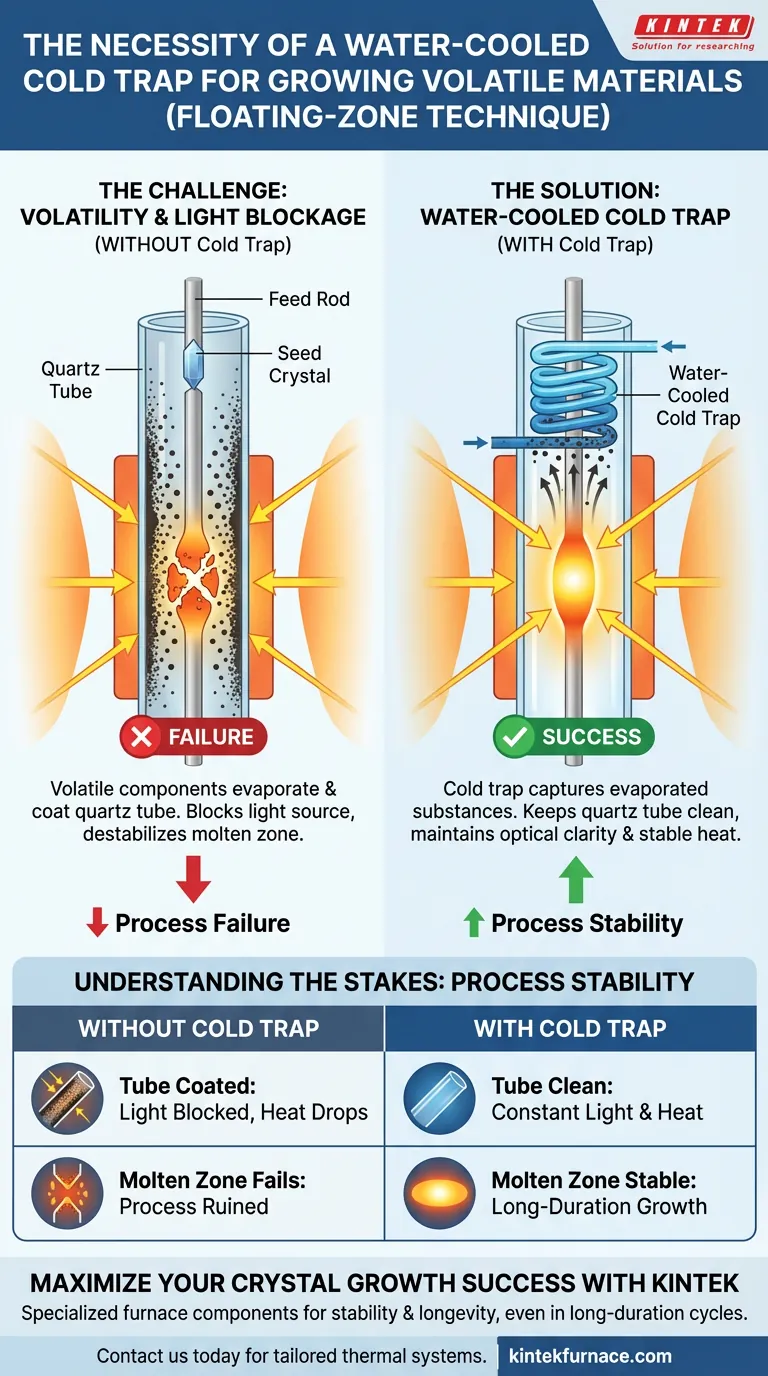
The necessity of a water-cooled cold trap stems directly from the requirement to maintain optical transparency during the crystal growth process. When growing materials with high volatility, evaporating particles inevitably deposit on the quartz tube, blocking the light source needed to sustain the melt and leading to process failure.
Volatile components threaten the stability of the Floating-Zone technique by coating the quartz tube and obstructing the heat source. A water-cooled cold trap mitigates this by providing a sacrificial surface for condensation, ensuring the quartz tube remains clean and light transmittance remains high.
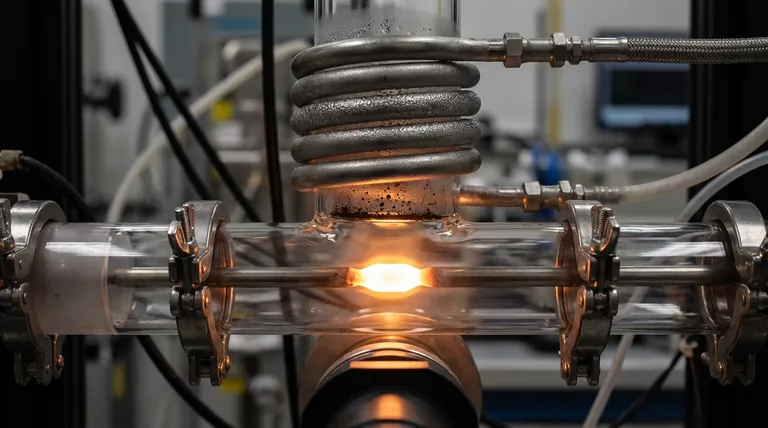
The Challenge of Volatility
The Deposition Mechanism
When materials with volatile components—such as ruthenates—are heated to their melting points, they do not simply transition to liquid. They release evaporated substances into the surrounding atmosphere.
In a standard setup, these substances seek the nearest surface to condense upon. Unfortunately, this is often the inner wall of the quartz tube, where the material accumulates as a dark powder.
The Impact on the Molten Zone
The Floating-Zone technique relies on precise optical heating. External light must pass through the quartz tube to maintain the molten zone.
When the tube becomes coated with dark powder, it blocks this critical light transmission. The resulting drop in thermal energy causes the molten zone to destabilize, often ruining the crystal growth.
How the Cold Trap Solves the Problem
Preferential Capture
A water-cooled cold trap introduces a specific, temperature-controlled surface located above the growth zone.
Because this trap is significantly colder than the surrounding quartz tube, it alters the condensation dynamics. Volatile particles are naturally drawn to this lowest-temperature point.
Maintaining Optical Clarity
By capturing the evaporated substances on the cold trap, the system prevents them from depositing on the quartz tube.
This keeps the optical path clear. With the tube free of obstruction, the heat supply remains constant and predictable. This stability is essential for growth cycles that may span several days.
Understanding the Stakes
The Risk of Omission
It is important to understand that the cold trap is not merely a "cleaning" device; it is a stability control.
Without it, the accumulation of powder creates a feedback loop. As the tube darkens, less heat reaches the sample, forcing the operator to increase power, which can lead to overheating the quartz and potential equipment failure.
Ensuring Process Stability
If your primary focus is growing volatile oxides (e.g., Ruthenates): Install a water-cooled cold trap to divert evaporation away from the quartz tube and prevent light blockage.
If your primary focus is long-duration growth cycles: Rely on the cold trap to maintain consistent light transmittance, ensuring the heat supply does not degrade over days of operation.
The cold trap converts a variable, unstable environment into a controlled system where optical efficiency is preserved.
Summary Table:
| Feature | Impact Without Cold Trap | Solution With Cold Trap |
|---|---|---|
| Quartz Tube | Coated with dark powder/deposits | Remains clean and transparent |
| Light Transmission | Blocked; heat energy drops | Constant and predictable |
| Molten Zone | Destabilizes and fails | Stable for long-duration growth |
| Volatility Risk | Damage to quartz and equipment | Safe capture of volatile particles |
Maximize Your Crystal Growth Success with KINTEK
Don't let material volatility compromise your research. Backed by expert R&D and manufacturing, KINTEK offers high-precision laboratory solutions including customizable Muffle, Tube, Rotary, Vacuum, and CVD systems designed for the most demanding high-temperature applications.
Whether you are growing volatile ruthenates or conducting long-duration growth cycles, our specialized furnace components ensure process stability and equipment longevity. Contact us today to discuss your unique needs and see how our tailored thermal systems can optimize your lab's performance.
Visual Guide
References
- Naoki Kikugawa. Recent Progress of Floating-Zone Techniques for Bulk Single-Crystal Growth. DOI: 10.3390/cryst14060552
This article is also based on technical information from Kintek Furnace Knowledge Base .
Related Products
- Multi Heating Zones CVD Tube Furnace Machine for Chemical Vapor Deposition Equipment
- Stainless Steel Quick Release Vacuum Chain Three Section Clamp
- High Temperature Muffle Oven Furnace for Laboratory Debinding and Pre Sintering
- Vertical Laboratory Quartz Tube Furnace Tubular Furnace
- Ultra High Vacuum CF Observation Window Flange with High Borosilicate Glass Sight Glass
People Also Ask
- What is the function of a multi-zone tube furnace in CVD synthesis? Master 2D In2Se3 Nanosheet Precision
- What environmental protection applications utilize multi zone tube furnaces? Unlock Precision in Waste Treatment and Green Tech
- What role do multi zone tube furnaces play in new energy research? Unlock Precise Thermal Control for Innovation
- What temperature-related capabilities make multi zone tube furnaces valuable for research? Unlock Precision Thermal Control
- Why are multi zone tube furnaces particularly useful for nanomaterial research? Unlock Precise Thermal Control for Advanced Synthesis