Precise thermal regulation is non-negotiable. A vacuum system or controlled cooling device is required during the post-sintering phase to strictly manage the rate of temperature reduction. This controlled process is the only effective way to release mechanical stresses accumulated within the ceramic at high temperatures, thereby preventing structural failure.
The primary function of controlled cooling is to prevent thermal shock. By modulating the temperature drop, manufacturers avoid the formation of micro-cracks, ensuring the structural integrity of large or complex ceramic components.
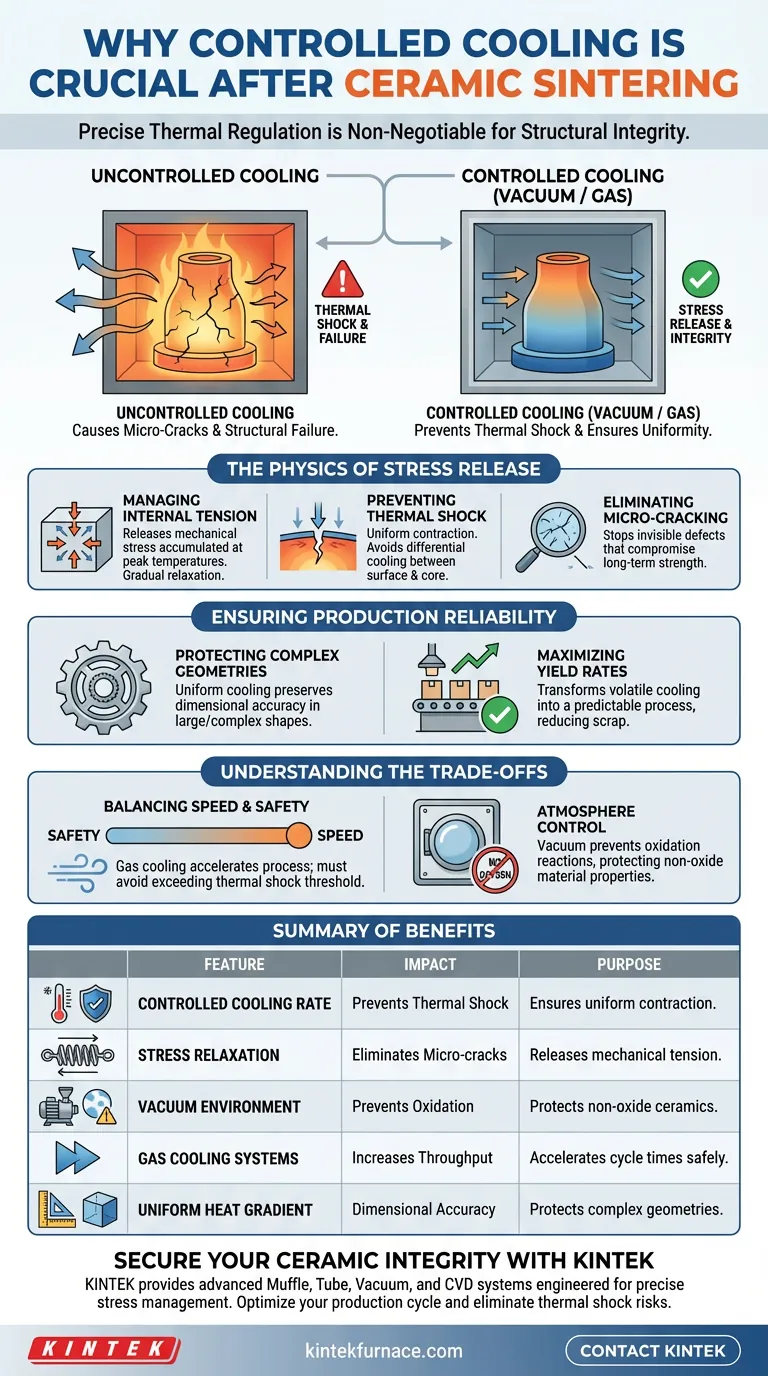
The Physics of Stress Release
Managing Internal Tension
Ceramics accumulate significant mechanical stress when held at peak sintering temperatures.
If the material is allowed to cool naturally or unevenly, these internal stresses become trapped. A controlled cooling system gradually lowers the temperature, allowing the material to relax and release these stresses harmlessly.
Preventing Thermal Shock
Rapid temperature changes trigger thermal shock, a leading cause of catastrophic failure in ceramics.
This phenomenon occurs when the surface cools faster than the core, creating differential contraction. Controlled cooling ensures the temperature gradient remains uniform throughout the part, effectively preventing this destructive reaction.
Eliminating Micro-Cracking
Even if a part does not fracture immediately, uncontrolled cooling often generates micro-cracks.
These microscopic defects compromise the material's long-term strength and performance. By precisely managing the cooling curve, the formation of these invisible but critical flaws is stopped at the source.
Ensuring Production Reliability
Protecting Complex Geometries
Standard cooling methods are often insufficient for large-sized or complex-shaped components.
These parts have varying cross-sections that cool at different rates naturally. A controlled system forces a uniform reduction in temperature, preserving the dimensional accuracy of intricate designs.
Maximizing Yield Rates
The cooling phase is a common point of failure in ceramic manufacturing.
Implementing a vacuum or controlled cooling system directly correlates to a high yield rate. It transforms a volatile cooling step into a predictable process, significantly reducing the number of scrapped parts.
Understanding the Trade-offs
Balancing Speed and Safety
While the primary goal is safety, modern vacuum furnaces can employ gas cooling to accelerate the process.
This allows for faster cycle times, increasing production throughput. However, this must be balanced carefully; increasing the cooling rate too aggressively risks reintroducing thermal shock, specifically in denser materials.
Atmosphere Control
While the primary reference highlights stress management, the vacuum environment plays a secondary protective role.
Maintaining a vacuum during the initial high-temperature cooling phase prevents oxidation reactions, particularly in non-oxide ceramics. It ensures that the material properties preserved during sintering are not degraded as the part cools down.
Making the Right Choice for Your Goal
To optimize your post-sintering process, assess your specific constraints:
- If your primary focus is structural integrity: Prioritize a slow, programmable cooling curve to fully release mechanical stresses and eliminate micro-cracking risks.
- If your primary focus is production throughput: Utilize gas cooling capabilities to shorten cycle times, provided the rate does not exceed the material's thermal shock threshold.
Controlled cooling is not merely a final step; it is the safeguard that solidifies the quality of the entire sintering cycle.
Summary Table:
| Feature | Impact on Ceramic Quality | Purpose in Cooling Phase |
|---|---|---|
| Controlled Cooling Rate | Prevents Thermal Shock | Ensures uniform contraction between core and surface. |
| Stress Relaxation | Eliminates Micro-cracks | Releases mechanical tension accumulated at peak temperatures. |
| Vacuum Environment | Prevents Oxidation | Protects material properties in non-oxide ceramics. |
| Gas Cooling Systems | Increases Throughput | Accelerates cycle times without compromising structural integrity. |
| Uniform Heat Gradient | Dimensional Accuracy | Protects complex geometries from warping or fracturing. |
Secure Your Ceramic Integrity with KINTEK
Don't let uncontrolled cooling ruin your high-performance ceramics. KINTEK provides industry-leading thermal solutions, including advanced Muffle, Tube, Vacuum, and CVD systems, specifically engineered for precise stress management and thermal regulation.
Backed by expert R&D and world-class manufacturing, our customizable lab high-temperature furnaces empower researchers and manufacturers to achieve higher yield rates and flawless structural results. Contact KINTEK today to discover how our tailored cooling technologies can optimize your production cycle and eliminate the risk of thermal shock.
Visual Guide
References
- Wencke Mohring, Christiane Stephan‐Scherb. High-Temperature Corrosion of High- and Medium-Entropy Alloys CrMnFeCoNi and CrCoNi Exposed to a Multi-Oxidant Atmosphere H2O–O2–SO2. DOI: 10.1007/s44210-023-00026-8
This article is also based on technical information from Kintek Furnace Knowledge Base .
Related Products
- Dental Porcelain Zirconia Sintering Ceramic Vacuum Press Furnace
- Vacuum Dental Porcelain Sintering Furnace for Dental Laboratories
- Vacuum Heat Treat Sintering Furnace with Pressure for Vacuum Sintering
- Vacuum Heat Treat Sintering Furnace Molybdenum Wire Vacuum Sintering Furnace
- Chairside Dental Porcelain Zirconia Sintering Furnace with Transformer for Ceramic Restorations
People Also Ask
- What factors determine the quality of sintered zirconia restorations? Master Material, Equipment, and Technique
- How do conventional vs rapid sintering in dental furnaces affect zirconia? Optimize Efficiency Without Sacrificing Strength
- What is the purpose of dental sintering furnaces? Transform Zirconia into Durable, High-Quality Dental Restorations
- What precautions should be taken when sintering zirconia in the Fast Slow Dental Sintering Furnace? Master Key Steps for Perfect Results
- What temperature range is used for sintering zirconia ceramics? Achieve Optimal Strength and Translucency