
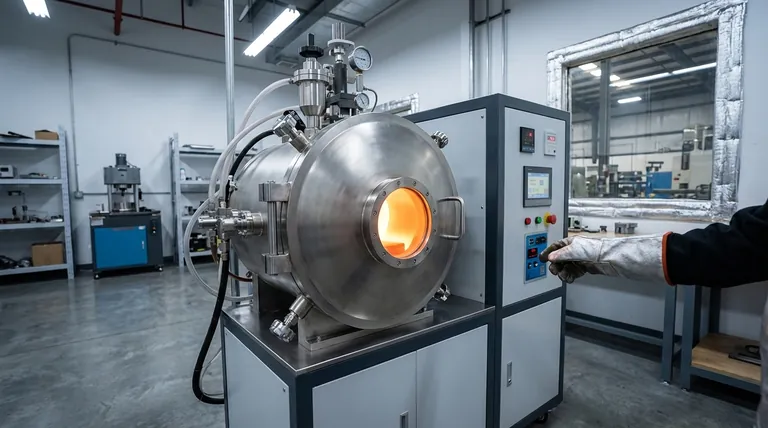
A Vacuum Induction Melting (VIM) furnace is necessary for H13 tool steel production because it creates a controlled, oxygen-free environment that prevents contamination during the critical melting phase. By utilizing electromagnetic induction to heat raw materials within a vacuum chamber, this process actively removes dissolved gases and volatile impurities that would otherwise compromise the structural integrity of the final component.
Core Takeaway Standard atmospheric melting exposes molten steel to reactive gases, resulting in defects that weaken tool steel. The VIM process eliminates these variables, ensuring the H13 steel achieves the strict chemical uniformity and freedom from oxide inclusions required for high-performance applications.
Eliminating Material Defects
The Critical Role of the Vacuum
The primary function of the VIM furnace is to isolate the molten metal from the atmosphere. In standard casting, air reacts with the metal, introducing oxygen and nitrogen.
By maintaining a low-pressure environment, the VIM furnace prevents these gases from reacting with the melt. This effectively stops the formation of oxide inclusions, which are microscopic defects that can lead to premature failure in tool steels.
Active Removal of Impurities
Beyond simply blocking air, the vacuum environment actively cleans the material. It facilitates the removal of dissolved gases and volatile impurities from the molten matrix.
This process ensures that impurity elements, such as phosphorus and sulfur, can be maintained at extremely low levels (typically below 0.01 wt%). This purification is essential for producing "clean" steel with superior mechanical properties compared to standard cast versions.
Ensuring Chemical Precision
Preserving Critical Alloying Elements
H13 tool steel relies on a specific balance of alloying elements to achieve its hardness and heat resistance. In open-air melting, some of these expensive elements can be lost through oxidation (burning off).
The VIM furnace minimizes this oxidation loss. This stability ensures that the final chemical composition matches the exact specifications required, providing a reliable foundation for adding specialized elements like Yttrium if needed.
Thermal and Compositional Control
Induction heating provides a precise, high-temperature source (capable of reaching 1600°C) that melts the charge rapidly and evenly.
The electromagnetic field used in induction also creates a natural stirring action within the molten pool. This guarantees chemical uniformity throughout the batch, preventing segregation where different parts of the metal have different properties.
Understanding the Trade-offs
Process Complexity and Cost
While VIM produces superior steel, it is a more complex and resource-intensive process than air melting. It requires specialized equipment to maintain vacuum integrity and precise temperature control.
Throughput Limitations
The necessity of creating a vacuum environment means VIM is typically a batch process. This can limit production speed compared to continuous casting methods used for lower-grade steels. However, for H13 components, the gain in material performance justifies the reduced throughput.
Making the Right Choice for Your Project
For H13 tool steel components, the melting method dictates the ultimate reliability of the part.
- If your primary focus is High-Performance Durability: Rely on VIM-processed steel to ensure the material is free of inclusions that cause fatigue cracks under stress.
- If your primary focus is Chemical Consistency: Use VIM to guarantee that the alloy composition is uniform and free from the segregation that occurs in standard casting.
The VIM furnace is not just a heating tool; it is a purification system that transforms raw H13 ingredients into a high-integrity engineering material.
Summary Table:
| Feature | VIM Process Benefit | Impact on H13 Steel |
|---|---|---|
| Environment | Oxygen-free Vacuum | Prevents oxide inclusions and structural defects |
| Impurity Removal | Degassing & Volatilization | Lowers sulfur/phosphorus levels for "cleaner" steel |
| Alloy Stability | Minimal Oxidation Loss | Preserves critical alloying elements for heat resistance |
| Homogeneity | Electromagnetic Stirring | Ensures uniform chemical composition across the batch |
| Temperature | Precise Induction Heating | Rapid, even melting up to 1600°C |
Elevate Your H13 Steel Production with KINTEK
Don't compromise on material integrity. KINTEK provides industry-leading vacuum and induction melting solutions designed to eliminate impurities and ensure absolute chemical precision. Backed by expert R&D and manufacturing, we offer Muffle, Tube, Rotary, Vacuum, and CVD systems, all customizable to meet your unique metallurgical needs.
Ready to produce cleaner, stronger H13 components? Contact our experts today to find the perfect high-temp furnace for your laboratory or production line.
References
- A Comparative Study of Directed Energy Deposition‐Arc and Casting: Enhancing Mechanical and Thermal Properties of Hot‐Work Tool Steels. DOI: 10.1002/srin.202500424
This article is also based on technical information from Kintek Furnace Knowledge Base .
Related Products
- Vacuum Induction Melting Furnace
- 600T Vacuum Induction Hot Press Vacuum Heat Treat and Sintering Furnace
- Vacuum Heat Treat Sintering and Brazing Furnace
- Small Vacuum Heat Treat and Tungsten Wire Sintering Furnace
- Vacuum Heat Treat Sintering Furnace Molybdenum Wire Vacuum Sintering Furnace
People Also Ask
- What are the core functions of the High Vacuum Induction Melting (VIM) furnace? Optimize DD5 Superalloy Purification
- What role does a Vacuum Induction Melting furnace play in the production of high-aluminum nickel-based superalloys?
- What is the role of VIM and directional solidification in aero-engine blade substrates? Engineering Extreme Durability
- Why is a Vacuum Induction Melting furnace (VIM) used for Cu-Zn-Al-Sn alloys? Achieve Precision Composition Control
- What are the advantages of using a VIM furnace to control residual oxygen pressure? Achieve Superior Metal Uniformity



















