
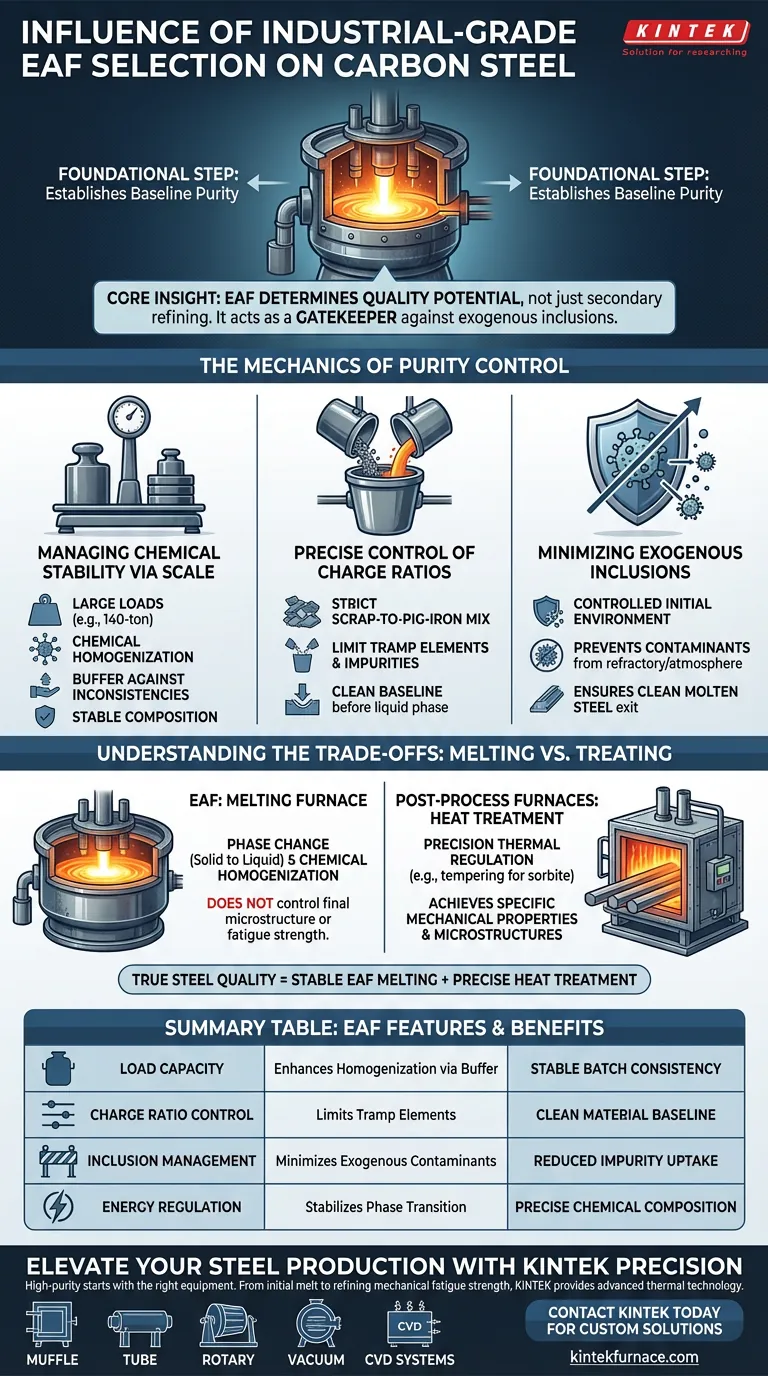
The selection of an industrial-grade Electric Arc Furnace (EAF) is the foundational step in establishing the baseline purity of carbon steel. It influences purity by enabling the precise management of large-scale loads, specifically through the control of energy input and the charging ratio of raw materials. This control is essential for stabilizing the chemical composition and minimizing external contaminants before the steel reaches secondary refining.
Core Insight While secondary refining is often credited with final purity, the EAF determines the quality potential of the melt. By stabilizing the chemical composition of large volumes and optimizing the scrap-to-pig-iron mix, the furnace acts as a gatekeeper against the introduction of exogenous non-metallic inclusions.

The Mechanics of Purity Control
Managing Chemical Stability via Scale
The capacity of an industrial EAF directly impacts the consistency of the steel.
Furnaces designed for large-scale operations, such as those processing 140-ton loads, offer significant advantages in chemical homogenization.
The sheer volume of the melt helps buffer against minor inconsistencies in raw materials, resulting in a more stable chemical composition across the entire batch.
Precise Control of Charge Ratios
The purity of the final product is heavily dictated by what enters the furnace.
High-grade EAFs allow operators to strictly control the "charging ratio" between scrap steel and pig iron.
Optimizing this ratio is the primary method for controlling the initial levels of tramp elements and impurities, setting a clean baseline before the steel is liquid.
Minimizing Exogenous Inclusions
Purity is not just about removing impurities; it is about preventing them.
The EAF provides a controlled initial container environment during the chaotic melting phase.
A properly selected furnace reduces the introduction of exogenous non-metallic inclusions—contaminants that enter the melt from the refractory lining or the atmosphere—ensuring the molten steel leaves the furnace as clean as possible.
Understanding the Trade-offs: Melting vs. Treating
It is critical to distinguish between the furnace used for melting and the furnace used for heat treatment.
The Limit of the EAF
The EAF is designed for phase change (solid to liquid) and chemical homogenization.
It does not control the final microstructure or fatigue strength of the solid steel; its role ends once the molten steel is tapped for refining or casting.
The Role of Post-Process Furnaces
While the EAF sets the purity, achieving specific mechanical properties requires a different equipment set, often confused with melting furnaces.
As noted in supplementary technical context, precise microstructures (such as tempered sorbite) are achieved using high-temperature electric furnaces capable of long tempering cycles (e.g., 120 minutes at 880°C).
Do not expect an EAF to perform the precision thermal regulation required for austenitization or tempering.
Making the Right Choice for Your Goal
To achieve high-integrity carbon steel, you must match the furnace capabilities to your specific stage of production.
- If your primary focus is Melt Cleanliness: Prioritize an EAF with high-capacity load management to ensure chemical stability and reduced inclusion uptake during the solid-to-liquid phase.
- If your primary focus is Mechanical Fatigue Strength: Recognize that while the EAF provides the clean material, you must invest in separate high-stability thermal equipment to control the transformation from martensite to sorbite.
True steel quality is achieved when the stability of the melting furnace is paired with the precision of subsequent heat treatment.
Summary Table:
| Feature | Impact on Carbon Steel Purity | Primary Benefit |
|---|---|---|
| Load Capacity | Enhances chemical homogenization via volume buffering | Stable batch consistency |
| Charge Ratio Control | Limits tramp elements through scrap/pig iron optimization | Clean material baseline |
| Inclusion Management | Minimizes exogenous non-metallic contaminants | Reduced impurity uptake |
| Energy Regulation | Stabilizes solid-to-liquid phase transition | Precise chemical composition |
Elevate Your Steel Production with KINTEK Precision
High-purity carbon steel starts with the right equipment. Whether you are managing the initial melt or refining mechanical fatigue strength, KINTEK provides the advanced thermal technology required for excellence.
Backed by expert R&D and manufacturing, KINTEK offers a comprehensive range of lab and industrial solutions, including Muffle, Tube, Rotary, Vacuum, and CVD systems. Our high-temperature furnaces are fully customizable to meet your unique metallurgical needs, ensuring you achieve the exact microstructures—from austenitization to tempering—that your application demands.
Ready to optimize your heat treatment process? Contact KINTEK today to discuss your custom solution.
Visual Guide
References
- Tomasz Lipiński. Analysis of the Distribution of Non-Metallic Inclusions and Its Impact on the Fatigue Strength Parameters of Carbon Steel Melted in an Electric Furnace. DOI: 10.3390/ma17246151
This article is also based on technical information from Kintek Furnace Knowledge Base .
Related Products
- Electric Rotary Kiln Continuous Working Small Rotary Furnace Kiln for Pyrolysis Plant Heating
- Electric Rotary Kiln Small Rotary Furnace for Activated Carbon Regeneration
- Electric Rotary Kiln Pyrolysis Furnace Plant Machine Small Rotary Kiln Calciner
- Silicon Carbide SiC Thermal Heating Elements for Electric Furnace
- Spark Plasma Sintering SPS Furnace
People Also Ask
- What are the advantages of electric rotary kilns compared to fuel-fired ones? Boost Precision and Efficiency in Your Process
- What materials can be processed in an electric rotary kiln? Versatile Solutions for Advanced Materials
- What advantages do electric rotary kilns offer over fuel-based kilns? Boost Efficiency and Purity in Your Process
- What are the primary applications of electric rotary kilns? Precision Thermal Processing for High-Value Materials
- In what ways are electric rotary kilns more environmentally friendly? Achieve Zero On-Site Emissions
















