
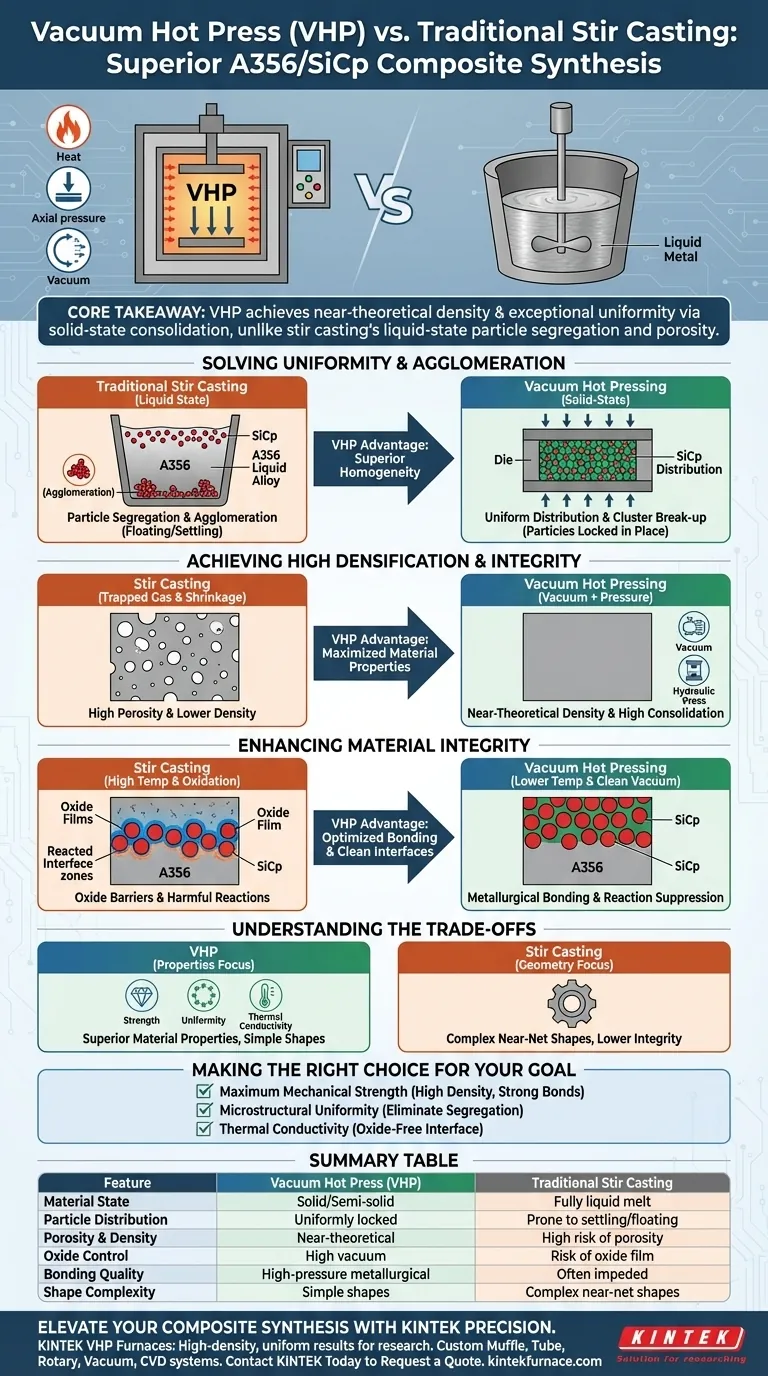
A Vacuum Hot Press (VHP) furnace is the superior choice for high-performance composite synthesis. It is preferred over stir casting primarily because it achieves near-theoretical density and exceptional microstructural uniformity. By applying simultaneous heat, axial pressure, and a vacuum, VHP eliminates common casting defects such as particle agglomeration, floating, and settling.
Core Takeaway While stir casting often results in segregated particles and porosity due to the liquid state of the metal, Vacuum Hot Pressing utilizes solid-state consolidation to lock reinforcing particles in place, ensuring a uniform, dense, and oxidation-free microstructure.

Solving the Uniformity Challenge
Overcoming Particle Segregation
In traditional stir casting, the matrix is fully melted. This liquid state allows SiCp particles to float or settle due to density differences between the ceramic reinforcement and the A356 alloy.
Vacuum Hot Pressing avoids this by using a solid-state or semi-solid process. Because the matrix does not fully melt into a free-flowing liquid, the reinforcing particles are locked in position, ensuring a homogeneous distribution throughout the material.
Eliminating Agglomeration
Fine particles tend to clump together (agglomerate) in liquid melts, creating weak points in the composite.
The VHP process applies significant axial pressure during sintering. This pressure forces the matrix material to flow plastically around the reinforcements, effectively breaking up clusters and preventing the agglomeration that plagues stir casting.
Achieving High Densification
Stir casting is prone to porosity caused by trapped gases or shrinkage during solidification.
VHP produces materials with extremely high density. The combination of vacuum (to remove gas) and high pressure (to close voids) consolidates the material to a level that casting methods simply cannot match.
Enhancing Material Integrity
Breaking the Oxide Barrier
Aluminum alloys like A356 naturally form stubborn oxide films that impede bonding between particles.
The high pressure and temperature in a VHP furnace induce plastic deformation. This deformation physically breaks these oxide films, exposing fresh metal surfaces and inducing true metallurgical bonding between the A356 matrix and the SiCp reinforcement.
Inhibiting Harmful Interfacial Reactions
At the high temperatures required for full melting in stir casting, aluminum can react chemically with silicon carbide, degrading the mechanical properties of the composite.
VHP allows for processing at lower temperatures. This suppresses these harmful chemical reactions, preserving the integrity of both the matrix and the reinforcement.
Preventing Matrix Oxidation
A356 is sensitive to oxidation at high temperatures, which introduces brittle inclusions into the final product.
The high vacuum environment (often <0.1 Pa) of a VHP furnace eliminates oxygen during the heating phase. This ensures clean interfaces and significantly higher thermal conductivity and mechanical strength compared to processing in air or inert gas covers.
Understanding the Trade-offs
Geometry vs. Property Quality
While VHP offers superior material properties, it is a batch process that typically produces simple shapes (discs, cylinders) requiring subsequent machining.
Stir casting can produce complex near-net shapes but sacrifices internal structural integrity. VHP is the trade-off you make when material performance is more critical than geometric complexity or high-volume throughput.
Making the Right Choice for Your Goal
- If your primary focus is Maximum Mechanical Strength: Choose the VHP furnace to ensure high density and strong metallurgical bonding without brittle reaction products.
- If your primary focus is Microstructural Uniformity: Rely on VHP to eliminate particle settling, floating, and agglomeration common in liquid processing.
- If your primary focus is Thermal Conductivity: Use VHP to ensure an oxide-free interface that maximizes heat transfer efficiency.
By leveraging the synergy of vacuum, pressure, and temperature, VHP transforms A356/SiCp from a simple mixture into a high-performance engineering material.
Summary Table:
| Feature | Vacuum Hot Press (VHP) | Traditional Stir Casting |
|---|---|---|
| Material State | Solid-state or semi-solid | Fully liquid melt |
| Particle Distribution | Uniformly locked in position | Prone to settling and floating |
| Porosity & Density | Near-theoretical density | High risk of gas porosity |
| Oxide Control | High vacuum removes oxygen | Risk of oxide film formation |
| Bonding Quality | High-pressure metallurgical bond | Often impeded by interfaces |
| Shape Complexity | Simple shapes (discs/cylinders) | Complex near-net shapes |
Elevate Your Composite Synthesis with KINTEK Precision
Don't let particle agglomeration or oxidation compromise your material integrity. KINTEK provides industry-leading Vacuum Hot Press (VHP) furnaces designed to deliver the high-density and microstructural uniformity your research demands.
Backed by expert R&D and manufacturing, KINTEK offers a comprehensive range of Muffle, Tube, Rotary, Vacuum, and CVD systems. All our lab high-temp furnaces are fully customizable to meet your unique processing needs, ensuring you achieve maximum mechanical strength and thermal conductivity every time.
Ready to optimize your high-performance materials?
Contact KINTEK Today to Request a Quote
Visual Guide
Related Products
- Vacuum Hot Press Furnace Machine for Lamination and Heating
- Vacuum Hot Press Furnace Machine Heated Vacuum Press
- Vacuum Hot Press Furnace Machine Heated Vacuum Press Tube Furnace
- 600T Vacuum Induction Hot Press Vacuum Heat Treat and Sintering Furnace
- Vacuum Heat Treat Sintering Furnace with Pressure for Vacuum Sintering
People Also Ask
- What are the primary components of a vacuum hot press furnace? Master the Core Systems for Precise Material Processing
- What safety features are incorporated in vacuum hot press furnaces? Ensure Operator and Equipment Protection
- What are the benefits of the vacuum environment system in a vacuum hot press furnace? Unlock High-Density Sintering
- What industries benefit from the use of vacuum hot press furnaces? Unlock High-Performance Materials for Your Industry
- How does the uniaxial pressure applied by a vacuum hot press furnace affect the microstructure of ZrC-SiC materials?



















