
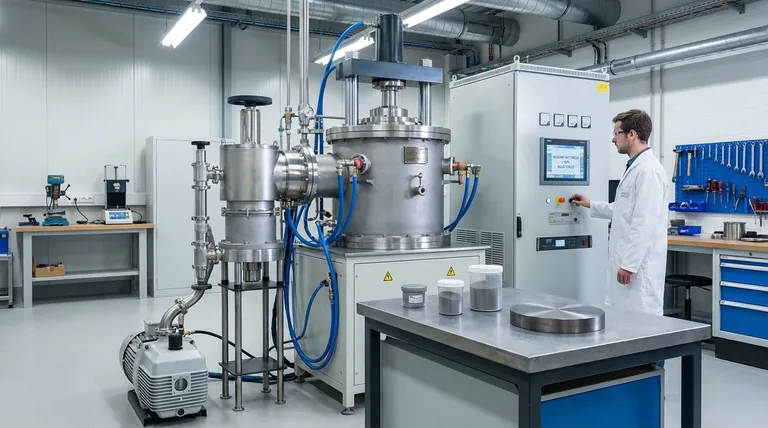
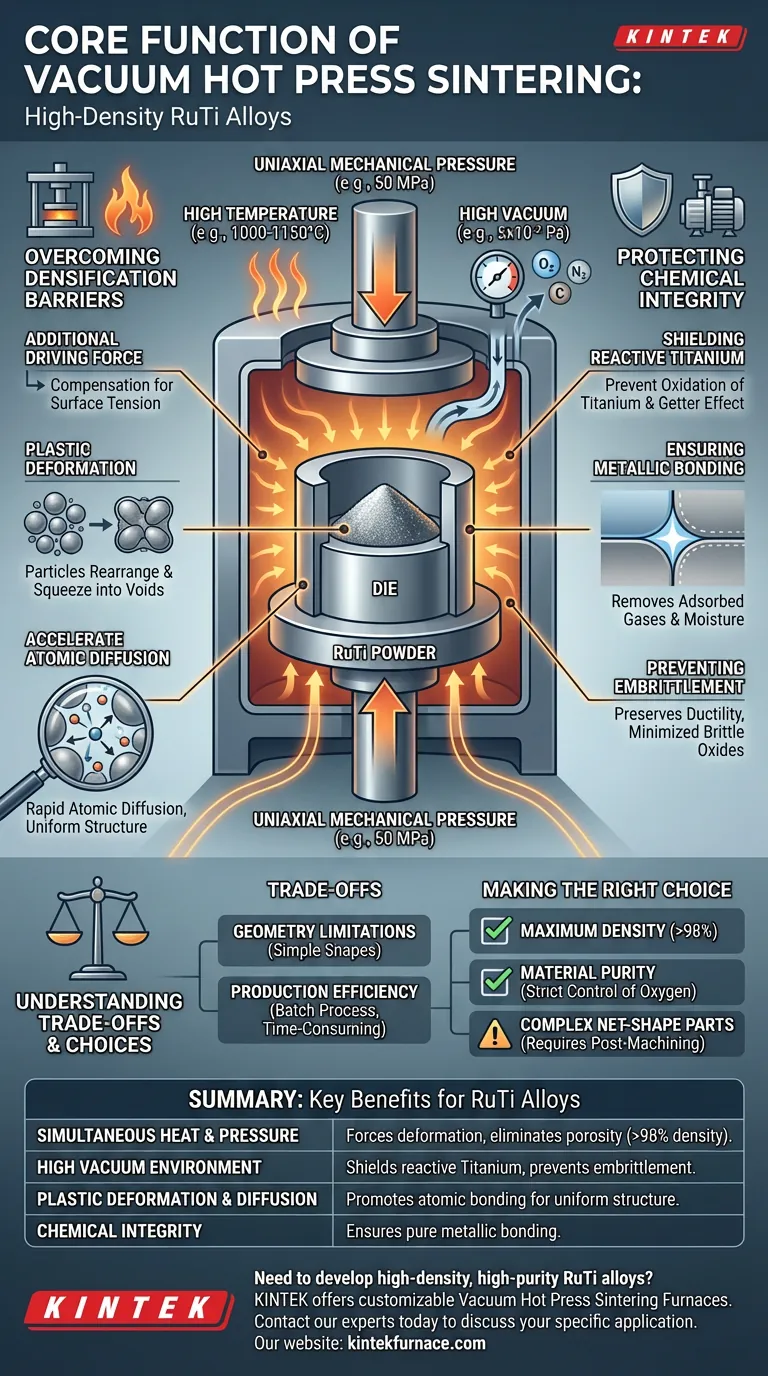
The core function of a vacuum hot press sintering furnace is the simultaneous application of high temperature, high vacuum, and uniaxial mechanical pressure. Specifically for RuTi (Ruthenium-Titanium) alloys, this equipment acts as a forced densification system. It overcomes the natural resistance of refractory materials to sinter by physically crushing powder particles together while chemically shielding the highly reactive titanium from oxidation.
The Bottom Line: Conventional heating is often insufficient to densify refractory RuTi alloys due to high surface tension and material hardness. Vacuum hot pressing provides the necessary external driving force (pressure) to achieve near-theoretical density, while the vacuum environment prevents the formation of brittle oxides that would ruin the alloy's ductility.
Overcoming the Barriers to Densification
For refractory alloys like RuTi, achieving high density is a contest against the material's own physical properties. The furnace serves as a tool to bypass these natural limitations through mechanical force.
Providing Additional Driving Force
In conventional sintering, particles bond solely through thermal energy. For RuTi, this is often insufficient to overcome surface tension.
The furnace applies significant mechanical pressure (e.g., 50 MPa). This acts as an external driving force that effectively compensates for neutralized surface tension.
Promoting Plastic Deformation
The combination of heat (e.g., 1000-1150°C) and pressure forces the metal powder particles to physically rearrange.
This leads to significant plastic deformation at the contact points. The particles are squeezed into voids, effectively eliminating porosity and creating a solid, high-density block.
Accelerating Atomic Diffusion
Pressure does not just squeeze the material; it activates kinetics.
By increasing the contact area between particles, the furnace facilitates rapid atomic diffusion. This ensures strong metallurgical bonding and promotes the formation of a uniform, high-hardness alloy structure.
Protecting Chemical Integrity
The "Vacuum" component of the furnace is just as critical as the "Press," particularly because Titanium is involved.
Shielding Reactive Titanium
Titanium and its alloys are extremely sensitive to interstitial elements like Oxygen, Nitrogen, and Carbon at high temperatures.
Without a vacuum, Titanium acts as a "getter," absorbing these gases. This leads to contamination and the formation of brittle compounds that degrade the alloy's mechanical properties.
Ensuring Metallic Bonding
The high vacuum environment (e.g., 5x10⁻² Pa) actively cleans the material during the process.
It removes adsorbed gases and moisture from the surface of the pre-alloyed powders. This purification of the interfaces ensures that when particles touch, they form a true metallic bond rather than being separated by an oxide layer.
Preventing Embrittlement
By isolating the alloy from impurity gases, the furnace preserves the ductility of the RuTi alloy.
This minimizes the risk of the material becoming brittle during the cooling phase, ensuring the final product retains both high hardness and the necessary structural integrity.
Understanding the Trade-offs
While vacuum hot pressing is superior for density and purity, it is not without operational constraints.
Geometry Limitations The process utilizes a uniaxial press (pressure from top and bottom). This limits production to simple shapes, such as discs, cylinders, or blocks. Complex geometries usually require secondary machining.
Production Efficiency This is a batch process. The heating, pressing, and cooling cycles can be time-consuming compared to continuous sintering methods. It is optimized for material quality, not high-volume throughput.
Making the Right Choice for Your Goal
When deciding if this process fits your manufacturing needs, consider your primary performance metrics.
- If your primary focus is Maximum Density: Rely on vacuum hot pressing to achieve >98% relative density and mechanical properties comparable to forged materials.
- If your primary focus is Material Purity: Use this method to strictly control oxygen content and prevent the formation of brittle impurity phases in Titanium-based alloys.
- If your primary focus is Complex Net-Shape Parts: Be aware that this method will require significant post-process machining; alternative methods like MIM (Metal Injection Molding) might offer better shaping but lower density.
Ultimately, for RuTi alloys, the vacuum hot press is the definitive solution for converting loose powder into a structural component without compromising chemical purity.
Summary Table:
| Function | Key Benefit for RuTi Alloys |
|---|---|
| Simultaneous Heat & Pressure | Forces particle deformation and eliminates porosity for >98% density. |
| High Vacuum Environment | Shields reactive titanium from oxygen/nitrogen, preventing embrittlement. |
| Plastic Deformation & Diffusion | Promotes atomic bonding for a uniform, high-hardness structure. |
| Chemical Integrity | Ensures pure metallic bonding by removing surface gases and moisture. |
Need to develop high-density, high-purity RuTi alloys or other advanced materials?
Backed by expert R&D and manufacturing, KINTEK offers a range of Vacuum Hot Press Sintering Furnaces, all customizable for your unique material science challenges. Our systems are engineered to deliver the precise combination of temperature, vacuum, and pressure required for superior results.
Contact our experts today to discuss how we can optimize a vacuum hot press solution for your specific application.
Visual Guide
Related Products
- 600T Vacuum Induction Hot Press Vacuum Heat Treat and Sintering Furnace
- Vacuum Hot Press Furnace Machine Heated Vacuum Press Tube Furnace
- Vacuum Heat Treat Sintering Furnace with Pressure for Vacuum Sintering
- 9MPa Air Pressure Vacuum Heat Treat and Sintering Furnace
- Vacuum Hot Press Furnace Machine for Lamination and Heating
People Also Ask
- Why use Vacuum Hot Press (VHP) for ZnS Ceramics? Achieve Superior IR Transparency and Mechanical Strength
- How does a vacuum hot press sintering furnace mitigate copper sintering swelling? Solve Fe-Cu Expansion Issues
- How does the vacuum environment in a vacuum hot press sintering furnace protect chromium-containing ceramics? Find out.
- What are the key advantages of vacuum hot press sintering furnaces? Achieve Superior Density and Purity in Materials
- What are the benefits of using a vacuum hot press sintering furnace for the preparation of SiCw/2024 aluminum matrix composites? Achieve High-Performance Aerospace Materials



















