
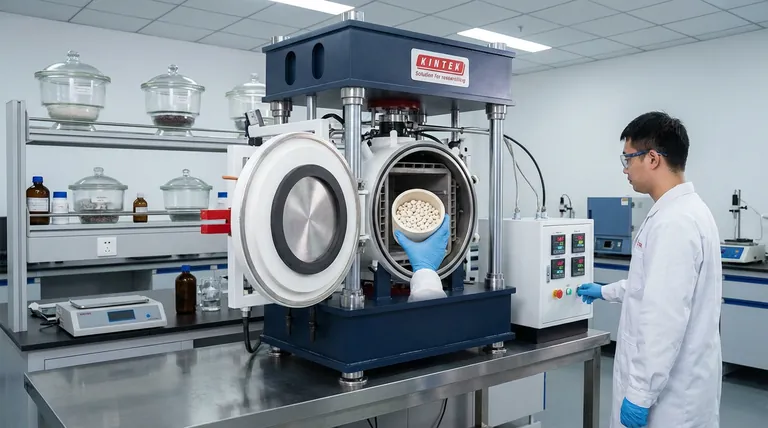
The primary role of a vacuum drying oven for Lithium Lanthanum Titanate (LLTO) is to rigorously eliminate trace moisture trapped within the ceramic’s porous structure. Beyond simple drying, this equipment provides a critical isolation barrier, preventing the electrolyte from absorbing atmospheric water or reacting with oxygen prior to assembly.
Core Takeaway LLTO ceramic pellets contain microscopic pores that adsorb moisture, which acts as a contaminant during battery operation. A vacuum drying oven is essential to deep-clean these pores and maintain an oxygen-free environment, preventing fatal chemical reactions with lithium metal anodes or sulfur cathodes that would otherwise compromise electrochemical data.
The Mechanics of Dehydration and Purity
Extracting Deeply Adsorbed Moisture
LLTO solid electrolytes are ceramic materials that often feature a porous microstructure. These micropores act as traps for atmospheric moisture, holding water molecules that surface drying cannot remove.
A vacuum drying oven applies heat under reduced pressure. This combination lowers the boiling point of water, forcing deeply adsorbed moisture out of the ceramic pores. This ensures the material is chemically pure before it ever touches a battery cell.
Ensuring Electrochemical Accuracy
The presence of water is one of the largest variables in electrochemical testing. If moisture remains in the LLTO, it introduces parasitic side reactions that skew results.
Using a vacuum oven standardizes the material state. It ensures that the performance data captured reflects the intrinsic properties of the LLTO, rather than the interference of water contamination.
The Importance of Controlled Storage
Preventing Interface Degradation
The most critical function of vacuum storage is protecting the battery interface. Solid-state batteries often pair LLTO with reactive components, such as lithium metal anodes or sulfur cathodes.
If the LLTO retains moisture, water molecules will migrate to the interface and react with the lithium metal. This reaction degrades the contact point between the anode and electrolyte, leading to poor cycle stability and premature cell failure.
Maintaining an Oxygen-Free Environment
Vacuum drying ovens double as protective storage vessels. By maintaining a vacuum, the system removes not only moisture but also oxygen.
Isolating the LLTO from oxygen is vital for preventing surface oxidation or passivation. This controlled environment maintains the electrolyte’s chemical stability throughout the duration of the testing process.
Risks of Inadequate Pretreatment
The "False Failure" Phenomenon
Skipping the vacuum drying step often leads to misdiagnosing material failure. Researchers may attribute poor performance to the LLTO chemistry when, in reality, the failure was caused by residual moisture.
Without vacuum drying, electrochemical impedance spectroscopy (EIS) results become unreliable. The water acts as an impurity that alters impedance values, making it impossible to benchmark the material accurately.
Irreversible Chemical Changes
While some moisture adsorption is physical and reversible, prolonged exposure can lead to chemical changes. Just as similar electrolytes (like Na2O or Lanthanum-based precursors) can undergo hydrolysis, neglecting proper storage for LLTO increases the risk of irreversible surface degradation.
Making the Right Choice for Your Goal
To ensure the reliability of your solid-state battery projects, apply the following protocols:
- If your primary focus is electrochemical testing: Prioritize deep vacuum drying to remove pore-trapped moisture, ensuring your baseline data is free from water-induced artifacts.
- If your primary focus is long-term sample preservation: Use the vacuum oven as a storage chamber to prevent atmospheric reaction with lithium anodes or sulfur cathodes, thereby maintaining interface stability.
Treat the vacuum drying process not as a cleaning step, but as a fundamental component of the electrolyte's chemical integrity.
Summary Table:
| Feature | Benefit for LLTO Electrolytes | Impact on Battery Performance |
|---|---|---|
| Deep Dehydration | Removes moisture from microscopic ceramic pores | Prevents parasitic side reactions |
| Vacuum Storage | Eliminates oxygen and atmospheric humidity | Maintains chemical stability & interface integrity |
| Controlled Heating | Lowers water boiling point for thorough drying | Ensures reliable EIS & electrochemical data |
| Atmospheric Isolation | Prevents reaction with Lithium/Sulfur components | Extends cycle life and prevents cell failure |
Elevate Your Solid-State Battery Research with KINTEK
Don't let residual moisture compromise your electrochemical data or lead to 'false failure' results. KINTEK provides high-precision vacuum drying ovens specifically designed for the rigorous pretreatment of Lithium Lanthanum Titanate (LLTO) and other advanced ceramics.
Backed by expert R&D and manufacturing, KINTEK offers a full suite of laboratory equipment—including Muffle, Tube, Rotary, Vacuum, and CVD systems—all customizable to meet your unique material science needs. Ensure the integrity of your solid electrolytes today.
Contact KINTEK for a Professional Solution
References
- Pei‐Yin Chen, Sheng‐Heng Chung. A solid-state electrolyte for electrochemical lithium–sulfur cells. DOI: 10.1039/d3ra05937e
This article is also based on technical information from Kintek Furnace Knowledge Base .
Related Products
- Laboratory Vacuum Tilt Rotary Tube Furnace Rotating Tube Furnace
- Vacuum Sealed Continuous Working Rotary Tube Furnace Rotating Tube Furnace
People Also Ask
- What are the key advantages of using a rotary tube furnace? Achieve Dynamic, Uniform Heating for Powders
- What optional features enhance the processing capabilities of rotary tube furnaces? Boost Efficiency with Advanced Customizations
- When are rotary tube furnaces not suitable for a process? Avoid Costly Mistakes in Thermal Processing
- What other fields utilize rotary tube furnaces? Discover Versatile Heating Solutions for Multiple Industries
- What are the technical advantages of using a rotary tube furnace for hydrochar activation? Achieve Superior Porosity

