
The synthesis of Ti3AlC2 mandates a tube high-temperature furnace with inert gas protection because the process relies on a precise solid-state reaction at approximately 1380 °C. At this specific thermal threshold, the elemental precursors—titanium and aluminum—become chemically aggressive toward oxygen and nitrogen, requiring a sealed, oxygen-free environment to prevent immediate degradation.
The tube furnace acts as a sealed reactor that pairs precise high-temperature heating with a continuous flow of high-purity argon. This setup is the only way to facilitate reactive sintering while preventing the rapid oxidation or nitridation that naturally occurs when exposed elemental powders encounter air at 1380 °C.
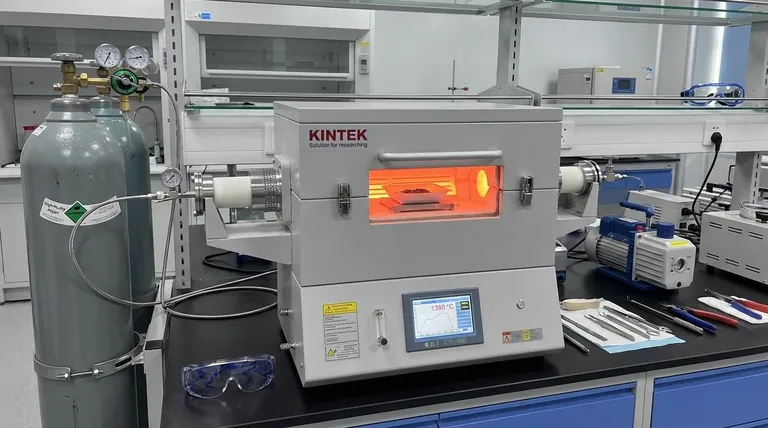
The Critical Role of Atmospheric Control
The primary challenge in synthesizing MAX phase materials like Ti3AlC2 is the chemical instability of the raw materials at high heat.
Preventing Elemental Oxidation
Titanium (Ti) and Aluminum (Al) are the key metallic components in this synthesis. At the required reaction temperature of 1380 °C, these metals are highly reactive with oxygen found in standard ambient air.
The Function of Inert Gas
A tube furnace allows for the introduction of high-purity argon gas. This continuous flow physically displaces oxygen from the chamber, creating a reducing or inert atmosphere that preserves the raw materials.
Avoiding Nitridation
Beyond oxygen, titanium is also prone to reacting with nitrogen to form titanium nitride. The sealed tube environment prevents atmospheric nitrogen from entering the reaction zone, ensuring the final product remains pure Ti3AlC2 rather than a contaminated byproduct.
The Necessity of Precision Heating
Atmospheric control must be paired with specific thermal conditions to drive the solid-state reaction.
Achieving Reaction Thresholds
The synthesis of Ti3AlC2 via reactive sintering of powders (TiC, Al, and Ti) requires temperatures reaching 1380 °C. Industrial-grade tube furnaces are designed to reach and sustain these temperatures, often capable of going as high as 1600 °C.
Ensuring Thermal Uniformity
The design of a tube furnace ensures uniform thermal distribution along the length of the tube. This minimizes temperature gradients that could lead to uneven sintering or incomplete reactions in different parts of the sample.
Programmable Heating Profiles
Advanced controllers on these furnaces allow for complex heating strategies. Users can program specific ramp rates, soak times, and cooling periods, which are essential for controlling the kinetics of the MAX phase formation.
Understanding the Trade-offs
While tube furnaces are essential for this process, they introduce specific operational constraints that must be managed.
Gas Flow Sensitivity
The system is entirely dependent on the integrity of the argon flow. Any interruption in gas supply or a leak in the tube seals during the high-temperature phase will result in rapid, irreversible oxidation of the sample.
Sample Volume Limitations
Tube furnaces generally have a smaller effective heating zone compared to box furnaces. This restricts the volume of bulk material that can be synthesized in a single run, making it ideal for research but potentially a bottleneck for mass production.
Making the Right Choice for Your Goal
To maximize the quality of your Ti3AlC2 synthesis, align your furnace operation with your specific objectives.
- If your primary focus is High Phase Purity: Prioritize the integrity of the vacuum seals and the purity of the argon source to strictly eliminate oxygen and nitrogen contamination.
- If your primary focus is Stoichiometric Accuracy: Utilize the furnace's programmable controller to fine-tune ramp rates and soak times, ensuring the reaction proceeds fully without thermal shock.
The combination of inert gas protection and precise thermal control is not optional; it is the fundamental requirement for converting reactive powders into stable MAX phase materials.
Summary Table:
| Feature | Requirement for Ti3AlC2 Synthesis | Impact on Final Product |
|---|---|---|
| Atmosphere Control | High-purity Argon gas flow | Prevents oxidation and nitridation of Ti and Al |
| Temperature Threshold | Precise 1380 °C | Facilitates reactive sintering and phase formation |
| Sealing Mechanism | Vacuum-tight tube seals | Maintains oxygen-free environment for pure MAX phase |
| Thermal Precision | Uniform distribution & ramp control | Ensures stoichiometric accuracy and consistent density |
Elevate Your Advanced Material Synthesis with KINTEK
Precise atmospheric control is the difference between high-purity MAX phases and contaminated samples. KINTEK provides industry-leading Tube, Muffle, Rotary, and Vacuum systems specifically engineered for reactive sintering and inert gas processing.
Backed by expert R&D and manufacturing, our furnaces are fully customizable to meet your unique temperature and gas flow requirements, ensuring your Ti3AlC2 synthesis is consistent and repeatable.
Ready to optimize your lab's high-temperature capabilities? Contact KINTEK Experts Today
Visual Guide

References
- Ramesh Subramani, Jin‐Ming Chen. Reinforced Capacity and Cycling Stability of CoTe Nanoparticles Anchored on Ti<sub>3</sub>C<sub>2</sub> MXene for Anode Material. DOI: 10.1002/smtd.202500725
This article is also based on technical information from Kintek Furnace Knowledge Base .
Related Products
- 1400℃ High Temperature Laboratory Tube Furnace with Alumina Tube
- 1700℃ High Temperature Laboratory Tube Furnace with Alumina Tube
- Vertical Laboratory Quartz Tube Furnace Tubular Furnace
- 1200℃ Split Tube Furnace Laboratory Quartz Tube Furnace with Quartz Tube
- 1700℃ Controlled Inert Nitrogen Atmosphere Furnace
People Also Ask
- How does zone-melting in tube furnaces synthesize bismuth micro-wires? Master Single-Crystal Thermoelectric Growth
- How are high-temp tube furnaces used to measure diffusion coefficients per Fick's law? Master Precision Annealing
- How do high-temperature laboratory tube furnaces ensure environmental stability? Precision Thermal Reduction Tips
- How are high-temperature laboratory tube furnaces applied in long-term vacuum homogenization heat treatments for intermetallic samples?
- How are high-temperature tube furnaces applied in testing ceramic-supported alloy membranes? Insights



















