
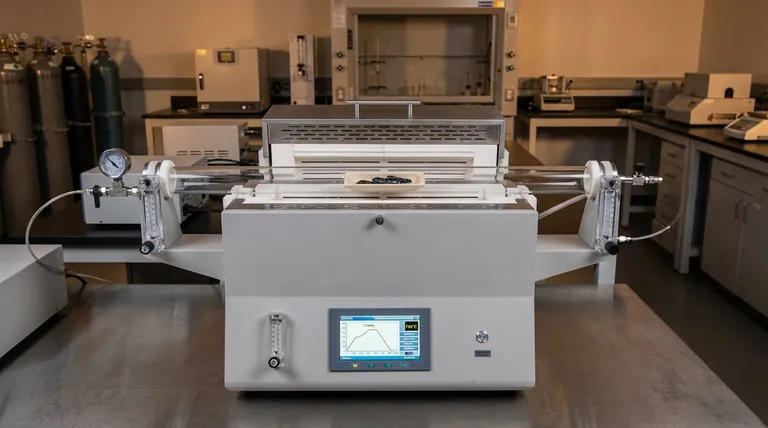
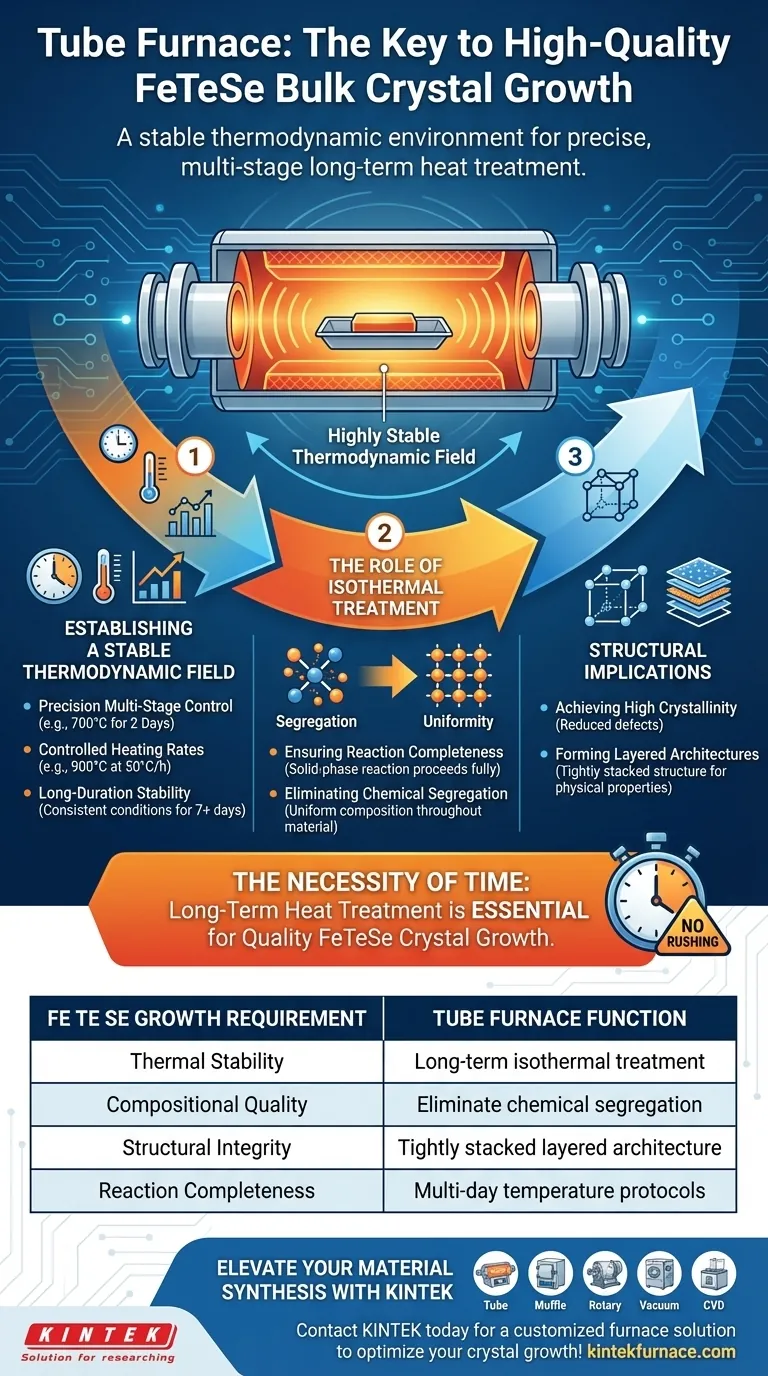
The primary function of a tube furnace in the growth of FeTeSe bulk crystals is to provide a highly stable thermodynamic environment capable of executing precise, multi-stage temperature protocols over extended periods. This specific thermal regulation is required to drive solid-phase reactions to completion, ensuring the final material achieves the necessary structural and chemical uniformity.
Long-term isothermal treatment is the essential condition for eliminating chemical composition segregation in FeTeSe crystals. Without the stable, prolonged heating provided by the tube furnace, the solid-phase reaction cannot proceed fully, compromising the crystallinity and layered architecture of the bulk crystal.
Establishing a Stable Thermodynamic Field
Precision Multi-Stage Control
The growth of FeTeSe requires more than a simple heating ramp; it demands a complex, programmed thermal schedule. A tube furnace excels at managing these multi-stage profiles, such as holding at 700°C for two days before increasing to higher temperatures.
Controlled Heating Rates
Beyond static holds, the furnace manages precise temperature gradients. For example, the process may require increasing the temperature to 900°C at a strict rate of 50°C/h over a period of six days.
Long-Duration Stability
The process is inherently time-intensive, often spanning over a week. The tube furnace provides the thermodynamic stability required to maintain consistent conditions throughout this prolonged duration.
The Role of Isothermal Treatment
Ensuring Reaction Completeness
The core purpose of the long-term heat treatment is to ensure the solid-phase reaction proceeds fully. Short-term heating is insufficient for the complex atomic arrangements required in FeTeSe synthesis.
Eliminating Chemical Segregation
One of the most critical challenges in crystal growth is compositional inconsistency. The extended isothermal treatment within the furnace effectively eliminates chemical composition segregation, ensuring the material is uniform throughout.
Structural Implications
Achieving High Crystallinity
The stability and duration of the heat treatment directly correlate to the quality of the crystal lattice. A fully completed reaction yields high-crystallinity bulk crystals, reducing defects in the final material.
Forming Layered Architectures
FeTeSe crystals rely on a specific structural arrangement to function correctly. The tube furnace process promotes a tightly stacked layered architecture, which is fundamental to the material's physical properties.
Understanding the Process Requirements
The Necessity of Time
The "trade-off" in this process is the significant time investment required. You cannot rush the solid-phase reaction; attempting to shorten the multi-day heating cycles will likely result in incomplete reactions and poor crystal quality.
Strict Adherence to Protocol
Success relies on the exact execution of the temperature program (e.g., the specific ramp rates and hold times). Deviating from the established thermodynamic field parameters risks re-introducing segregation or failing to achieve the desired layered structure.
Making the Right Choice for Your Goal
To maximize the quality of your FeTeSe bulk crystals, prioritize the programming capabilities of your furnace.
- If your primary focus is Compositional Uniformity: Ensure your program includes sufficient long-term isothermal holds to eliminate chemical segregation.
- If your primary focus is Structural Integrity: Adhere strictly to slow heating rates (e.g., 50°C/h) to promote a tightly stacked layered architecture.
By respecting the need for long-term thermodynamic stability, you ensure the synthesis of high-performance, defect-free crystals.
Summary Table:
| Feature | FeTeSe Growth Requirement | Tube Furnace Function |
|---|---|---|
| Thermal Stability | Long-term isothermal treatment | Provides a stable thermodynamic field for 7+ days |
| Compositional Quality | Eliminate chemical segregation | Ensures solid-phase reactions proceed to completion |
| Structural Integrity | Tightly stacked layered architecture | Precise multi-stage control (e.g., 50°C/h ramp rates) |
| Reaction Completeness | Multi-day temperature protocols | High-precision programming for complex thermal schedules |
Elevate Your Material Synthesis with KINTEK
Achieving perfect FeTeSe bulk crystals requires uncompromising thermal precision and long-term stability. Backed by expert R&D and manufacturing, KINTEK offers high-performance Tube, Muffle, Rotary, Vacuum, and CVD systems designed to handle complex, multi-stage temperature protocols. Our lab high-temp furnaces are fully customizable to meet your unique research needs, ensuring high crystallinity and zero chemical segregation.
Ready to optimize your crystal growth? Contact KINTEK today for a customized furnace solution!
Visual Guide
References
- Jiawei Liu, Qingyu Yan. Reaction-driven formation of anisotropic strains in FeTeSe nanosheets boosts low-concentration nitrate reduction to ammonia. DOI: 10.1038/s41467-025-58940-x
This article is also based on technical information from Kintek Furnace Knowledge Base .
Related Products
- Vertical Laboratory Quartz Tube Furnace Tubular Furnace
- Magnesium Extraction and Purification Condensing Tube Furnace
- Multi Zone Laboratory Quartz Tube Furnace Tubular Furnace
- High Pressure Laboratory Vacuum Tube Furnace
- Slide PECVD Tube Furnace with Liquid Gasifier PECVD Machine
People Also Ask
- What are the key differences between single-zone and multi-zone vertical tube furnaces? Choose the Right Furnace for Your Lab
- What physical conditions does a vertical tube furnace provide for desulfurization experiments? Precision Heat Control
- What are the main characteristics of vertical tube furnaces? Optimize Your Lab with Space-Saving, Uniform Heating
- How do heat treatment processes influence the configuration of a vertical tube furnace? Optimize for Quenching, Annealing, and More
- How are wafers loaded and unloaded in a vertical tube furnace? Achieve Precision and Purity in Wafer Processing


















