
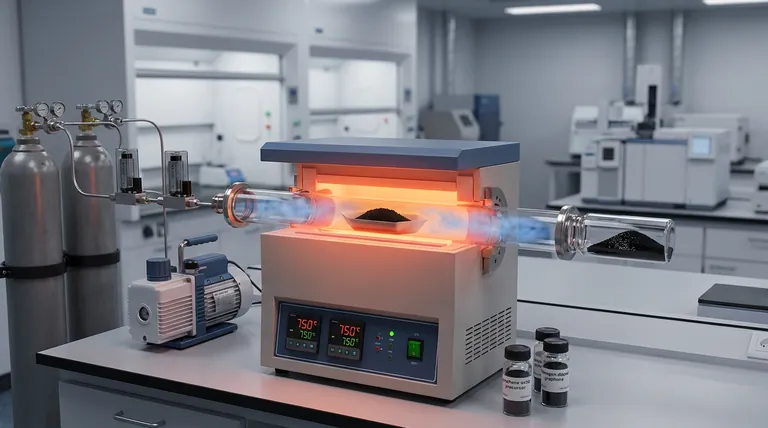
A high-temperature tube atmosphere furnace serves as the precision reactor required to chemically restructure graphene oxide derived from waste plastics. It establishes a strictly controlled environment—specifically maintaining 750°C under a protective Argon atmosphere—to facilitate thermal annealing. This process drives the reaction between graphene oxide and nitrogen precursors (such as urea), effectively embedding nitrogen atoms into the carbon lattice to fundamentally alter the material's electronic and catalytic properties.
Core Takeaway: The furnace is not merely a heating element; it is an atomic-level construction site. By strictly controlling heat and atmosphere, it enables the substitution of carbon atoms with nitrogen to form specific structural configurations (pyridinic, pyrrolic, or graphitic), turning waste-derived carbon into a high-performance catalyst carrier.
The Mechanics of Nitrogen Doping
To understand the furnace's role, one must look at how it manipulates the atomic structure of the material.
Precise Thermal Annealing
The furnace provides a stable high-temperature environment, specifically at 750°C.
At this critical temperature, the thermal energy is sufficient to break specific chemical bonds within the graphene oxide and the nitrogen precursor (urea).
This energy drives the annealing reaction, allowing nitrogen atoms to migrate and integrate into the graphene lattice structure.
Creating the Inert Shield
The furnace maintains a strict Argon protective atmosphere throughout the heating process.
This inert environment is non-negotiable; it prevents the carbon and nitrogen from reacting with oxygen in the air, which would lead to combustion (burning the material away) rather than doping.
By excluding oxygen, the furnace ensures that the chemical potential is directed entirely toward the reconstruction of the carbon skeleton and the embedding of nitrogen.
Forming Functional Nitrogen Structures
The combination of specific heat and inert gas facilitates the creation of three distinct nitrogen configurations: pyridinic, pyrrolic, and graphitic nitrogen.
These specific structures are responsible for regulating the electronic transport properties of the final material.
The presence of these nitrogen types transforms the inert carbon sheet into an active material capable of serving as a robust carrier for catalytic reactions.
From Waste Plastic to Advanced Material
While the doping happens at 750°C, the furnace plays a broader role in the lifecycle of the material, derived from the cracking of waste plastics.
Deoxygenation and Reduction
Before and during doping, the high-temperature environment facilitates the deoxygenation of graphene oxide (GO).
The heat effectively removes oxygen-containing groups from the lattice, converting the material into reduced graphene oxide (rGO).
This restoration of the carbon network is essential for recovering conductivity and providing a stable base for nitrogen atoms to attach.
Carbon Skeleton Reconstruction
As indicated by the processing of waste plastics, pyrolysis furnaces utilize these high temperatures to drive chemical cracking.
This breaks down the complex polymer chains of waste plastics and reconstructs them into ordered carbon nanosheets.
The tube furnace refines this crude carbon product, polishing its structure and pore architecture to maximize its surface area and reactivity.
Understanding the Trade-offs
While the tube furnace is a powerful tool, precise control is required to avoid diminishing returns.
Temperature Sensitivity
If the temperature deviates significantly from the target (e.g., 750°C), the ratio of nitrogen types (pyridinic vs. graphitic) will shift.
Too low, and the nitrogen may not integrate fully into the lattice; too high, and the material may suffer from excessive structural defects or loss of functional surface area.
Atmospheric Integrity
The purity of the inert atmosphere (Argon) is the single biggest point of failure.
Even trace amounts of oxygen leaking into the tube during the high-temperature phase can cause oxidative decomposition, destroying the graphene sheets rather than doping them.
Making the Right Choice for Your Goal
The specific parameters you set on the furnace dictate the final properties of your material.
- If your primary focus is catalytic activity: Ensure precise temperature stability at 750°C to maximize the formation of pyridinic and pyrrolic nitrogen, which are active sites for catalysis.
- If your primary focus is electronic conductivity: Prioritize the strictness of the inert atmosphere and reduction time to ensure maximizing the graphitic nitrogen content and thorough deoxygenation.
The high-temperature tube furnace is the bridge that transforms low-value plastic waste into high-value functional nanomaterials through precise atomic engineering.
Summary Table:
| Parameter | Role in Nitrogen Doping | Key Outcome |
|---|---|---|
| Temperature (750°C) | Facilitates thermal annealing & bond breaking | Embedding nitrogen into carbon lattice |
| Argon Atmosphere | Provides an inert, oxygen-free shield | Prevents combustion; ensures structural integrity |
| Precursor Reaction | Drives urea-to-graphene chemical bonding | Formation of pyridinic, pyrrolic, and graphitic N |
| Thermal Reduction | Removes oxygen-containing functional groups | Restores electrical conductivity in rGO |
Elevate Your Material Science with KINTEK Precision
Transform waste into high-performance catalysts with the reliability of KINTEK engineering. Backed by expert R&D and world-class manufacturing, we provide high-performance Tube, Muffle, Rotary, Vacuum, and CVD systems tailored for complex processes like nitrogen-doping and thermal annealing.
Whether you are a researcher or an industrial manufacturer, our customizable lab high-temperature furnaces ensure the atmospheric purity and thermal stability your unique projects demand.
Ready to optimize your carbon reconstruction? Contact us today to discuss your custom furnace needs!
References
- Sunil Dhali, Nanda Gopal Sahoo. Waste plastic derived nitrogen-doped reduced graphene oxide decorated core–shell nano-structured metal catalyst (WpNrGO-Pd–Ru) for a proton exchange membrane fuel cell. DOI: 10.1039/d3ma01006f
This article is also based on technical information from Kintek Furnace Knowledge Base .
Related Products
- 1400℃ High Temperature Laboratory Tube Furnace with Alumina Tube
- 1700℃ Controlled Inert Nitrogen Atmosphere Furnace
- 1700℃ High Temperature Laboratory Tube Furnace with Alumina Tube
- 1200℃ Controlled Inert Nitrogen Atmosphere Furnace
- 1400℃ Controlled Inert Nitrogen Atmosphere Furnace
People Also Ask
- How does zone-melting in tube furnaces synthesize bismuth micro-wires? Master Single-Crystal Thermoelectric Growth
- How do high-temperature laboratory tube furnaces ensure environmental stability? Precision Thermal Reduction Tips
- How are high-temperature laboratory tube furnaces applied in long-term vacuum homogenization heat treatments for intermetallic samples?
- How are high-temp tube furnaces used to measure diffusion coefficients per Fick's law? Master Precision Annealing
- How are high-temperature tube furnaces applied in testing ceramic-supported alloy membranes? Insights



















