
A horizontal tube furnace serves as a high-precision reaction platform, essential for simulating the extreme thermal conditions required to study heavy metal behavior. Operating typically between 800°C and 1200°C, this equipment utilizes an enclosed chamber and controlled airflow to create a stable oxidative atmosphere, allowing researchers to observe exactly how heavy metals combust, volatilize, and undergo adsorption.
By stabilizing temperature and airflow, the horizontal tube furnace isolates the variables of migration and transformation, providing the controlled environment necessary to measure heavy metal adsorption performance accurately.
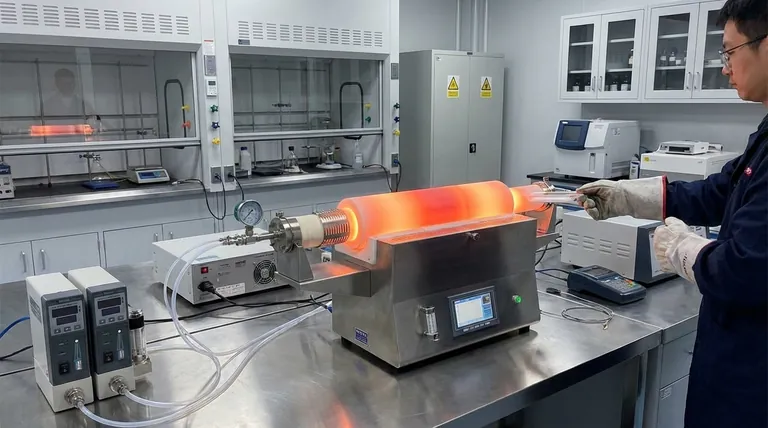
Creating a Controlled Thermal Environment
Precise Temperature Regulation
Research into heavy metal adsorption requires exact thermal conditions to be valid. The horizontal tube furnace provides a consistent heating zone, generally ranging from 800°C to 1200°C.
This high-temperature capability ensures that the simulation matches the intensity of real-world industrial processes, such as waste incineration.
The Importance of the Enclosed Chamber
To study adsorption, external variables must be eliminated. The furnace’s enclosed chamber structure isolates the samples from the surrounding lab environment.
This containment is critical for safety and data integrity, ensuring that the heavy metals interact only with the intended variables within the tube.
Establishing a Stable Oxidative Atmosphere
Temperature alone is not enough; the chemical environment must also be controlled. The furnace allows for specific airflow rates to be introduced into the chamber.
This airflow maintains a stable oxidative atmosphere, which determines how the metals chemically transform during the experiment.
Analyzing Heavy Metal Behavior
Driving Migration and Transformation
Before heavy metals can be adsorbed, they often change states. The furnace acts as the catalyst for these changes, driving the combustion and volatilization of the samples.
This allows researchers to track the "migration" of metals—how they move from a solid phase in the raw material to a gas phase in the exhaust stream.
evaluating Adsorption Performance
Once the metals are volatilized, the furnace environment facilitates the study of their capture. It provides the platform where the interaction between the gaseous metals and the adsorbent materials occurs.
Because the environment is stable, any change in metal concentration can be directly attributed to the adsorption performance of the material being tested, rather than environmental fluctuations.
Understanding the Trade-offs
Stability vs. Real-World Chaos
The primary strength of the horizontal tube furnace—its stability—is also a potential limitation. It creates an idealized environment where airflow and temperature are constant.
However, real-world industrial furnaces often experience fluctuations and "dirty" environments. Therefore, while the data from a tube furnace is scientifically precise, it represents a "best-case" or controlled scenario rather than the chaotic reality of full-scale operations.
Applying This to Your Research Goals
To get the most out of a horizontal tube furnace, you must align its capabilities with your specific research objectives.
- If your primary focus is Fundamental Mechanisms: Prioritize the temperature control features to isolate exactly at which thermal points specific metals volatilize and adsorb.
- If your primary focus is Process Optimization: Focus on manipulating the airflow rates to simulate different residence times and oxidative conditions found in industrial scenarios.
The horizontal tube furnace is the definitive tool for transforming the complex chaos of heavy metal combustion into measurable, actionable scientific data.
Summary Table:
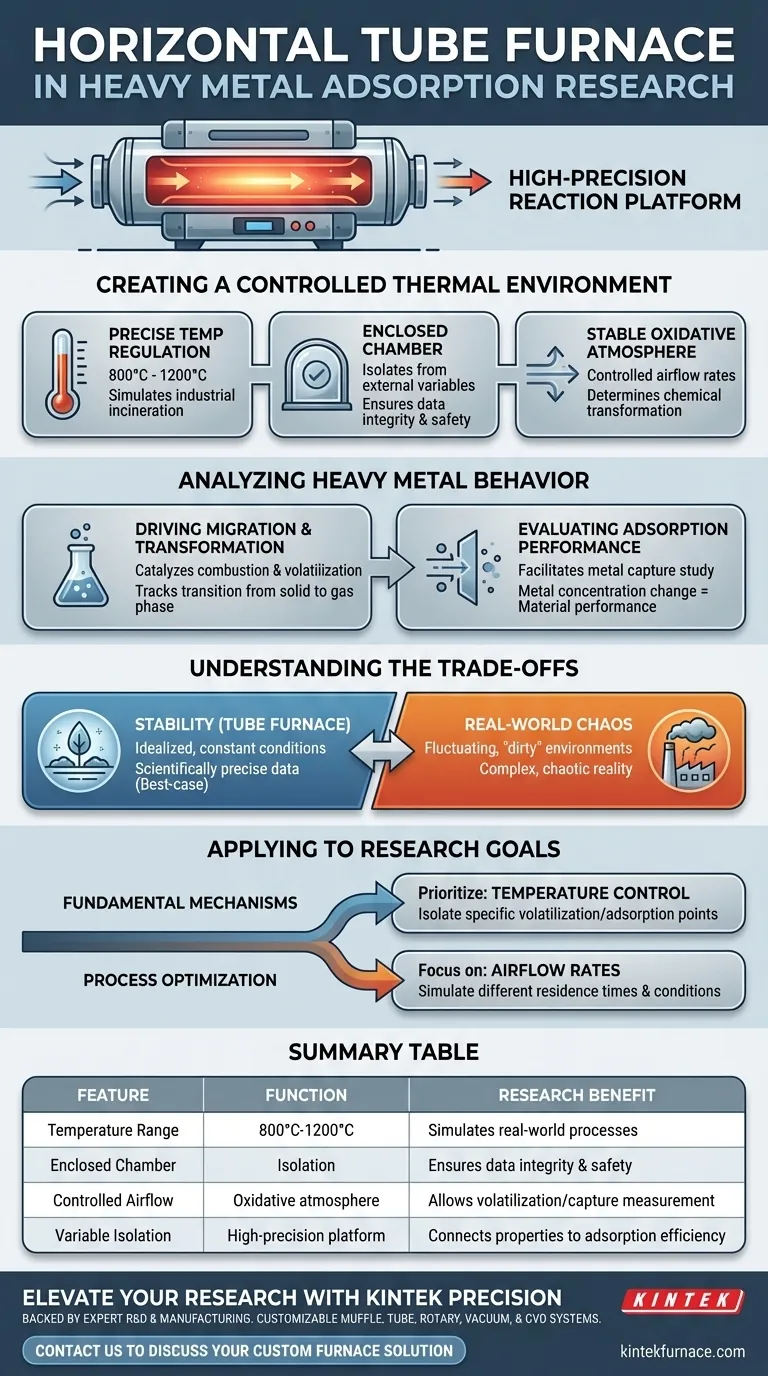
| Feature | Function in Adsorption Research | Research Benefit |
|---|---|---|
| Temperature Range | 800°C to 1200°C | Simulates real-world industrial waste incineration |
| Enclosed Chamber | Isolation from environment | Ensures data integrity and safety for toxic metal study |
| Controlled Airflow | Stable oxidative atmosphere | Allows measurement of metal volatilization and capture |
| Variable Isolation | High-precision reaction platform | Connects material properties directly to adsorption efficiency |
Elevate Your Heavy Metal Research with KINTEK Precision
Don't let unstable thermal environments compromise your data. Backed by expert R&D and manufacturing, KINTEK offers high-performance Muffle, Tube, Rotary, Vacuum, and CVD systems, all fully customizable to meet the rigorous demands of heavy metal adsorption studies.
Whether you require precise airflow control for oxidative atmosphere simulations or ultra-stable heating zones for material characterization, our engineering team is ready to build the exact high-temperature furnace your lab needs.
Contact us today to discuss your custom furnace solution and achieve the scientific accuracy your research deserves.
Visual Guide
References
- Jiangze Luo, Xian Wei. Comprehensive Experimental and DFT Studies on the Effect of Sodium and Calcium on Heavy Metals Adsorption Performance by Quartz During Coal Combustion. DOI: 10.3390/molecules30244792
This article is also based on technical information from Kintek Furnace Knowledge Base .
Related Products
- Vertical Laboratory Quartz Tube Furnace Tubular Furnace
- Vacuum Sealed Continuous Working Rotary Tube Furnace Rotating Tube Furnace
- Split Multi Heating Zone Rotary Tube Furnace Rotating Tube Furnace
- High Pressure Laboratory Vacuum Tube Furnace
- Multi Zone Laboratory Quartz Tube Furnace Tubular Furnace
People Also Ask
- What are the key differences between single-zone and multi-zone vertical tube furnaces? Choose the Right Furnace for Your Lab
- What is a vertical tube furnace and how does it function? Optimize Material Processing with Precision
- How are wafers loaded and unloaded in a vertical tube furnace? Achieve Precision and Purity in Wafer Processing
- How do heat treatment processes influence the configuration of a vertical tube furnace? Optimize for Quenching, Annealing, and More
- What is the purpose of using an industrial-grade vertical tube furnace in phosphorus recovery? High-Fidelity Simulation



















