The use of a high-vacuum sealed quartz tube is mandatory in this process to prevent the immediate oxidation of reactive raw materials while establishing the closed pressure system required for chemical transport. Specifically, Iron (Fe), Germanium (Ge), and Tellurium (Te) are highly susceptible to degradation when exposed to oxygen at the elevated temperatures (up to 800°C) necessary for crystallization.
Core Takeaway: The quartz tube acts as both a protective shield and a chemical engine. It isolates reagents from atmospheric contaminants to preserve stoichiometry and creates a pressurized, inert environment where transport agents like Iodine can efficiently cycle materials across a temperature gradient.
The Critical Functions of the Quartz Vessel
The Chemical Vapor Transport (CVT) method relies on delicate chemical equilibria. The sealed quartz tube is not merely a container; it is an active component of the synthesis infrastructure.
Prevention of Precursor Oxidation
The primary challenge in growing Fe4GeTe2 is the high reactivity of the metallic precursors. Iron (Fe), in particular, oxidizes rapidly at high temperatures.
A high-vacuum environment (often reaching levels of approximately 10⁻⁶ Torr) ensures the complete evacuation of oxygen and water vapor. Without this vacuum seal, the raw materials would degrade into oxides rather than reacting to form the desired chalcogenide crystal lattice.
Facilitating the Transport Agent Cycle
CVT growth is driven by a transport agent, typically Iodine (I2), which moves materials from a source zone to a growth zone.
This mechanism requires a closed system. The sealed tube allows the Iodine to vaporize, react with the solid raw materials to form gaseous intermediates, and migrate across a temperature gradient. If the system were open, the transport agent and volatile components (like Tellurium) would simply evaporate, destroying the reaction stoichiometry.
Thermal and Chemical Stability
The growth process for Fe4GeTe2 involves processing temperatures up to 800°C.
Quartz is uniquely suited for this application because it retains structural integrity at these temperatures without softening or collapsing. Furthermore, high-purity quartz is chemically inert; it does not react with the aggressive Iodine transport agent or the metallic precursors, ensuring that impurities from the container walls do not contaminate the final single crystal.
Understanding the Trade-offs
While the quartz tube method is the standard for high-purity growth, there are inherent risks and limitations you must manage.
The Risk of Tube Rupture
Creating a closed system at 800°C generates significant internal vapor pressure. If the initial vacuum sealing is flawed, or if the ratio of transport agent to tube volume is miscalculated, the internal pressure can exceed the tensile strength of the quartz, leading to an explosion.
Purity Dependencies
The quality of the vacuum seal is absolute. A "partial" vacuum is effectively a failure. Even microscopic leaks or insufficient initial evacuation will allow enough oxygen to alter the magnetic and electronic properties of Fe4GeTe2, which are sensitive to stoichiometric deviations.
Making the Right Choice for Your Goal
To ensure the successful synthesis of Fe4GeTe2, you must align your preparation protocols with your specific scientific objectives.
- If your primary focus is Electronic Purity: Prioritize the evacuation process, ensuring the tube reaches at least 10⁻⁶ Torr to eliminate moisture and oxygen that cause electron scattering defects.
- If your primary focus is Stoichiometric Precision: Ensure the tube is sealed quickly after loading and consider the volatility of Tellurium; the closed system prevents the loss of volatile elements, maintaining the correct Fe:Ge:Te ratio.
Ultimately, the sealed quartz tube is the guarantor of the closed thermodynamic system required to transform raw metallic powders into high-quality single crystals.
Summary Table:
| Feature | Function in CVT Growth | Benefit for Fe4GeTe2 |
|---|---|---|
| High Vacuum Seal | Eliminates oxygen and moisture | Prevents precursor oxidation and degradation |
| Closed System | Pressurizes transport agents (e.g., Iodine) | Ensures efficient material cycling & stoichiometry |
| Quartz Material | Thermal stability up to 800°C+ | Maintains structural integrity and chemical inertness |
| Pressure Gradient | Enables vapor transport across zones | Facilitates precise single crystal formation |
Maximize Your Material Synthesis Precision with KINTEK
High-quality Fe4GeTe2 crystals demand rigorous thermal environments and absolute purity. Backed by expert R&D and world-class manufacturing, KINTEK provides high-performance Muffle, Tube, Rotary, Vacuum, and CVD systems designed to meet the strictest laboratory standards. Whether you need specialized quartz tube setups or customizable high-temperature furnaces, our solutions are tailored to ensure your research yields flawless results.
Ready to elevate your crystallization process? Contact us today to discuss your unique needs!
References
- Riju Pal, Atindra Nath Pal. Spin-reorientation driven emergent phases and unconventional magnetotransport in quasi-2D vdW ferromagnet Fe4GeTe2. DOI: 10.1038/s41699-024-00463-y
This article is also based on technical information from Kintek Furnace Knowledge Base .
Related Products
- High Pressure Laboratory Vacuum Tube Furnace
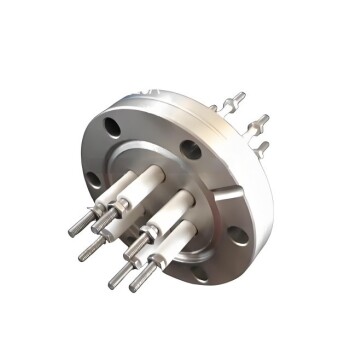
- Ultra-High Vacuum Flange Aviation Plug Glass Sintered Airtight Circular Connector for KF ISO CF
- Vertical Laboratory Quartz Tube Furnace Tubular Furnace
- Vacuum Sealed Continuous Working Rotary Tube Furnace Rotating Tube Furnace
- 1200℃ Split Tube Furnace Laboratory Quartz Tube Furnace with Quartz Tube
People Also Ask
- What role does a high vacuum tube furnace play in Co-Al sintering? Master High-Purity Porous Material Synthesis
- What are the different types of tube furnaces available? Find the Perfect Fit for Your Lab's Needs
- What are the main advantages of vacuum tube furnaces in the market? Achieve Purity and Precision in Material Processing
- What is the role of a vacuum tube furnace during the final thermal treatment stage of Fe3O4@CSAC catalysts?
- What role does a laboratory tube furnace play in geological and mineralogical research? Unlock Earth's Secrets with Precision