
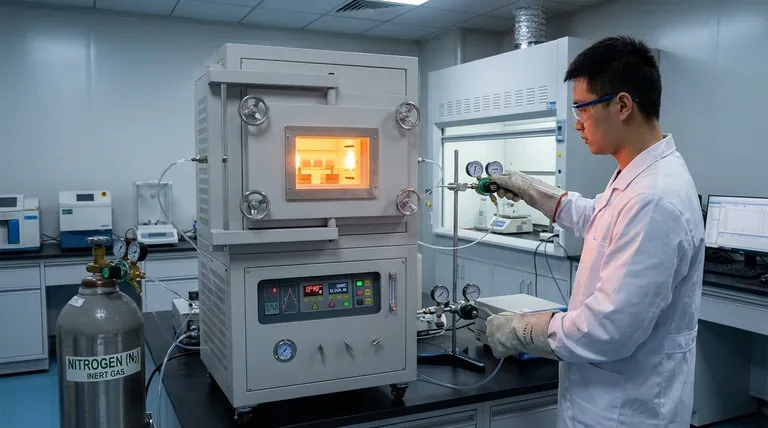
The necessity of a tube furnace with a flowing nitrogen environment stems from the need to precisely manipulate the oxidation states of iron at extreme temperatures. This specialized setup allows for calcination at 1,200 °C and sintering at 1,240 °C while maintaining a controlled reducing or inert atmosphere. By preventing full oxidation, the system ensures the coexistence of $Fe^{2+}$ and $Fe^{3+}$ ions, which is the fundamental requirement for the electrical transport properties of W-type hexagonal ferrites.
The tube furnace serves as a precision chemical reactor that balances thermal energy with atmospheric chemistry. Its primary role is to stabilize the specific iron valence ratio required to transform a standard ceramic into a functional semiconductor.
The Role of High-Temperature Thermal Processing
Achieving Phase Formation via Calcination
The preparation of $BaFe_{2-x}Co_xFe_{16}O_{27}$ requires a preliminary calcination step at 1,200 °C. This high-energy environment facilitates the solid-state reaction between raw materials, ensuring the initial formation of the W-type hexagonal structure.
Densification Through Sintering
Following calcination, the material undergoes sintering at 1,240 °C to achieve its final density. The tube furnace provides the stable thermal profile necessary to bond ceramic particles without melting the structure or causing uncontrolled grain growth.
Atmospheric Control and Ion Regulation
The $Fe^{2+}/Fe^{3+}$ Valence Balance
The most critical function of the flowing nitrogen is to act as a controlled inert or reducing environment. In a standard oxygen-rich atmosphere, iron would naturally trend toward its highest oxidation state ($Fe^{3+}$), which would degrade the intended performance of the ferrite.
Engineering Semiconductor Characteristics
The presence of nitrogen encourages the coexistence of $Fe^{2+}$ and $Fe^{3+}$ ions. This specific ionic mixture is what imparts the desired semiconductor characteristics and electrical transport properties to the ceramic, making it functional for electronic applications.
Precise Gaseous Flow
A "flowing" environment is superior to a static one because it continuously displaces oxygen and volatile byproducts. This ensures that the chemical potential of the atmosphere remains constant throughout the entire multi-hour heating cycle.
Understanding the Trade-offs and Constraints
Risks of Atmospheric Inconsistency
If the nitrogen flow is interrupted or the tube seal is compromised, oxygen ingress will rapidly oxidize the $Fe^{2+}$ ions. This shift destroys the W-type phase's unique electrical properties, turning a precision semiconductor into a high-resistance insulator.
Thermal Gradients in Tube Furnaces
While tube furnaces provide excellent atmospheric control, they can suffer from radial temperature gradients. If the ceramic sample is too large or poorly positioned, the center of the material may not reach the required 1,240 °C, leading to incomplete sintering.
How to Apply This to Your Synthesis Project
When preparing high-performance ferrites, your equipment configuration must prioritize atmospheric purity and thermal precision.
- If your primary focus is electrical conductivity: Ensure your nitrogen flow rate is calibrated to maintain a strictly inert environment, as even trace oxygen will alter the $Fe^{2+}/Fe^{3+}$ ratio.
- If your primary focus is structural density: Focus on the sintering ramp rate within the tube furnace to prevent cracking while reaching the 1,240 °C target.
- If your primary focus is phase purity: Use the calcination stage at 1,200 °C to fully react the precursors before the final shaping and sintering.
Successfully synthesizing $BaFe_{2-x}Co_xFe_{16}O_{27}$ requires viewing the nitrogen-filled tube furnace not just as a heater, but as a critical tool for electronic valence engineering.
Summary Table:
| Process Parameter | Temperature | Atmosphere Requirement | Key Outcome |
|---|---|---|---|
| Calcination | 1,200 °C | Flowing Nitrogen | Initial W-type phase formation via solid-state reaction |
| Sintering | 1,240 °C | Flowing Nitrogen | Material densification and stable grain growth |
| Valence Control | High Temp | Inert/Reducing (N2) | Maintenance of $Fe^{2+}$/$Fe^{3+}$ ratio for conductivity |
| Flow Dynamics | Constant | Continuous Displacement | Prevents oxygen ingress and ensures chemical consistency |
Elevate Your Material Synthesis with KINTEK Precision
Precise atmospheric control is the difference between a functional semiconductor and a failed batch. Backed by expert R&D and manufacturing, KINTEK offers high-performance Tube, Muffle, Rotary, Vacuum, and CVD systems designed to meet the rigorous demands of electronic ceramic synthesis. Our customizable lab high-temp furnaces provide the thermal stability and gas-tight integrity required for critical valence engineering in ferrites and advanced materials.
Ready to optimize your $Fe^{2+}/Fe^{3+}$ balance?
Contact KINTEK today to discuss your custom furnace needs.
Visual Guide

References
- Xiaozhi Zhang, Tian‐Ran Wei. Thermoelectric transport properties of BaFe<sub>2</sub>Fe<sub>16</sub>O<sub>27</sub> hexaferrites. DOI: 10.20517/microstructures.2024.81
This article is also based on technical information from Kintek Furnace Knowledge Base .
Related Products
- Vacuum Sealed Continuous Working Rotary Tube Furnace Rotating Tube Furnace
- 1400℃ High Temperature Laboratory Tube Furnace with Alumina Tube
- 1700℃ High Temperature Laboratory Tube Furnace with Alumina Tube
- 1200℃ Split Tube Furnace Laboratory Quartz Tube Furnace with Quartz Tube
- Vertical Laboratory Quartz Tube Furnace Tubular Furnace
People Also Ask
- What is the purpose of rotary tube furnaces? Achieve Uniform Heat Treatment for Powders and Granules
- What are the key advantages of using a rotary tube furnace? Achieve Dynamic, Uniform Heating for Powders
- How does the amount of material processed vary between batch and continuous rotary tube furnaces? Scale Your Production Efficiently
- What are the advantages of rotary tube furnaces in fuel compatibility? Boost Efficiency and Cut Costs
- What is the temperature range of some rotary tube furnaces? Achieve Uniform Heating Up to 1200°C



















