
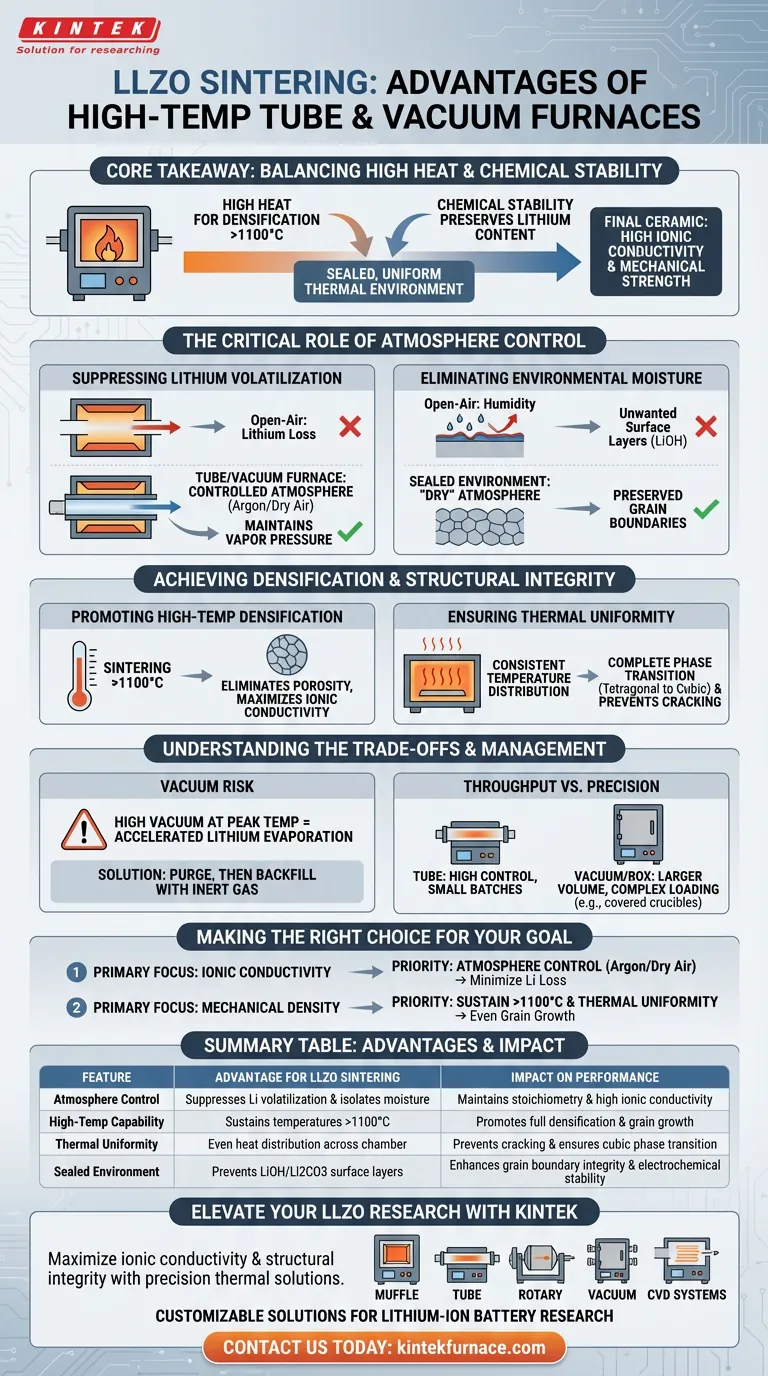
High-temperature tube and vacuum furnaces provide the precise environmental control required to successfully sinter Li7La3Zr2O12 (LLZO). These systems allow the process to occur under specific, regulated atmospheres—such as dry air or argon—which effectively suppresses lithium volatilization and neutralizes the detrimental effects of environmental moisture while supporting temperatures above 1100°C.
Core Takeaway Processing LLZO requires a delicate balance between high heat for densification and chemical stability to preserve lithium content. Advanced furnaces solve this by creating a sealed, uniform thermal environment that prevents material degradation, ensuring the final ceramic achieves high ionic conductivity and mechanical strength.
The Critical Role of Atmosphere Control
The primary challenge in sintering LLZO is its chemical instability at high temperatures. Standard open-air firing often leads to lithium loss and moisture contamination, which degrades performance.
Suppressing Lithium Volatilization
Lithium is highly volatile at the sintering temperatures required for LLZO (typically above 1100°C). Tube and vacuum furnaces allow for the introduction of specific atmospheres, such as Argon or dry air, or the use of sacrificial powder beds within a controlled chamber. This controlled environment maintains the necessary vapor pressure to prevent lithium from evaporating out of the crystal structure.
Eliminating Environmental Moisture
LLZO is sensitive to humidity, which can lead to the formation of unwanted surface layers (like Lithium Hydroxide) that impede ionic conductivity. These furnaces provide a sealed environment that isolates the material from ambient humidity. By processing in a "dry" atmosphere, the integrity of the grain boundaries is preserved, resulting in superior electrochemical performance.
Achieving Densification and Structural Integrity
Beyond chemistry, the physical properties of the ceramic rely heavily on the thermal precision these furnaces provide.
Promoting High-Temperature Densification
To achieve a dense ceramic pellet with high mechanical strength, LLZO typically requires sintering temperatures exceeding 1100°C. High-temperature tube and vacuum furnaces are designed to reach and sustain these extreme temperatures reliably. This heat promotes grain growth and eliminates porosity, which is essential for maximizing the material's ionic conductivity.
Ensuring Thermal Uniformity
Consistency across the sample is vital to prevent cracking and ensure a complete phase transition from tetragonal to cubic structures. These furnaces offer excellent thermal uniformity, ensuring that the entire sample experiences the same thermal history. This prevents local temperature differences that could lead to incomplete phase transitions, side products, or thermal stress cracks.
Understanding the Trade-offs
While these furnaces offer significant advantages, they introduce specific complexities that must be managed.
The Risk of Vacuum on Stoichiometry
While "vacuum furnaces" are advantageous for their sealing and purging capabilities, sintering LLZO under a high vacuum at peak temperatures can be detrimental. The low pressure can accelerate lithium evaporation rather than prevent it. Therefore, these furnaces are best used to purge oxygen and moisture, after which they should often be backfilled with an inert gas rather than holding a hard vacuum during the soak.
Throughput vs. Precision
Tube furnaces offer the highest degree of atmosphere control for small batches but are often limited in sample volume. In contrast, larger vacuum or box furnaces can process more material but may require more complex loading configurations (such as covered crucibles) to maintain the local lithium atmosphere around the samples.
Making the Right Choice for Your Goal
To maximize the performance of your LLZO electrolyte, align your furnace operation with your specific material objectives.
- If your primary focus is Ionic Conductivity: Prioritize atmosphere control (Argon or Dry Air) to minimize lithium loss and ensure the cubic phase is maintained.
- If your primary focus is Mechanical Density: Ensure the furnace can sustain temperatures >1100°C with high thermal uniformity to promote even grain growth without cracking.
The success of LLZO sintering lies not just in reaching high temperatures, but in the ability to strictly control the chemical environment during the thermal cycle.
Summary Table:
| Feature | Advantage for LLZO Sintering | Impact on Performance |
|---|---|---|
| Atmosphere Control | Suppresses lithium volatilization and isolates moisture | Maintains stoichiometry and high ionic conductivity |
| High-Temp Capability | Sustains temperatures >1100°C | Promotes full densification and grain growth |
| Thermal Uniformity | Even heat distribution across the chamber | Prevents cracking and ensures cubic phase transition |
| Sealed Environment | Prevents formation of LiOH/Li2CO3 surface layers | Enhances grain boundary integrity and electrochemical stability |
Elevate Your LLZO Research with KINTEK
Maximize the ionic conductivity and structural integrity of your solid-state electrolytes with KINTEK’s precision thermal solutions. Backed by expert R&D and manufacturing, KINTEK offers Muffle, Tube, Rotary, Vacuum, and CVD systems, all fully customizable to meet the rigorous demands of lithium-ion battery research.
Ready to optimize your sintering process? Contact us today to discuss how our high-temperature furnaces can deliver the atmosphere control and thermal precision your lab needs.
Visual Guide
References
- Degradation mechanisms in low-voltage Wadsley–Roth TiNb<sub>2</sub>O<sub>7</sub> electrodes upon cycling with Li. DOI: 10.1039/d4ta06441k
This article is also based on technical information from Kintek Furnace Knowledge Base .
Related Products
- High Temperature Muffle Oven Furnace for Laboratory Debinding and Pre Sintering
- 1400℃ High Temperature Laboratory Tube Furnace with Alumina Tube
- 1700℃ High Temperature Laboratory Tube Furnace with Alumina Tube
- 2200 ℃ Tungsten Vacuum Heat Treat and Sintering Furnace
- 1200℃ Split Tube Furnace Laboratory Quartz Tube Furnace with Quartz Tube
People Also Ask
- What thermal phenomena occur during polymer binder burnout in ceramic green bodies? Lab Furnace Guide
- What role does a high-temperature muffle furnace play in STFO synthesis? Achieve Pure Perovskite Results
- Why is controlled heat treatment in a muffle furnace necessary for calcined clay? Achieve Optimal Pozzolanic Activity
- How does a high-temperature muffle furnace facilitate the formation of LaNbxAl1−xO3+δ perovskite structures? Key Roles
- What role does a high-temperature muffle furnace play in the multi-stage synthesis of Li0.5MnFe1.5O4? Key to Pure Spinel



















