
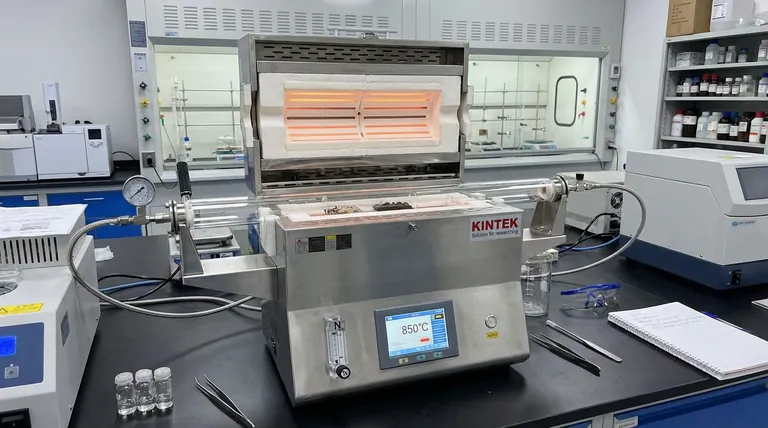
A tube high-temperature furnace is strictly required for this process because it provides the controlled environment necessary to facilitate delicate vapor-phase reactions while preventing material degradation. Specifically, it maintains a strictly controlled inert atmosphere (typically Nitrogen) to prevent the oxidation of reactive molybdenum precursors and selenium powder. Furthermore, its precise programmed temperature capabilities enable the in-situ reaction of Mo(CO)6 and selenium vapor, ensuring the formation of MoSe2 layers with specific lattice strains on the gold template.
Core Takeaway: The tube furnace acts as a precision reactor that isolates sensitive precursors from oxygen while managing complex thermal profiles. Without this equipment, the precursors would oxidize rather than react, preventing the formation of the specific lattice structure required for the composite.
The Critical Role of Atmosphere Control
Preventing Precursor Oxidation
The primary function of the tube furnace in this synthesis is to create an anaerobic environment. Molybdenum precursors and selenium powder are highly susceptible to oxidation at elevated temperatures.
By introducing a continuous flow of inert gas, such as Nitrogen ($N_2$), the furnace creates a protective barrier. This ensures that the materials react with each other rather than with atmospheric oxygen.
Eliminating Impurity Layers
Creating a pure interface between the gold template and the MoSe2 coating is essential for the composite's performance.
If oxygen were present, oxide impurity layers would form at the grain boundaries. As seen in similar high-temperature sintering processes, eliminating these oxides is critical for ensuring strong interfacial bonding and material integrity.
Achieving Precise Reaction Kinetics
Facilitating Vapor Phase Deposition
The synthesis of Au@MoSe2/graphene composites relies on vapor phase deposition. The furnace must heat solid precursors until they transition into a vapor state.
This allows the Mo(CO)6 and selenium to mix and react in-situ. The tube furnace design is specifically optimized to contain these vapors within a concentrated reaction zone.
Controlling Lattice Strain through Heat
Temperature acts as a sculpting tool for the material's microstructure.
Through precise programmed temperature control, the furnace dictates how the MoSe2 forms on the gold surface. This control is required to induce specific lattice strains in the coating layer, which often determines the final electronic or catalytic properties of the composite.
Understanding the Trade-offs
Complexity of Parameter Control
While the tube furnace enables precision, it introduces sensitivity to process variables. A slight deviation in gas flow rates or temperature ramp-up speeds can alter the vapor pressure of the selenium.
Thermal Stress Management
Strict adherence to the programmed temperature profile is not just about chemistry; it is about structural integrity.
Just as gradient temperature control is used in other infiltration processes to prevent skeletal damage, the heating ramp in this synthesis must be carefully managed. Rapid thermal fluctuations could lead to poor uniformity in the coating or defects in the graphene/gold template.
Making the Right Choice for Your Goal
To maximize the quality of your Au@MoSe2/graphene composites, focus on these operational priorities:
- If your primary focus is material purity: Rigorously purge the tube with Nitrogen prior to heating to ensure a completely anaerobic condition before the precursors become reactive.
- If your primary focus is structural tuning: Devote your attention to the programmed temperature profile, as the heating rate directly influences the lattice strain and quality of the MoSe2 coating.
The tube furnace is not merely a heating source; it is the containment vessel that makes this complex chemical architecture possible.
Summary Table:
| Feature | Requirement in Synthesis | Impact on Composite Quality |
|---|---|---|
| Atmosphere Control | Constant Nitrogen (N2) flow | Prevents oxidation of Mo precursors and Se powder |
| Temperature Precision | Programmed ramp & soak rates | Dictates lattice strain and MoSe2 coating uniformity |
| Vapor Containment | Sealed quartz/ceramic tube | Facilitates in-situ vapor phase deposition |
| Purity Management | Anaerobic environment | Eliminates oxide impurities at grain boundaries |
Elevate Your Material Synthesis with KINTEK
Precise control over atmosphere and thermal profiles is non-negotiable for high-performance composites like Au@MoSe2/graphene. KINTEK provides the advanced heating solutions required for these delicate vapor-phase reactions.
Backed by expert R&D and world-class manufacturing, we offer a comprehensive range of Muffle, Tube, Rotary, Vacuum, and CVD systems. Whether you are conducting fundamental research or scaling production, our lab high-temp furnaces are fully customizable to meet your unique thermal processing needs.
Ready to optimize your reaction kinetics? Contact our technical experts today to find the perfect furnace for your laboratory.
References
- Tao Zhang, Hong Jin Fan. Biaxial strain induced OH engineer for accelerating alkaline hydrogen evolution. DOI: 10.1038/s41467-024-50942-5
This article is also based on technical information from Kintek Furnace Knowledge Base .
Related Products
- 1400℃ High Temperature Laboratory Tube Furnace with Alumina Tube
- 1700℃ High Temperature Laboratory Tube Furnace with Alumina Tube
- 1200℃ Split Tube Furnace Laboratory Quartz Tube Furnace with Quartz Tube
- Vertical Laboratory Quartz Tube Furnace Tubular Furnace
- High Pressure Laboratory Vacuum Tube Furnace
People Also Ask
- How does zone-melting in tube furnaces synthesize bismuth micro-wires? Master Single-Crystal Thermoelectric Growth
- How are high-temp tube furnaces used to measure diffusion coefficients per Fick's law? Master Precision Annealing
- How are high-temperature laboratory tube furnaces applied in long-term vacuum homogenization heat treatments for intermetallic samples?
- How do high-temperature laboratory tube furnaces ensure environmental stability? Precision Thermal Reduction Tips
- How are high-temperature tube furnaces applied in testing ceramic-supported alloy membranes? Insights



















