
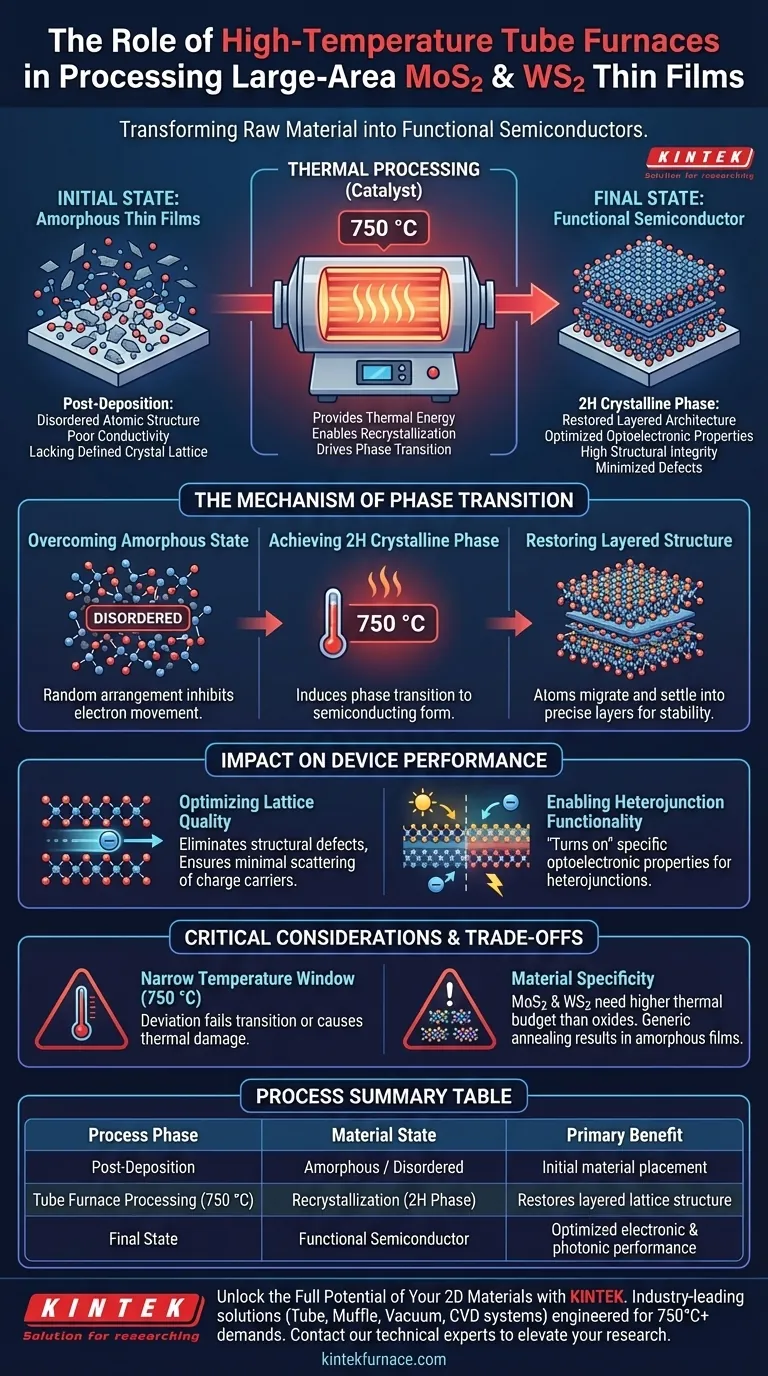
A high-temperature tube furnace is the catalyst that transforms raw material into a functional semiconductor. In their initial state immediately after deposition, large-area MoS2 and WS2 thin films are typically amorphous, lacking a defined crystal structure. The tube furnace provides the necessary thermal energy to reorganize the atomic structure, converting the material into a high-quality, semiconducting state.
Core Insight: Deposition places the material on the substrate, but the thermal processing defines its utility. The high-temperature treatment drives a critical phase transition—specifically at 750 °C—which is required to restore the material's layered lattice and activate the optoelectronic properties essential for device performance.
The Mechanism of Phase Transition
Overcoming the Amorphous State
Freshly deposited thin films of Molybdenum Disulfide (MoS2) and Tungsten Disulfide (WS2) often suffer from atomic disorder.
In this amorphous state, the atoms are randomly arranged rather than aligned in a repeating pattern. This lack of order severely inhibits the material's ability to conduct electrons or interact with light effectively.
Achieving the 2H Crystalline Phase
The primary function of the tube furnace is to facilitate recrystallization.
By subjecting the films to high temperatures, specifically around 750 °C, the process induces a phase transition. This shifts the material from its amorphous starting point into the desired 2H crystalline phase, which is the semiconducting form of these transition metal dichalcogenides.
Restoring the Layered Structure
MoS2 and WS2 are two-dimensional materials defined by their distinct layered architecture.
The thermal energy provided by the furnace allows atoms to migrate and settle into these precise layers. This restoration of the lattice structure is non-negotiable for ensuring the physical stability and quality of the film.
Impact on Device Performance
Optimizing Lattice Quality
High performance requires high structural integrity.
The recrystallization process eliminates structural defects that occur during deposition. By optimizing the lattice quality, the furnace ensures that charge carriers (electrons) can move through the film with minimal scattering or resistance.
Enabling Heterojunction Functionality
These films are often used to create heterojunctions—interfaces between two different semiconductors.
For a heterojunction to function, the materials must possess specific optoelectronic properties. The heat treatment ensures these properties are "turned on," allowing the device to perform its intended electronic or photonic functions efficiently.
Critical Considerations and Trade-offs
The Temperature Window is Narrow
Precision is paramount when operating the tube furnace.
The primary reference indicates that 750 °C is the target temperature for these specific materials. Deviating significantly from this temperature may fail to induce the 2H phase transition or, conversely, could damage the thin film through excessive thermal stress.
Material Specificity
It is vital to distinguish between the needs of different materials.
While other thin films may require annealing at lower temperatures (such as 300 °C or 375 °C for oxides or CZTS), MoS2 and WS2 require a significantly higher thermal budget. Applying a "generic" annealing recipe will likely result in a film that remains amorphous and electronically dead.
Making the Right Choice for Your Goal
When designing your processing workflow, align your thermal treatment with your specific performance targets:
- If your primary focus is Structural Integrity: Ensure your furnace can maintain a stable 750 °C to fully restore the layered lattice and eliminate amorphous regions.
- If your primary focus is Electronic Performance: Prioritize the achievement of the 2H crystalline phase, as this specific structure dictates the semiconducting behavior of the device.
Ultimately, the tube furnace is not just a heating element; it is the tool that dictates the final electronic identity of your thin film.
Summary Table:
| Process Phase | Material State | Temperature Requirement | Primary Benefit |
|---|---|---|---|
| Post-Deposition | Amorphous / Disordered | Ambient | Initial material placement |
| Tube Furnace Processing | Recrystallization (2H Phase) | ~750 °C | Restores layered lattice structure |
| Final State | Functional Semiconductor | Controlled Cooling | Optimized electronic & photonic performance |
Unlock the Full Potential of Your 2D Materials with KINTEK
Transitioning from amorphous films to high-performance semiconductors requires absolute thermal precision. KINTEK provides industry-leading high-temperature solutions—including Tube, Muffle, Vacuum, and CVD systems—engineered to meet the rigorous 750°C+ demands of MoS2 and WS2 processing.
Backed by expert R&D and world-class manufacturing, our systems are fully customizable to your unique lab requirements, ensuring your thin films achieve the perfect 2H crystalline phase every time.
Ready to elevate your material research? Contact our technical experts today to find the ideal furnace for your application.
Visual Guide
References
- Matteo Gardella, F. Buatier de Mongeot. Large area van der Waals MoS<sub>2</sub>–WS<sub>2</sub> heterostructures for visible-light energy conversion. DOI: 10.1039/d3lf00220a
This article is also based on technical information from Kintek Furnace Knowledge Base .
Related Products
- Vacuum Sealed Continuous Working Rotary Tube Furnace Rotating Tube Furnace
- 1400℃ High Temperature Laboratory Tube Furnace with Alumina Tube
- 1700℃ High Temperature Laboratory Tube Furnace with Alumina Tube
- 1200℃ Split Tube Furnace Laboratory Quartz Tube Furnace with Quartz Tube
- Vertical Laboratory Quartz Tube Furnace Tubular Furnace
People Also Ask
- What is the purpose of rotary tube furnaces? Achieve Uniform Heat Treatment for Powders and Granules
- What are the key advantages of using a rotary tube furnace? Achieve Dynamic, Uniform Heating for Powders
- How does the amount of material processed vary between batch and continuous rotary tube furnaces? Scale Your Production Efficiently
- What are the advantages of rotary tube furnaces in fuel compatibility? Boost Efficiency and Cut Costs
- What is the temperature range of some rotary tube furnaces? Achieve Uniform Heating Up to 1200°C



















