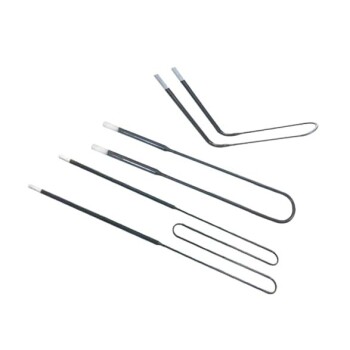
A resistance heating furnace is critical during the chlorination phase because it provides the precise thermal stability required to facilitate a controlled chemical reaction between metallic hafnium (Hf) and chlorine gas (Cl2). By maintaining the chlorination chamber at a specific, constant temperature, the furnace ensures the reaction produces the necessary precursor gas without fluctuation.
Core Takeaway: The resistance heating furnace generates a continuous and uniform thermal field. This thermal consistency ensures a constant generation rate of Hafnium Tetrachloride (HfCl4), which is the prerequisite for a stable precursor flow and a controllable coating growth rate downstream.
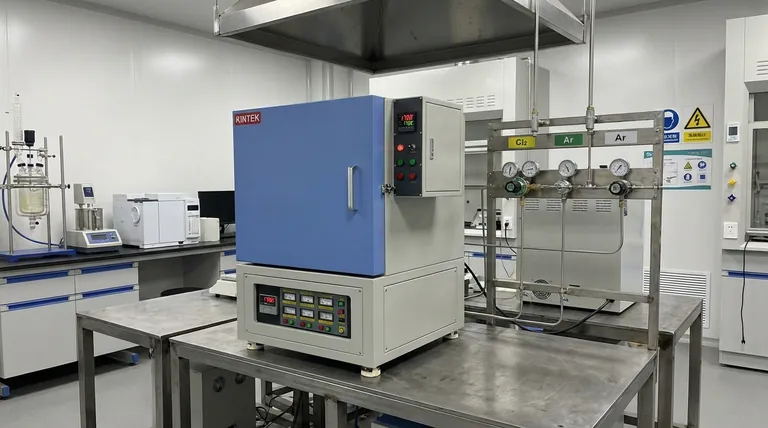
The Importance of Thermal Uniformity
Facilitating a Stable Reaction
The reaction between metallic hafnium and chlorine gas requires a specific temperature environment to proceed efficiently. A resistance heating furnace is selected specifically for its ability to maintain the chlorination chamber at this exact setpoint. This prevents reaction stalls or runaways that could occur with less stable heating methods.
Creating a Continuous Thermal Field
The primary advantage of this furnace type is the creation of a continuous and uniform thermal field. Unlike localized heating sources, a resistance furnace heats the chamber evenly. This uniformity eliminates "cold spots" that could inhibit the reaction or "hot spots" that might damage the equipment or alter reaction byproducts.
Consistent Precursor Generation
The direct result of a uniform thermal field is the constant generation rate of HfCl4 gas. In chemical vapor deposition processes, the "source" material must be generated at a predictable rate. The resistance furnace ensures that the conversion of solid Hf to gaseous HfCl4 happens steadily, not in bursts.
Impact on Coating Quality
Establishing Stable Precursor Flow
The HfCl4 gas generated in the furnace serves as the precursor flow for the subsequent deposition stage. Because the heating is consistent, the flow of this precursor to the deposition zone remains stable. This stability is the foundation of a reliable production process.
Ensuring Controllable Growth Rates
The ultimate goal of using this specific heating method is to achieve a controllable coating growth rate. If the furnace temperature fluctuated, the amount of HfCl4 generated would vary, causing the final HfO2 coating to grow unevenly. Resistance heating locks in the variables, allowing for precise control over coating thickness and quality.
Understanding the Trade-offs
Thermal Inertia
While resistance heating offers excellent stability, it is characterized by high thermal inertia. This means the system is slow to heat up and slow to cool down compared to induction or infrared heating. This makes it ideal for steady-state processes but less agile if rapid temperature cycling is required.
Energy Efficiency vs. Control
Resistance furnaces are generally efficient at maintaining heat but can consume significant power during the initial ramp-up. The trade-off is accepted here because the priority is process stability over rapid cycle times. The cost of energy is weighed against the high cost of failed coating batches due to temperature variance.
Making the Right Choice for Your Process
If you are optimizing your HfO2 coating production, consider these strategic priorities:
- If your primary focus is Coating Uniformity: Prioritize the calibration of your resistance furnace to ensure the thermal field is perfectly uniform across the entire chlorination chamber.
- If your primary focus is Process Repeatability: Implement strict monitoring of the furnace power input, as this directly correlates to the generation rate of the HfCl4 precursor.
By stabilizing the thermal environment at the very beginning of the process, you guarantee the integrity of the final HfO2 layer.
Summary Table:
| Feature | Impact on Hf Chlorination | Benefit to HfO2 Production |
|---|---|---|
| Uniform Thermal Field | Prevents cold/hot spots in the chamber | Consistent HfCl4 precursor generation rate |
| High Thermal Stability | Maintains precise reaction setpoints | Prevents reaction stalls or thermal runaways |
| Controlled Heating | Locks in precursor gas flow variables | Achieves predictable and uniform coating thickness |
| Thermal Inertia | High steady-state temperature retention | Ideal for reliable, long-cycle production runs |
Elevate Your Thin-Film Production with KINTEK Precision
Precise thermal control is the backbone of high-quality HfO2 coating. Backed by expert R&D and world-class manufacturing, KINTEK offers a comprehensive range of Muffle, Tube, Rotary, Vacuum, and CVD systems, all of which can be fully customized to meet your specific Hf chlorination and lab high-temp needs.
Don't let temperature fluctuations compromise your precursor stability. Partner with KINTEK to achieve unmatched process repeatability and coating integrity.
Consult with our thermal experts today
References
- Junyu Zhu, Xuxiang Zhang. Oxidation Resistance of Ir/HfO2 Composite Coating Prepared by Chemical Vapor Deposition: Microstructure and Elemental Migration. DOI: 10.3390/coatings14060695
This article is also based on technical information from Kintek Furnace Knowledge Base .
Related Products
- Multi Heating Zones CVD Tube Furnace Machine for Chemical Vapor Deposition Equipment
- Laboratory Quartz Tube Furnace RTP Heating Tubular Furnace
- 2200 ℃ Graphite Vacuum Heat Treat Furnace
- Vacuum Heat Treat Sintering Furnace with Pressure for Vacuum Sintering
- Split Multi Heating Zone Rotary Tube Furnace Rotating Tube Furnace
People Also Ask
- What is the function of a multi-zone tube furnace in CVD synthesis? Master 2D In2Se3 Nanosheet Precision
- What role do multi zone tube furnaces play in new energy research? Unlock Precise Thermal Control for Innovation
- Why are multi zone tube furnaces particularly useful for nanomaterial research? Unlock Precise Thermal Control for Advanced Synthesis
- What environmental protection applications utilize multi zone tube furnaces? Unlock Precision in Waste Treatment and Green Tech
- What temperature-related capabilities make multi zone tube furnaces valuable for research? Unlock Precision Thermal Control